

Asserting one's character
From the early months of 2025, climate change demonstrated its severity with a historic summer flood following Typhoon No. 1, submerging tens of thousands of hectares of rice and other crops. At the same time, the complex spread of African swine fever and volatile agricultural markets posed unprecedented challenges.
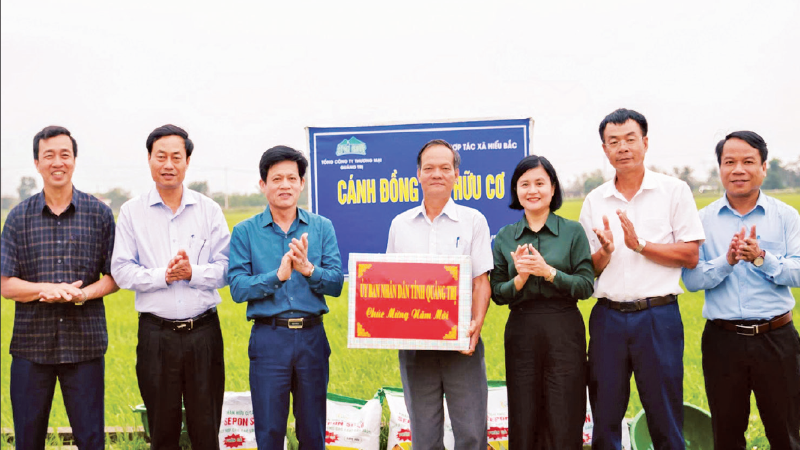 |
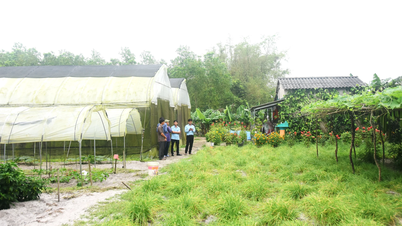
| Leaders of Quang Tri province and the Department of Agriculture and Environment visited a model of organic rice production in Hieu Giang commune. |
However, with the spirit of "Discipline-Responsibility, Proactiveness-Timeliness, Streamlining-Efficiency, Acceleration-Breakthrough," the sector has transformed challenges into opportunities for innovation. The biggest highlight is the decisiveness in reorganizing the administrative apparatus. Implementing Decision No. 251/QD-UBND, the Department of Agriculture and Environment successfully completed the merger, reducing the number of specialized departments by up to 60% and the number of state management sub-departments by nearly 58%. This streamlining did not weaken the apparatus; on the contrary, it created a smooth operating mechanism, minimizing cumbersome procedures for citizens and businesses.
Economic results have proven the correctness of that direction. The growth rate of agricultural, forestry, and fisheries production value is estimated at 2.9%; total food production remains at approximately 600,000 tons. The forestry sector continues to be a source of pride for Quang Tri, with a forest cover rate of 61.47%, and the area of sustainably managed forests (FSC/PEFC) is constantly expanding, opening the door for the forestry economy to reach international standards.
The percentage of communes meeting the new rural standards is 56.5% (39/69 communes after merger). In the fisheries sector, Quang Tri has demonstrated high responsibility in implementing the EC's recommendations on combating IUU fishing. With over 99% of offshore fishing vessels equipped with vessel tracking devices, the locality is striving together with the whole country to remove the "yellow card" and protect the sustainable livelihoods of fishermen.
One of the most significant milestones of 2025 is the leap forward in digital transformation. The sector has built and operated a multi-layered digital mapping system, integrating data from land, forestry, irrigation, and minerals. For the first time, artificial intelligence has been applied to optimize the process of issuing land use rights certificates and smart forest monitoring. AI cameras at critical points have helped the Forest Protection Department detect forest fire risks early.
Simultaneously, the management of natural resources and the environment has seen substantial improvements. The province's "90-Day Campaign to Clean Up the National Land Database" excellently achieved second place nationwide. The rate of urban solid waste and hazardous waste collection remained high at over 98%, affirming the commitment to economic development coupled with environmental protection, without sacrificing ecology for rapid growth.
Aspiration for ecological agriculture and civilized farmers.
According to Tran Quoc Tuan, Director of the Quang Tri Department of Agriculture and Environment, 2026 marks the beginning of the realization of the resolutions of the Party congresses at all levels. The Quang Tri Department of Agriculture and Environment has set ambitious yet humane goals, aiming towards a model of "ecological agriculture, modern rural areas, and civilized farmers." This involves a strong shift in thinking from agricultural production to agricultural economics.
Economically, the sector aims for a 3% growth rate in agricultural, forestry, and fisheries production value, stable food production, and increased export turnover of key agricultural products such as Khe Sanh coffee, pepper, plantation timber, and medicinal herbs. However, instead of focusing solely on quantity, the 2026 strategy prioritizes quality and added value. Quang Tri will concentrate on organic farming, circular agriculture, reducing greenhouse gas emissions, and promoting the forest carbon credit market, a promising new resource.
Regarding resource management, the central task is the effective implementation of the 2024 Land Law and its implementing decrees. In particular, social welfare continues to be a top priority. The goal of reducing the number of poor households by 3,500-4,000 each year is not just a number, but a commitment to "leaving no one behind" on the journey of building new rural areas. Rural clean water programs, the elimination of temporary housing, and vocational training for ethnic minority workers will be implemented with the highest priority resources.
According to Comrade Tran Quoc Tuan, the Agriculture and Environment sector of Quang Tri province is standing at the threshold of a new phase of development with confidence and determination for comprehensive innovation. To realize the goal of double-digit growth in the next five years, the joint efforts and unity of the entire political system and the people are prerequisites. With a foundation built on digital transformation, a green economic mindset, and a streamlined and effective administrative apparatus, it is believed that the agricultural sector will not only be a "support" but also the main driving force to propel Quang Tri to breakthroughs, becoming a shining example of sustainable development in the central region.
According to NDĐT
Source: https://baoquangtri.vn/kinh-te/202603/khat-vong-chuyen-doi-xanh-deb35cf/

![[Image] A night of light, many layers of message](https://vphoto.vietnam.vn/thumb/1200x675/vietnam/resource/IMAGE/2026/03/10/1773158812907_hoa-nhac9-jpg.webp)

































































Comment (0)