


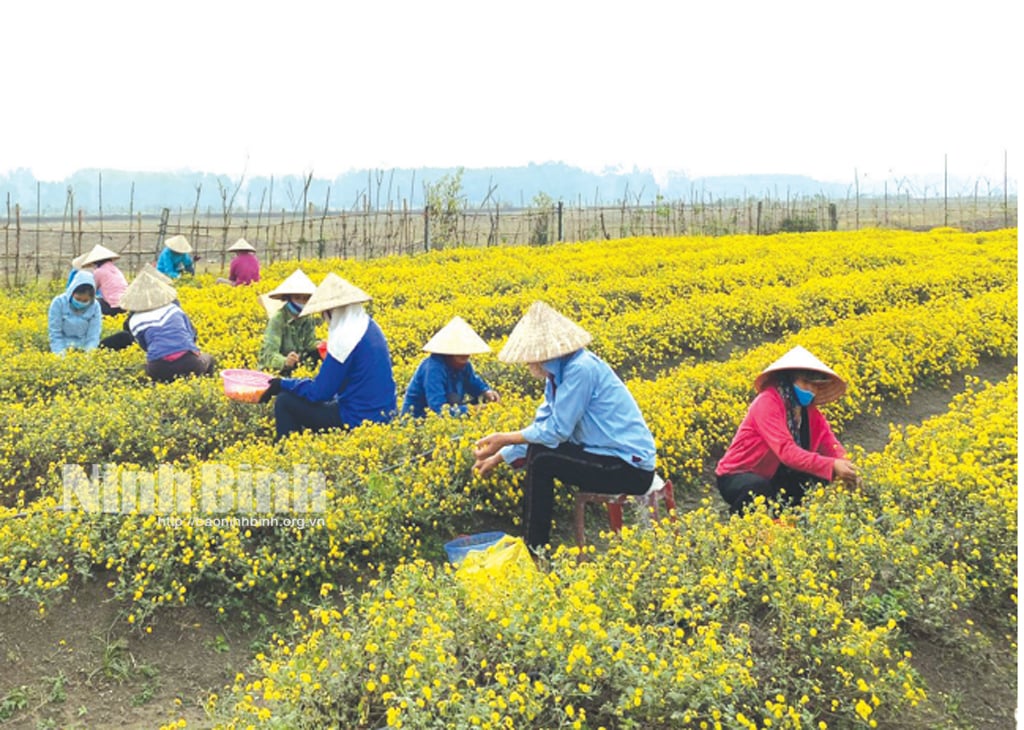
Modern farmers are not afraid of innovation.
In the ongoing process of social innovation, prominent among them are the farmers who dare to think outside the box and take action to transform local agricultural production.
A prime example is Mr. Bui Duc Thinh from Gia Hoa commune, Gia Vien district. At his advanced age, Mr. Thinh still demonstrates remarkable acumen in applying technology to the management of his fish farm. With 2.6 hectares of fish ponds designed according to a modern model, equipped with water pumps, aeration systems, and automatic feeders, all fish care activities are handled with just a touch of his smartphone.
Sharing his thoughts about this "indispensable assistant," Mr. Thinh couldn't hide his joy: "This tiny phone can replace 2-3 people working tirelessly in the pond. It saves time and effort, and it's accurate too."
"Thanks to it, the fish grow faster, and I also earn more income. Last year, my family made a profit of about 600 million VND!" Mr. Thinh's story is a vivid example of how technology has become a lever, helping farmers improve productivity and quality of life.
It's not just Mr. Thinh; across the vast rice fields of Ninh Binh , more and more farmer-owners are boldly investing in mechanization for production. A prime example is the large-scale farmer Trinh Viet Chien in Kim Phu village, Ninh Khang commune, Hoa Lu city.
Owning 300 acres of leased rice fields, Mr. Chien has invested in a comprehensive system of machinery covering all stages from land preparation, sowing seedlings, transplanting, tending, to harvesting. He even uses drones for spraying pesticides and fertilizing, a common sight on the vast rice paddies.
Thanks to 100% mechanization, Mr. Chien confidently asserted: "Sowing and planting hundreds of acres of rice fields only takes 10-15 days. Production costs are also reduced by almost half compared to manual labor. In recent years, rice prices have been high, and I earn several hundred million dong each year." Mr. Chien's success is not only a source of personal pride but also inspires many, proving that farming can also lead to wealth.
From these pioneering individuals, an innovative farming community has emerged. The large-scale farming club, with 45 members owning over 800 hectares of rice-producing land, has been established, creating a sustainable cooperative force.
Mr. Bui Huu Ngoc, Director of the Provincial Agricultural Extension and Trade Promotion Center, shared: "We expect this force to be the pioneering 'new generation of farmers,' creating a revolution in the province's agricultural production."
The center is planning to support them in accessing even more advanced technologies, moving towards smart agriculture, reducing costs, increasing efficiency, and protecting the environment. Gradually, rice cultivation will form a market for selling emission certificates, contributing to increased income for farmers.
Towards a green and sustainable future.
Innovation in Ninh Binh's agricultural fields goes beyond simply applying technology and mechanization. Recognizing the importance of food quality and safety, farmers in the province are increasingly focusing on technical standards, safe production, and traceability, linked to the development of raw material areas.
To date, the province has 21 establishments that have been granted VietGAP certification, and 8 establishments that have been granted certificates for organic products in accordance with the requirements of the Vietnamese Organic Agriculture Standard. The total area certified as organic is 26.1 hectares, supplying the market with approximately 293.8 tons of organic products, including golden flower tea, medicinal plants, chrysanthemum, Cuc Phuong ginseng, kudzu root, turmeric, and various vegetables and fruits.
The area for producing high-quality organic rice has reached nearly 5,000 hectares and is widely implemented in all districts and cities in the province. Most of the key agricultural products of the communes have established traceability systems by production and business establishments, ensuring the requirements for storing and retrieving information at each stage from production to storage, processing, and product trade.
According to 2024 data, the average per capita income in rural areas reached VND 70.74 million/person/year, showing a significant improvement in economic life thanks to positive changes in agricultural production. With the goal of comprehensively improving the material and spiritual lives of rural people, Ninh Binh is continuing to focus on restructuring the agricultural sector towards an ecological and multi-value-oriented approach.
Comrade Dinh Van Khiem, Deputy Director of the Department of Agriculture and Environment, emphasized: The purpose of ecological agriculture is to create an ecologically sustainable agricultural system with economic potential, meeting the ever-increasing needs of people without degrading resources and the environment.
In the future, Ninh Binh's agriculture will not only play a role in ensuring food security but also aim to serve tourism and provide distinctive, high-quality agricultural products to the local market and tourists. The province identifies its competitive advantage not in the scale of its land or cheap labor, but in its tourism potential and the uniqueness of its local products.
Ninh Binh's agriculture sector does not aim for large-scale export competition but focuses on quality and added value, aiming to serve approximately 1 million people in the province and millions of tourists annually. To realize this vision, Ninh Binh will focus on developing agriculture in a multi-sectoral, multi-value direction, maximizing the potential of each ecological zone.
Concentrated, specialized commodity production areas will be systematically planned, while simultaneously forming green belts, ecological agricultural routes serving tourism, and high-tech agricultural zones. The province also pays special attention to preserving and promoting traditional agricultural products and local specialties associated with the development of agricultural tourism and OCOP products.
Applying advanced farming methods such as smart agriculture, precision agriculture, circular agriculture, and organic farming will be the foundation for building a green, clean, harmonious, and sustainable agricultural sector, contributing to urban ecological landscapes and promoting tourism.
Alongside advanced agriculture, the province is also developing rural areas in a modern, green, clean, and beautiful direction, while still preserving traditional cultural identity. The goal is to create a better living environment, narrow the gap between rural and urban areas by creating a "city within a village, village within a city" concept, while simultaneously protecting the environment and developing sustainable agriculture.
The image of Ninh Binh farmers in the future is that of "civilized farmers"—those who master technology and markets, possess professional production knowledge and skills, and contribute to building a prosperous, beautiful, and civilized homeland.
With continuous efforts, Ninh Binh is gradually realizing its goal of becoming a pioneering and model province in ecological agriculture, modern rural areas, and civilized farmers by 2030. This is not only an economic goal but also an aspiration for a better life for the people of the ancient capital.
Source: https://baoninhbinh.org.vn/khat-vong-doi-moi-tren-dong-ruong-923995.htm















![[Photo] Prime Minister Pham Minh Chinh receives the Director General of TASS News Agency (Russian Federation)](https://vphoto.vietnam.vn/thumb/1200x675/vietnam/resource/IMAGE/2026/02/25/1772024599891_dsc-8041-jpg.webp)















































Comment (0)