

Despite being banned, the railway-side cafes remain a favorite destination for tourists. However, behind that beauty lie risks to traffic safety.
Safety concerns
The Hanoi Department of Tourism recently issued a document requesting that tourism businesses in the capital not bring tourists to the railway-side coffee street.
Accordingly, to ensure safety and security on the railway for tourists, the Hanoi Department of Tourism requires travel agencies in the city not to promote or organize tours that take tourists to the railway-side coffee street area, especially in the Cua Nam, Hang Bong, and Cua Dong wards.
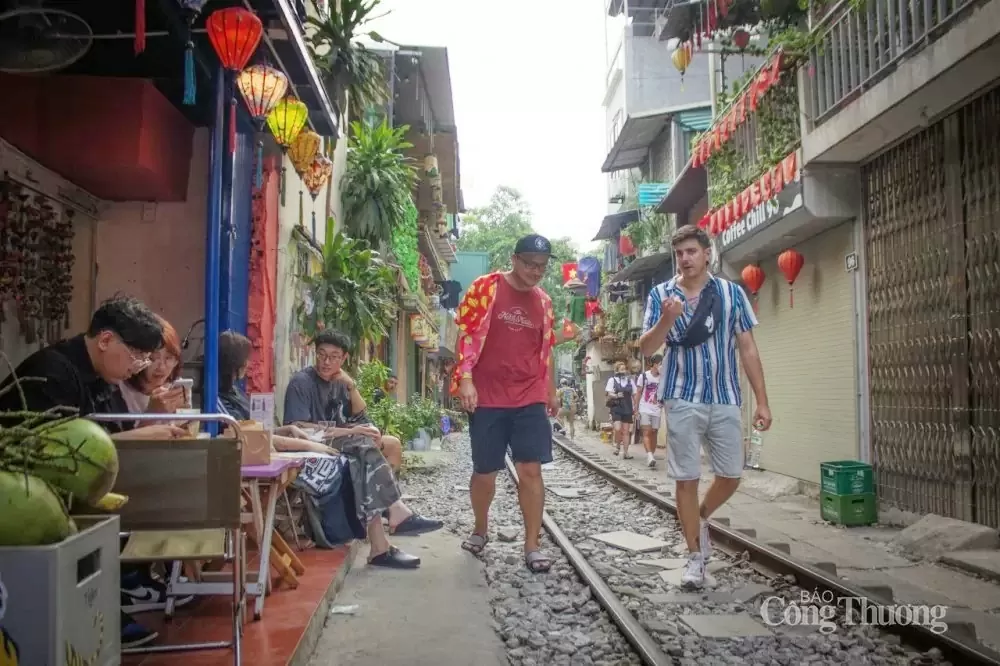 |
| Coffee shops near the railway tracks pose potential safety risks. Photo: Thu Trang |
The official document states that businesses providing travel and tourist transportation services must seriously implement measures to ensure railway traffic safety and urban order.
In fact, coffee businesses operating in the railway area continue despite repeated enforcement actions due to potential traffic safety risks. Railway-side cafes have even become popular on social media and have been featured in numerous international publications as a must-visit destination for foreign tourists in Hanoi. Therefore, despite the ban, tourists still find ways to visit and take photos at these cafes.
According to authorities, the business at the railway-side cafes seriously violates railway safety regulations. For example, the minimum distance for the guardrail is 3 meters, but in many areas it is currently only 1 meter...
Mr. T, a long-time resident of the railway-side cafe area in Phung Hung, shared: " I find the railway-side cafes complicated and posing many potential traffic safety risks. Sometimes tourists even spill onto the railway tracks, litter indiscriminately, and create noise that affects the lives of local residents ."
Meanwhile, Ms. P, who frequently passes through the area with the railway-side cafe, said: " Every time I go to work past the railway-side cafe, I feel uneasy. Tourists spill out onto the road, taking photos and videos, which is very dangerous. Sometimes it even causes traffic jams ."
Long-term calculations are needed.
Many cafes along the railway line are located on the border of three wards: Dien Bien (Ba Dinh district), Cua Nam, and Hang Bong (Hoan Kiem district). Recently, authorities have implemented many decisive measures such as: public awareness campaigns, enforcement actions to remove violations, issuing administrative violation reports, and erecting barriers to block access to cafes on both sides of the railway.
However, these measures have proven ineffective, merely addressing the issue temporarily, so the situation of food stalls operating along the railway line continues to recur, posing a danger to tourists.
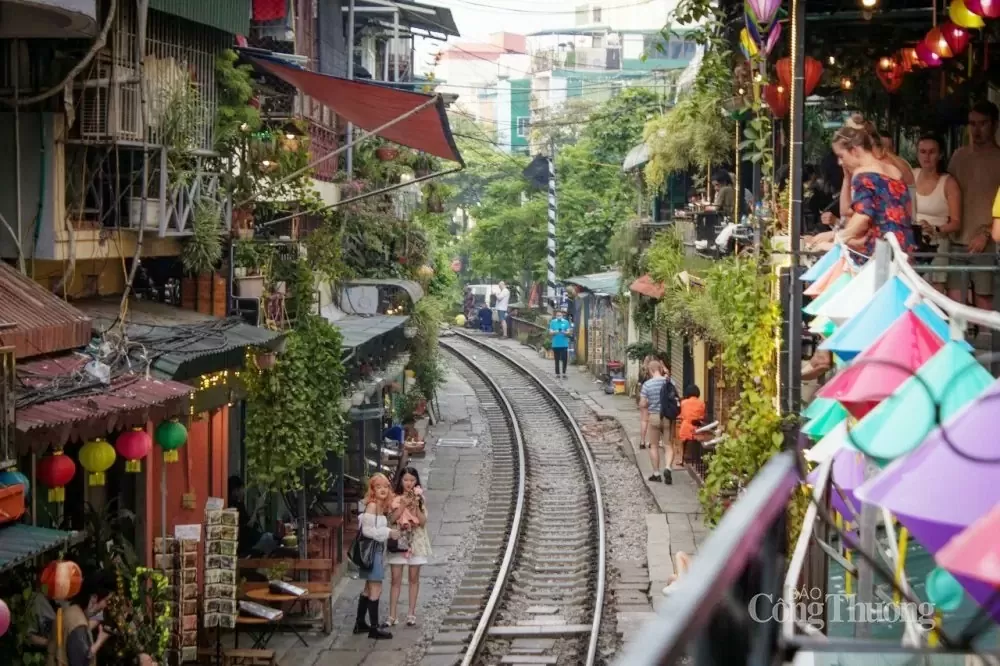 |
| Photo: Thu Trang |
In my opinion, to effectively manage business and tourism activities in the railway-side coffee districts, establishing a specific and unified legal framework is absolutely essential. This requires close coordination and consensus from relevant ministries and agencies to create clear and common mechanisms for handling violations.
Proper management of railway-side cafes will bring many practical benefits such as: ensuring safety for residents and tourists; maintaining urban order and aesthetics; increasing revenue for the budget; and developing sustainable tourism.
Some possible solutions include: establishing a dedicated management board, assigning personnel to monitor the area, coordinating information between the train station and the neighborhood to announce train schedules, and strengthening supervision by local authorities.
International experience shows that managing tourist sites with inherent risks is entirely feasible. For example, the Maeklong railway market in Thailand employs a warning system, announces train schedules, and closely monitors the area. Similarly, in Japan, attractions near railway lines are equipped with barriers, signage, and designated viewing areas, ensuring safety while respecting the living space of local residents.
Therefore, the management of railway-side coffee shops needs to be done systematically and scientifically, while learning from international experience will help maximize their economic and tourism potential, as well as ensure the safety of locals and tourists.
Currently, Vietnam is also implementing strategic projects to develop railway tourism through the restoration of the first railway line from the French colonial era in Da Lat and Ninh Thuan. Repairing and upgrading old railway tracks and stations is a necessary step in the process of building destinations and attracting tourists. This is because international tourists are increasingly exploring train-based tourism destinations. This is a novel experience that many tourists are very enthusiastic about.
Developing train tourism using a unique model will create differentiation, adding attractive destinations and experiences. This promises to enhance communication, promotion, and attract tourists to Vietnam. With this novel form of tourism, Vietnam will become a top choice for travelers on their exploration journeys, instead of the familiar, monotonous experiences.
Previously, the Vietnam Railway Authority sent a document requesting the Hanoi People's Committee to take measures to prevent and disperse gatherings of people filming, taking photos, and drinking coffee within the railway safety corridor. The Hang Bong, Cua Nam, and Cua Dong wards have organized patrols, disseminated information, and encouraged residents to comply with the Railway Law. Warning signs in multiple languages indicating "dangerous area" have been placed at the beginning of the railway line passing through Tran Phu, Nguyen Thai Hoc, and Dien Bien Phu streets. Local authorities are in the process of revoking the business registration certificates of the violating households. Therefore, to ensure the safety of tourists, travel and tourist transportation businesses are required to seriously implement measures to ensure railway traffic safety and urban order in the city. |
Source: https://congthuong.vn/ca-phe-duong-tau-khi-ve-dep-tiem-an-rui-ro-377579.html


![[Photo] General Secretary and President To Lam meets with National Assembly delegates from ethnic minorities.](https://vphoto.vietnam.vn/thumb/1200x675/vietnam/resource/IMAGE/2026/04/20/1776696701056_a1-bnd-8331-3342-jpg.webp)

![[Image] National Assembly discusses the implementation of the socio-economic development plan.](https://vphoto.vietnam.vn/thumb/1200x675/vietnam/resource/IMAGE/2026/04/20/1776696707422_ndo_br_img-20260420-185419-jpg.webp)








































































Comment (0)