

North Korean leaders have instructed the military to maintain a strategic deterrence advantage over the U.S. and South Korea, with its arsenal of ballistic and cruise missiles carrying nuclear warheads.
In late September, North Korea's parliament incorporated nuclear state status and nuclear forces policy into the constitution, following Chairman Kim Jong-un's call for accelerated nuclear weapons modernization to maintain strategic deterrence advantage, while criticizing the trilateral alliance between the US, Japan, and South Korea as "the Asian version of NATO."
North Korea currently possesses a diverse arsenal, including numerous ballistic and cruise missiles capable of carrying nuclear warheads, sufficient to deter the US and its allies and serve its own objectives.
Strategic cruise missiles
North Korea tested its first strategic cruise missile in September 2021. This was Pyongyang's first cruise missile capable of carrying a nuclear warhead.
Western experts believe that cruise missiles fly slower and are less powerful than ballistic missiles, making them easier to intercept, but their ability to fly low makes them easier to conceal from air defense radar and gives them greater accuracy.
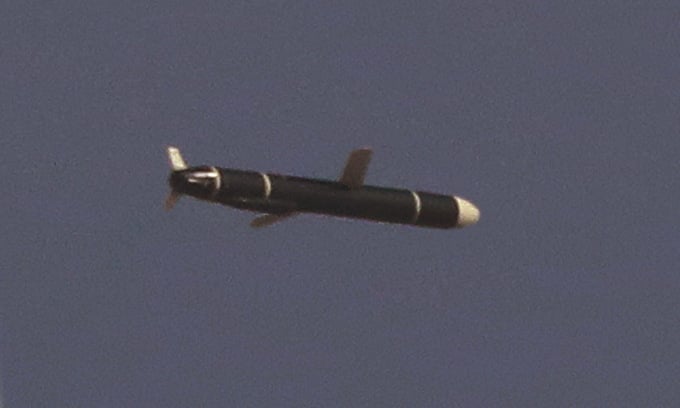
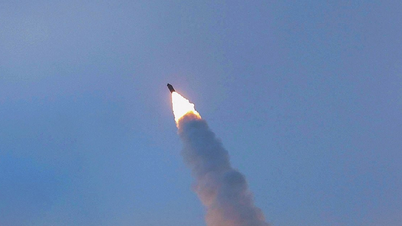
A North Korean strategic cruise missile was test-fired in September 2021. Photo: KCNA
UN Security Council resolutions prohibit North Korea from testing ballistic missiles, but do not target long-range cruise missiles. The most recent launch of such a missile was on the morning of September 2nd, during a live-fire exercise simulating a nuclear attack by the Strategic Cruise Missile Operations Unit of the Western Military District.
During the test, two missiles were launched toward the sea west of the Korean Peninsula and flew along figure-eight trajectories, completing their 1,500 km journey in 7,672 and 7,681 seconds, respectively. The missiles then detonated at an altitude of 150 meters above a deserted island, simulating a precision nuclear strike against an enemy target.
Intense-Range Ballistic Missiles (IRBMs)
IRBMs are ballistic missiles with a range of 3,000-5,500 km. North Korea's main IRBM is currently the Hwasong-12, developed to replace the long-standing but unreliable Musudan ballistic missile.
The US-based Center for Strategic International Studies (CSIS) estimates that the Hwasong-12 can travel 4,500 km with a 500 kg warhead, 3,700 km with a 650 kg warhead, or nearly 6,000 km with a smaller warhead.
North Korea has launched the Hwasong-12 missile eight times, including six in 2017 and two last year. After the first three failed attempts, the remaining missiles were all successfully tested, with four flying over Japanese territory.
In the test on October 4, 2022, the Hwasong-12 missile was launched almost vertically, reaching an altitude of 970 km and traveling a distance of 4,600 km, before falling into the sea outside the country's exclusive economic zone.
The Japanese Ministry of Defense believes that if launched at a standard angle, the Hwasong-12 missile could easily reach Guam and the Aleutian Islands, where strategic US military bases are located. Japanese Defense Minister Yasukazu Hamada said this missile has an "unprecedented range" in previous North Korean weapons tests.
Intercontinental ballistic missiles (ICBMs)
ICBMs are ballistic missiles with a range exceeding 5,500 km, designed for deep-sea nuclear strikes against enemy territory, but can also carry conventional, chemical, and biological warheads. ICBMs typically follow a parabolic trajectory, reaching altitudes of 1,200 km and traversing thousands of kilometers with optimal firing angles.
North Korea first announced a successful ICBM test on July 4, 2017, with the Hwasong-14 model, which had an estimated range of 10,000 km, enough to reach the US state of Alaska. Leader Kim Jong-un then described it as "a gift for the Americans on their Independence Day."
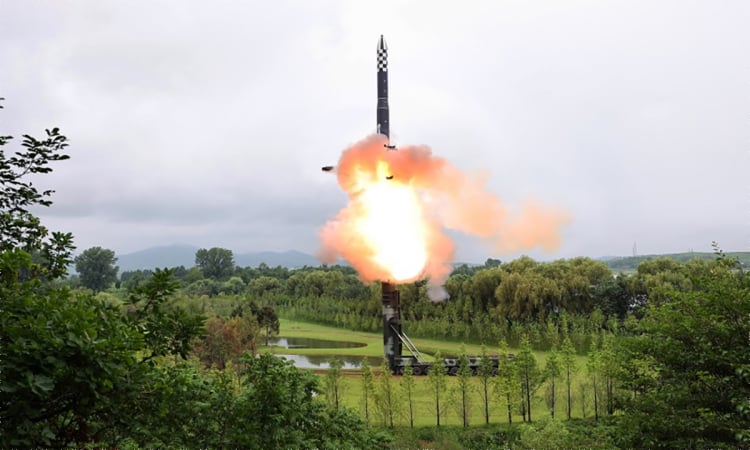
The Hwasong-18 missile during a test launch in July. Video: KCTV
Pyongyang subsequently developed the Hwasong-15 and Hwasong-17 models with a range of approximately 15,000 km, sufficient to cover the entire territory of the United States. Western experts believe that the Hwasong-17 can carry multiple independently targetable re-entry vehicles (MIRVs) and decoys, capable of overwhelming and penetrating the Ground-Based Midcourse Defense (GMD) system currently protecting the United States.
North Korea has also successfully test-fired two Hwasong-18 solid-fuel ICBMs this year. Developing solid-fuel ICBMs has long been one of Pyongyang's key objectives, aimed at increasing the survivability of its strategic missile forces in the event of conflict.
Submarine-launched ballistic missiles (SLBMs)
While SLBMs are less accurate and powerful than ICBMs, ballistic missile submarines can remain hidden underwater for extended periods to launch a retaliatory strike in the event of a preemptive attack on North Korea. SLBMs using conventional warheads can also be deployed to destroy high-value tactical targets and those located in fortified underground bunkers.
Pyongyang has repeatedly tested the Pukguksong-3 SLBM, with an estimated range of 1,700-2,500 km, and also unveiled the larger Pukguksong-4A version during a military parade on October 10, 2020.
North Korean media on September 6th released images of the launching ceremony of the submarine "Hero Kim Kun-ok," hull number 841, equipped with 10 launch tubes capable of carrying various types of SLBMs.
Hypersonic missile
Pyongyang is pursuing efforts to develop hypersonic missiles, weapons with speeds of approximately 6,000-12,000 km/h. Their high speed, maneuverability, and low atmospheric flight path make hypersonic weapons much more difficult to track and intercept than traditional ballistic missiles, posing a significant challenge to any modern air defense system.
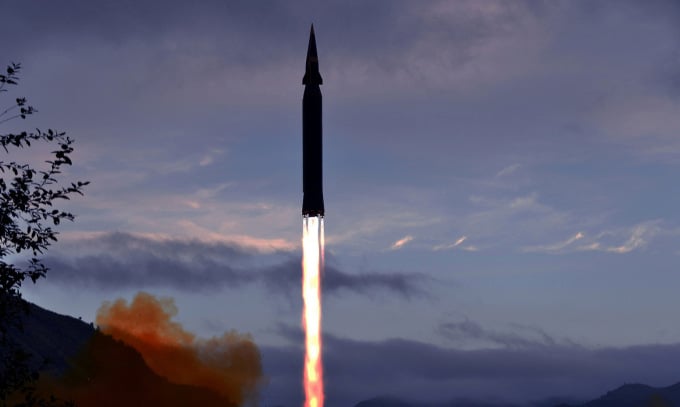
The Hwasong-8 hypersonic missile lifts off the launch pad during a test in September 2021. Photo: KCNA
North Korea has tested the Hwasong-8 hypersonic missile three times, once in September 2021 and twice in 2022. The country has developed two variants of the hypersonic warhead with different shapes, one of which shares many similarities with Russia's Avangard and China's DF-17.
Nuclear warheads
Since 2006, North Korea has conducted six nuclear tests, the most powerful of which took place in September 2017. Experts estimate that this warhead has a power equivalent to 100,000-370,000 tons of TNT, far exceeding the 15,000 tons of explosives in the atomic bomb the US dropped on Hiroshima during World War II.
Last year, North Korea declared itself an "irreversible" nuclear power, and Kim Jong-un recently called for an "exponential" increase in weapons production, including tactical nuclear weapons.
The Korea Institute for Defense Analysis estimates that Pyongyang possesses approximately 80-90 nuclear warheads and is also working to miniaturize them for use on various types of missiles in its arsenal.
Vu Anh (According to AFP, KCNA )
Source link






























































































Comment (0)