

Most pottery artisans in Yang Tao commune (Lak district) today don't know the origins or history of M'nong pottery; they only know that a pottery tradition has existed for a very long time in this low-lying area – a place with many streams and springs, surrounded by the picturesque and poetic Lak Lake. M'nong pottery is closely linked to the history of the M'nong community's settlement in this region.
Despite enduring many historical upheavals, the miraculous vitality of pottery has preserved its original elements and a process passed down through generations. Without machinery, potters, molds, or kilns (open-air firing), M'nong pottery relies on the skill and dexterity of the artisans to create unique and distinctive shapes.
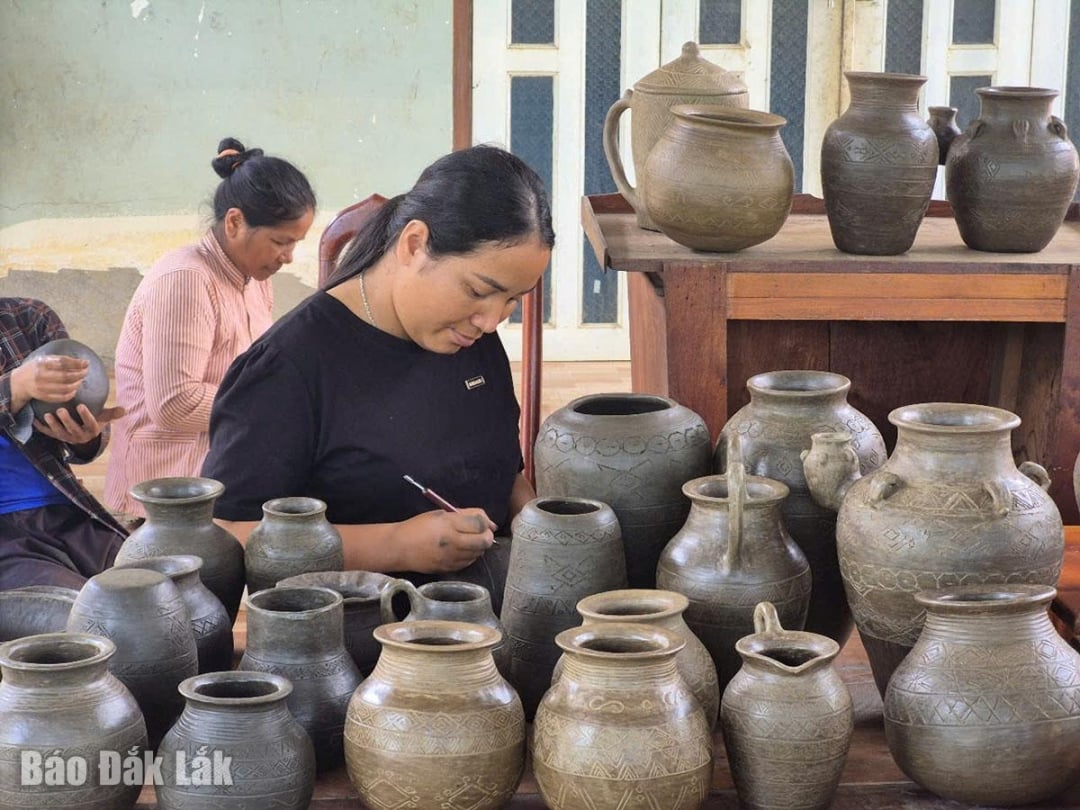 |
| The M'nong people in Yang Tao commune (Lak district) practice drawing patterns on pottery products. |
With that in mind, the preservation and promotion of the traditional cultural values of pottery making is a priority for local authorities and relevant agencies. For example, in May of this year, the Department of Culture, Sports and Tourism organized a training course on decorating pottery products with patterns to enhance the aesthetic value of M'nong pottery in Yang Tao commune, Lak district. The trainees were artisans and local people with many years of experience in pottery making. They participated in the course with enthusiasm, eager to develop and preserve the cultural identity of their ethnic group.
Artisan H. Phiết Uông, from Dơng Băk village (74 years old) – one of the oldest students in the course – shared that she has known how to make pottery for a long time, but all the pottery products she and other people in Yang Tao commune made were plain pottery (without patterns). At her age, she knew that absorbing the knowledge and skills to decorate pottery with patterns was not easy, but when the class was announced, she was the first to register. In the class, she received meticulous and detailed guidance from the teacher on each stroke of the brush on paper and on the clay surface. Once she mastered the skills, she and other students practiced drawing patterns on finished pottery products. After one month of participating in the class, she was able to decorate her pottery with animal patterns such as elephants, turtles, lizards, and some nature scenes.
Student H Hễ Bkrông (Yok Đuôn village, Yang Tao commune) shared that attending the class, she and other students not only learned skills but also gained a deeper understanding of the profound cultural meaning and value of traditional patterns – motifs that are not only beautiful but also embody the soul and identity of the M'nông people.
The class has opened up a new path, not only as an opportunity to preserve the craft passed down from their ancestors, but also to help learners become more confident in continuing to contribute to the protection and promotion of pottery making in the local area. Her family has a display and exhibition space, and a place to experience the pottery-making process of the M'nong people in the locality.
With the knowledge gained from this class, she will strive to further hone her decorative skills to improve the quality of ceramic products, meet the aesthetic demands of users, especially tourists , and increase her family's income from the traditional pottery making craft.
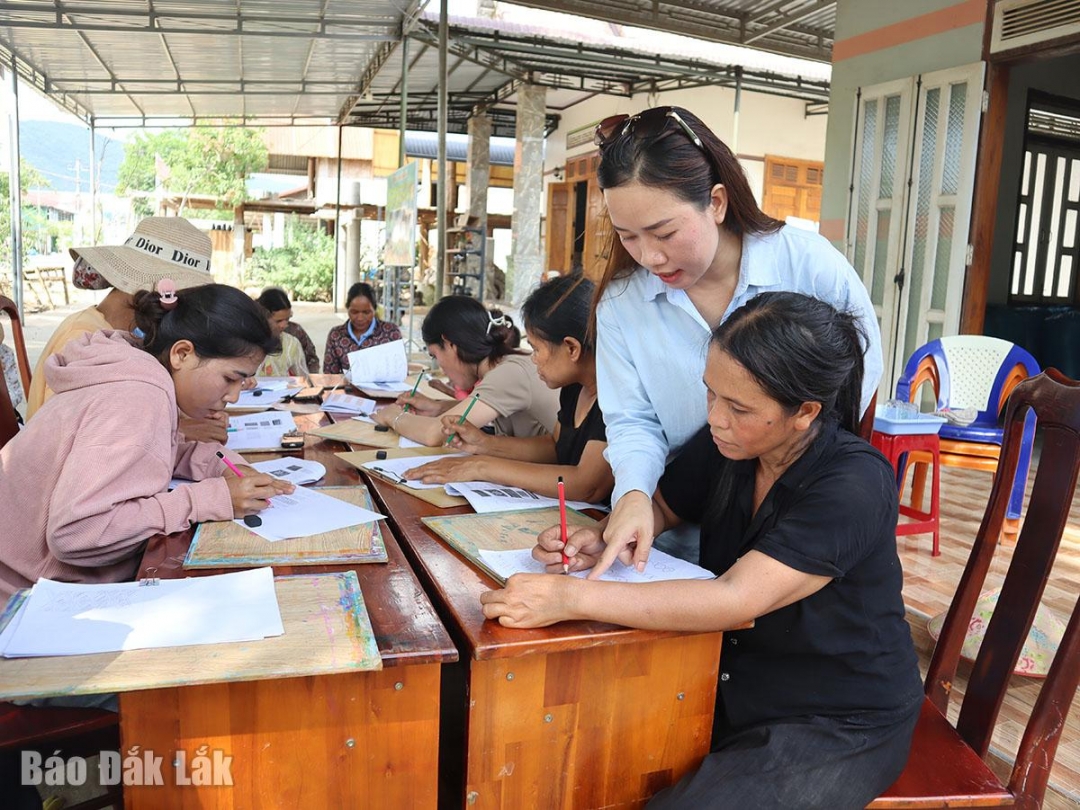 |
| Local artisans and people learn the decorative patterns and techniques used in M'nong pottery. |
H. Niem Kuan (13 years old) is the youngest student in the class, eager to learn and gain experience in order to continue and preserve the pottery craft passed down from her ancestors. H. Niem shared that she feels very happy to learn about the traditional pottery craft of her ethnic group. During the class, not only was she taught each stroke by the teacher, but she also had the opportunity to further cultivate her love for the traditional culture of the M'nong people.
Ms. Duong Vy Ha, a lecturer at Dak Lak College of Culture and Arts – who directly taught and guided the class – assessed that the ceramic products, after being "given life" by the artisans and students with patterns and designs, not only became more beautiful in form but also more vibrant and attractive. The decorative patterns depict animals, natural landscapes, and familiar objects associated with daily life, reflecting the breath of life and therefore feeling very close and familiar to the people. If they continue to train and develop, with the skillful hands of the artisans and people, the traditional values and characteristics of M'nong pottery will continue to spread to all parts of the country and to international tourists.
| At the end of 2024, the pottery-making craft in Yang Tao commune (Lak district) was recognized by the Ministry of Culture, Sports and Tourism as a National Intangible Cultural Heritage. This will open up many opportunities for preservation, development, and the formation of a wider market for the handcrafted pottery products of the M'nong people. |
Source: https://baodaklak.vn/van-hoa-du-lich-van-hoc-nghe-thuat/202506/khoac-ao-moi-cho-gom-mnong-068122c/



![[Photo] General Phan Van Giang welcomes Chinese Defense Minister Dong Jun.](https://vphoto.vietnam.vn/thumb/1200x675/vietnam/resource/IMAGE/2026/03/18/1773808281415_giao-luu-bien-gioi-vntq-lan-10-6829-5690-jpg.webp)
















































































Comment (0)