

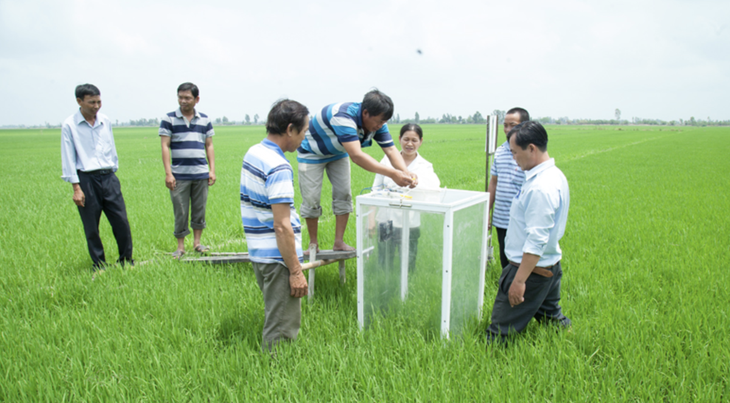
Farmers in Can Tho measure greenhouse gas emissions in their rice fields with the assistance of local agricultural experts - Photo: World Bank
In an interview with Tuoi Tre newspaper ahead of the 14th Party Congress regarding the achievements of Vietnam's agriculture, farmers, and rural areas, the Vice Chairman of the National Assembly and former Minister of Agriculture and Rural Development, Le Minh Hoan, said: "In 40 years of reform, the agricultural sector has become a pillar, achieving achievements beyond expectations."
Entering a new era, the agricultural sector is expected to develop even more strongly, rising alongside the nation's prosperity.
Policies truly come alive when they understand the psychology of farmers.

* From the "liberating productive forces" phase to the restructuring and digital transformation of agriculture, the development of specialized commodity production areas; the implementation of the new rural development program and, more recently, the development of ecological agriculture - modern rural areas - civilized farmers in the spirit of the Party's 13th National Congress resolution, how, in your opinion, have these policy turning points been implemented and what lessons can be learned?
- From the land allocation system to the distribution of land to peasant households, from household economic development to cooperative economics, from specialized commodity farming areas to the construction of new rural areas and now ecological agriculture, it has been a journey of continuous adjustment to suit reality.
The biggest lesson, in my opinion, is that policies only truly come alive when they originate from real life and understand the psychology of farmers. Every successful turning point stems from listening to the voice of the fields, from the very real needs of the people.
Today, a new turning point is emerging – treating fields, ponds, and livestock farms as "open factories." There, processes are standardized, data is recorded, labor productivity is measured, quality is controlled, while still preserving the ecological flexibility and identity of the rural area.
We also learned that agricultural development cannot be separated from rural areas and farmers; we cannot just look at the crops but must look at the people, the community, and the ecosystem. When policies create space for people, businesses, and scientists to proactively innovate, innovation will come from below, more sustainably and for the long term.
Agriculture, environment, and rural areas need to be viewed as a whole.
* After 40 years of implementing the reform policy, Vietnam's agriculture and rural areas have achieved tremendous and comprehensive achievements, but there are undoubtedly also shortcomings. So, what institutional and policy bottlenecks need to be addressed, sir?
- In my opinion, alongside the achievements, we must also frankly acknowledge the bottlenecks. Institutions are still fragmented, and policies sometimes lag behind reality. Supply chain linkages are still weak. Production scale is still small, and the organizational capacity of the collective economy is uneven.
Science and technology have not yet become a driving force in agriculture. The industry's ecosystem is not fully understood, and therefore remains fragmented. There is a lack of cohesion among the stakeholders: government, specialized agencies, farmers, businesses, scientists, experts, and even the media.
The biggest challenge is not just capital or technology, but the mindset for development management. How can policies on land, credit, science and technology, environment, etc., be harmoniously integrated, avoiding overlaps, and creating favorable conditions for people and businesses to participate?
Establishing provincial-level innovation centers linked to agriculture and rural areas is one way to overcome this bottleneck. In these centers, scientists, businesses, cooperatives, and farmers work together to experiment, learn, and adjust. Technology is not imposed from above, but rather learned through trial and error right in the fields.
Agriculture, environment, and rural areas need to be viewed as a whole, not three separate fields. When institutional bottlenecks are removed, the flow of innovation in society will naturally be unleashed.
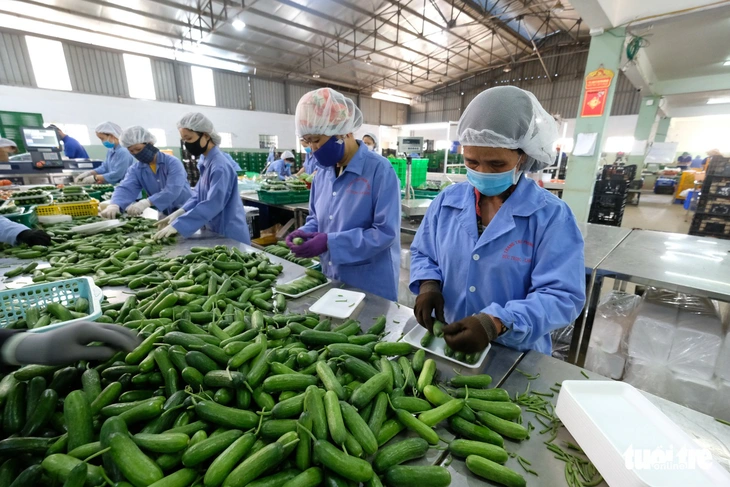
High-quality agricultural products are cleaned one by one and labeled with traceability tags right from the farm warehouse in the Da Lat agricultural region (Lam Dong province) - Photo: M.VINH
* During his visits to the grassroots and conversations with farmers, the topics he often discussed revolved around new approaches and new ways of thinking; how to help people become wealthy and stay rooted in the land where they were born and raised. What are his expectations for the 14th National Congress regarding the modernization of agriculture?
- During my visits to the villages, what I heard most often from the people was not the desire to get rich quickly, but rather to live a stable life, have a future for their children and grandchildren, and to have a long-term connection to their homeland.
I expect the 14th National Congress to continue opening up new development opportunities for rural areas. A place where farmers are not left behind in the modernization process. A place where young people can return to agriculture using knowledge and technology. A place where each village can both preserve its identity and keep pace with the times.
It is a rural area that not only has concrete roads and sturdy houses, but also a "knowledge infrastructure" with community learning centers, innovation centers, and knowledge-sharing spaces for farmers. A place where every farmer can learn throughout their life, improve their skills, and become a professional farmer.
Ultimately, development is about making people happier in the very land they live on.

Farmers in the Mekong Delta use drones to spray pesticides on rice crops - Photo: CHI CONG
Reorganize production according to the "factory in the field" concept.
* The goal of the 14th National Congress Resolution is to shift the rural economic structure towards a green, ecological, circular, value-chain-based, and efficient direction. This emphasizes the importance of applying science and technology and digital transformation in agriculture; and developing large-scale, high-quality, and high-value commodity production areas. In your opinion, what needs to be done to achieve this goal?
- Shifting the rural economic structure towards a green, ecological, circular, and value-chain-based approach is an inevitable path; it's not a matter of choice, but rather a matter of whether to start early or late.
Science, technology, and digital transformation are not meant to replace farmers, but to free up labor, increase productivity, and improve the quality of production. Artificial intelligence (AI) doesn't do the farming for farmers, but it can help predict weather, pests, and markets; helping farmers know when to sow, when to reduce crop yields, and when to switch crops.
To achieve this, production needs to be reorganized according to the "factory in the field" mindset: standardizing processes, digitizing data, greening production, and transparentizing the value chain. Provincial-level innovation centers will be the place to connect data, technology, and people so that science and technology truly become the driving force for increasing national labor productivity.
When farmers understand their position in the value chain, and when each field is seen as part of an economic, environmental, cultural, and social ecosystem, the goals of the XIV Party Congress resolution will no longer be slogans but will become a vibrant reality on every field and in every village.
Agriculture not only feeds the nation but also nurtures Vietnamese identity. Intellectualizing farmers, industrializing the fields, and fostering innovation in every farm are the most sustainable paths for the country's progress.
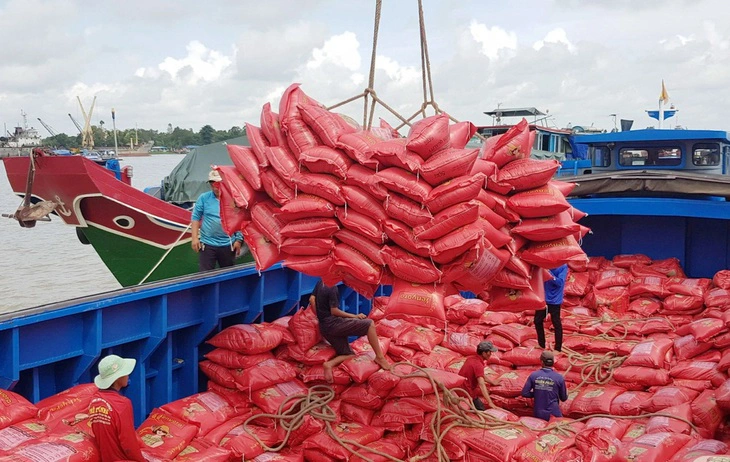
Vietnamese rice for export - Photo: BUU DAU
Farmers take ownership of the "workshop in the fields".
According to Deputy Speaker of the National Assembly Le Minh Hoan, the fact that the documents of the 14th National Congress continue to affirm that "farmers are the main actors" not only have the significance of a declaration, but also represent a very fundamental institutional orientation for the new era of development.
The stakeholders are not passive beneficiaries, but rather co-creators of policy, partners in its implementation, and co-beneficiaries of development. When farmers are placed at the center, every policy design must answer the question: Will this policy help farmers live better lives on their land?
To truly empower farmers, they must be educated. This involves not only providing technical guidance on farming techniques but also equipping them with market-oriented thinking, data-driven thinking, and agricultural economics. When farmers understand the process, costs, emissions, and market, they can truly take control of their own "farm factories."
This is also a way for Vietnamese agriculture to develop in depth, avoid unbalanced development, and create a solid social foundation for the country's modernization.
Chairman of the People's Committee of Dong Nai Province, Nguyen Van Ut:
Expectations for breakthrough policy decisions on regional linkage institutions.

As a locality located in the Southern key economic region, holding a strategically important position in regional connectivity, Dong Nai is well aware of its responsibility towards the overall development of the country.
Over the years, despite numerous difficulties and challenges, the province has persistently reformed its development thinking, focusing on removing bottlenecks, especially in infrastructure, institutions, and the investment environment. This has led to positive and noticeable changes.
One of Dong Nai's most notable achievements is its investment in developing regional transportation infrastructure.
A series of large-scale projects are being implemented simultaneously, such as Long Thanh International Airport, inter-regional expressways, ring roads, and connections between seaports and logistics... These projects not only create a new look for the province but also contribute to reshaping the development space of the entire Southeast region.
From a transit point, Dong Nai is gradually becoming a modern hub for trade, logistics, industry, and services in the South, aiming to form a new growth pole alongside Ho Chi Minh City.
Dong Nai hopes that the 14th National Congress of the Party will issue strategic, groundbreaking, and long-term visionary policies, further affirming the development model based on science and technology, innovation, digital transformation, and green growth, creating strong momentum for the country and localities.
The province has high expectations for groundbreaking policy decisions on regional development institutions, regional linkages, and stronger decentralization and delegation of power to effectively exploit the potential and comparative advantages of each locality, creating new momentum for the Southeast region in general and Dong Nai in particular to achieve high and sustainable growth rates in the next term.
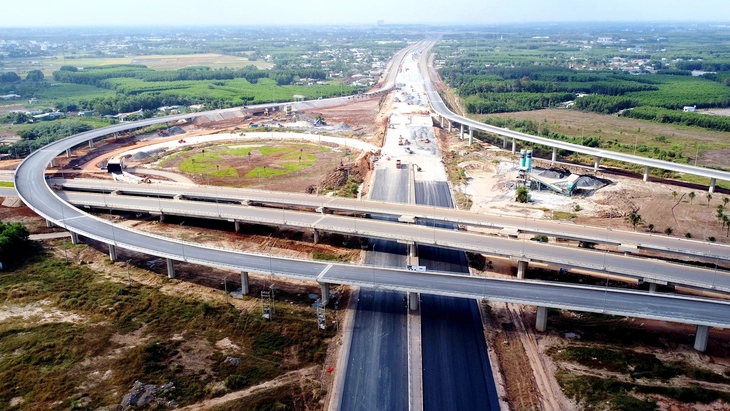
The interchange between connecting roads T1 and T2 and the Bien Hoa - Vung Tau expressway. This is a crucial interchange connecting Long Thanh airport to national highways, expressways, and ring roads - Photo: A Loc
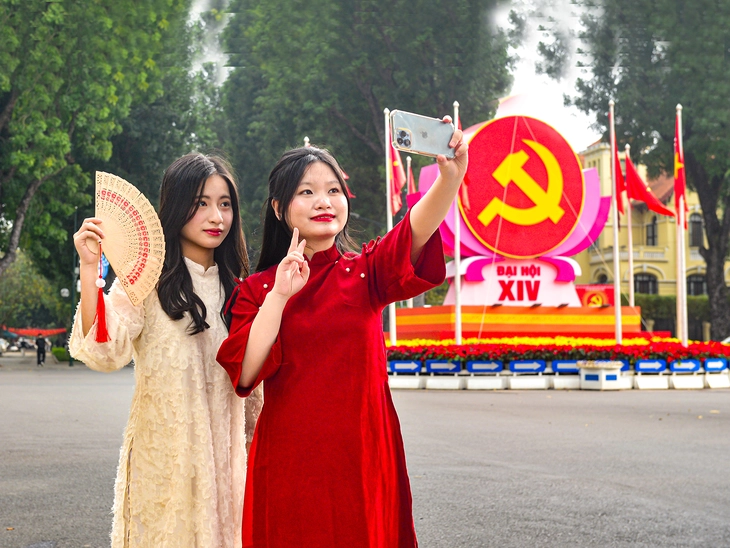
Nhat Le and Ha Phuong pose for a photo amidst the streets adorned with flags and flowers welcoming the 14th National Congress at the intersection of Doc Lap - Dien Bien Phu - Chu Van An streets in Hanoi on January 18th - Photo: PHUC TAI

Presented by: N.KH.
Source: https://tuoitre.vn/khoi-mo-nhung-khong-gian-phat-trien-moi-20260119075456966.htm
























































































Comment (0)