The essence in every layer of palm leaf
For generations, the conical hat from Chuong village has been an enduring symbol, deeply intertwined with Vietnamese culture and memories. Under the skillful hands of artisans, the conical hat becomes a rustic symbol embodying the national spirit, with its nostalgic beauty and traditional cultural value. It is associated with the image of graceful Vietnamese women in their ao dai (traditional dress), memories of the countryside, rice fields, old markets, and even traditional festivals.
When we inquired about the traditional craft, everyone in Chuong village knew about it, but when asked when the hat-making craft began, few knew the exact date. According to old accounts, the village started producing hats in the 8th century. In the past, Chuong village specialized in making various types of hats for different social classes, such as the three-tiered hat for girls, and the pointed hat, long hat, and conical hat for boys and wealthy men.
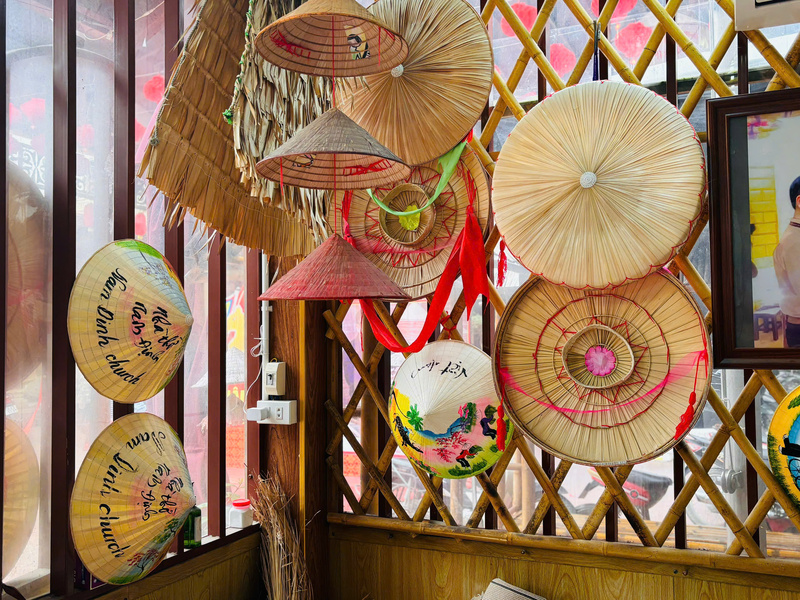
The conical hat from Chuong village (Thanh Oai commune, Hanoi ) has existed for hundreds of years alongside the ancient village. Photo: Nhat Chi
To make a conical hat, the craftsman must go through more than 15 manual steps, from selecting the leaves, whittling the bamboo strips, bending the frame, arranging the leaves, to sewing the hat with nylon or parachute cord. The leaves must be dried in the sun until their green color turns silvery white. Then, the leaves are quickly smoothed to be flat without tearing. Next, the craftsman arranges each leaf into the hat frame, a layer of bamboo sheath and another layer of leaves, then sews them together, requiring skill because the leaves are easily torn. Finally, a light coat of varnish is applied to the surface to give the hat a natural shine and protect it from mold.
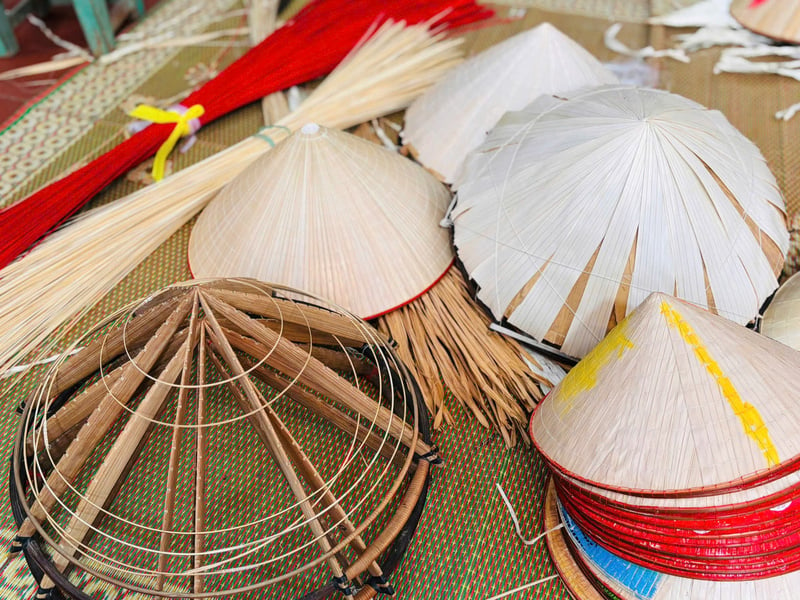
The artisans still meticulously handcraft each step, from weaving the leaves to decorating the hats. Photo: Nhat Chi
During its development, Chuong village produced many types of traditional hats such as the chin-strap hat, silk hat, and hat made from glued-together old leaves. The chin-strap hat was worn by the elderly when going to the temple, while the silk hat was used in artistic performances and shows. The hat made from glued-together old leaves served women who worked in the fields because it was very sturdy and could protect them from the sun and rain.
To create a complete conical hat, hatmakers must be meticulous in every step, patient and skillful with each stitch. On sunny days, the leaves are dried throughout the village because the sunnier the weather, the whiter the leaves become, resulting in a more beautiful and durable hat, but the villagers also work hard and sweat profusely.
Hands that persevere through changing times.
In modern society, when traditional craftspeople are willing to change their mindset and create products according to customer tastes, craft villages are not just memories but also a vibrant part of the contemporary cultural flow.
Speaking to a reporter from the Industry and Trade Newspaper, artisan Le Van Tuy said that he is one of the few people still clinging to the craft in Chuong village, diligently preserving the value of conical hats every day, continuing the journey of bringing OCOP 4-star products closer to international tourists and exporting them to many countries around the world .

Artisan Le Van Tuy has won numerous awards for preserving the traditional craft of making conical hats. Photo: Nhat Chi
Born into a family of hat makers, Mr. Tuy has been involved with palm leaves and bamboo frames since his childhood, helping his parents pick leaves and sew hats to sell at the market. Sharing about his connection to the craft, Mr. Tuy was initially encouraged to become a teacher in the village, but due to poverty and the long distance to school, he couldn't bring himself to abandon hat making and continued to maintain it to support his family financially .
For over half a century, artisan Le Van Tuy has been diligently working with bamboo frames and palm leaves. For him, preserving the craft is not just about making a living, but also about preserving the soul of his ancestors and of Chuong village – the centuries-old land where he was born and raised.
To preserve the essence of Vietnamese culture, Mr. Tuy has introduced dozens of different hat styles to the market, varying in design and material, such as conical hats, straw hats, oil-painted hats, silk hats, and monk hats. Among these, five products have been recognized as 4-star OCOP products: the silk-on-the-outer-side conical hat, the bridal hat, the double-sided silk conical hat, the cluster-shaped hat, and the special traditional conical hat.
Every day, Mr. Tuy's workshop produces about 500 conical hats for the market, mainly serving as gifts and souvenirs for foreign tourists. For him, each hat is a work of art, with paintings and patterns meticulously and carefully drawn down to the smallest detail.
"Some hats can be made in just a few hours, but others take a whole week to complete ," Mr. Tuy shared.
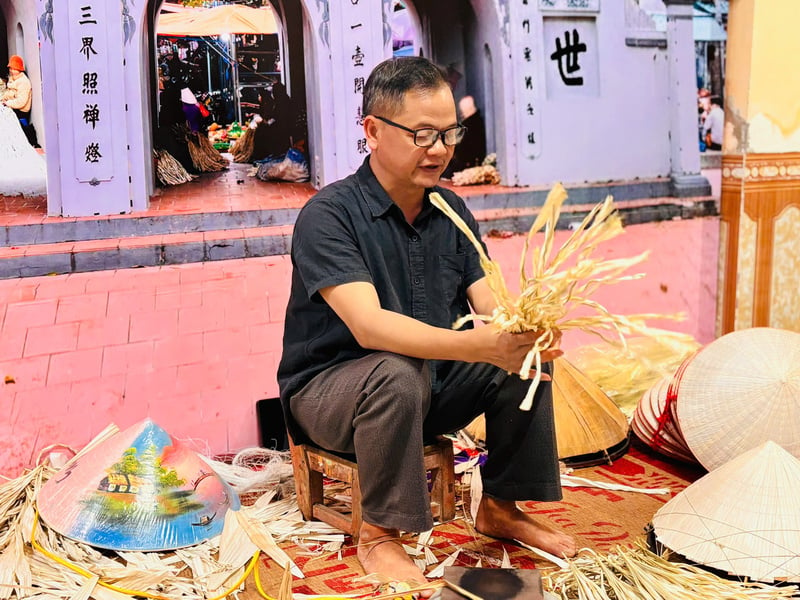
Mr. Le Van Tuy - a craftsman who has been making conical hats for over half a century in Chuong village. Photo: Nhat Chi.
Thanks to his efforts, Mr. Tuy brought his Chuong village's conical hats to the first Autumn Fair in 2025 and reached a large customer base. Notably, his monk-style hats were also displayed at the National Press Conference in 2023 and were honored to be chosen by the state as gifts for heads of state. For him, this is a great reward for over 50 years of dedication to the craft.
Not content with simply preserving the craft, Mr. Tuy has transformed his home into a cultural experience space. Organizing experiential sessions for students and tourist tours to visit the village has helped Chuong village's conical hats reach more customers both domestically and internationally, contributing to the local economic development.

Every month, Mr. Tuy's hat-making experience center welcomes hundreds of foreign tourist groups. Photo: Nhat Chi
More than half a century has passed, and the "little boy" of yesteryear has now become a skilled artisan, not only preserving the products of his homeland but also actively promoting Vietnamese culture to friends around the world.
Through the ups and downs of time, the craft of making conical hats is no longer as prosperous as it once was, but the artisans of Chuong village still diligently sew each hat, continuing the tradition because they believe that the old values in the present flow are a cultural feature that cannot be allowed to fade away.
Source: https://congthuong.vn/gin-giu-net-xua-qua-vanh-non-lang-chuong-445547.html
























































































Comment (0)