"When competing internationally, if you saw a team dragging a Styrofoam box wrapped in tape, you knew it was the Vietnamese team. People often jokingly called them the 'Styrofoam Box Team'," chef Trinh Tuan Dung recalled his days in Wales for the Global Chefs Challenge 2026 finals.
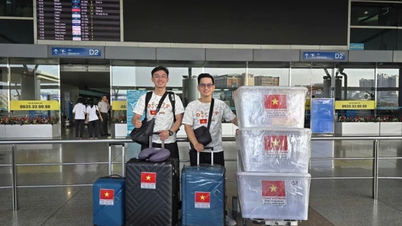
While many teams arrived with state-of-the-art equipment and a large support staff, the Vietnamese delegation consisted of only two members: Trinh Tuan Dung (born in 1999) and assistant cook Le Dac Minh Quan (born in 2005). Their luggage comprised five pieces of belongings weighing approximately 115 kg, containing pots and pans and styrofoam boxes filled with local agricultural products such as Hoa Loc mangoes and Ly Son garlic.
The final results were announced on May 19th, with the team finishing 8th out of 15 and winning the silver medal, marking the first time Vietnam has had a representative participate in and win an award at the global finals of this competition.
The Global Chefs Challenge is considered the "Olympics" of the global culinary industry, organized every two years by the World Chefs Association (Worldchefs). The competition brings together outstanding chefs representing various continents, undergoing a rigorous judging process encompassing cooking techniques, flavor, and waste management according to international standards.

Dung and Quan brought boxes of Vietnamese kitchenware and agricultural products to the final round. Photo: Tuan Dung
Behind this achievement lies nine months of challenging preparation. At the Asian semi-finals in Malaysia in early 2025, Dung thought he couldn't advance after seeing the impressive performances of the other teams. However, after helping Singapore secure a place in the final, he decided to postpone his master's studies to focus on training.
Starting in September 2025, he began developing the menu, and in December found a suitable assistant chef, Nguyen Minh Quan, a contestant under 25 years old as per the competition's regulations.
The competition required each team to prepare 4 dishes, totaling 12 servings, within 7 hours. The Vietnamese team's menu was based on traditional cuisine but presented using modern techniques.
The appetizer is inspired by Vietnamese savory pancakes (banh xeo). The fish dish features Central Vietnamese flavors with lemongrass and lime leaves. The main course is based on pho, and the dessert uses Hoa Loc mangoes, green pomelos, and palm sugar. The team also uses Phu Quoc fish sauce throughout to maintain its unique identity.
"Vietnamese agricultural products and cuisine are of sufficient quality to meet the stringent standards in international professional markets, and are capable of standing on par with high-end ingredients from other countries," Dung said.

The four-course menu of the Vietnamese team at the Global Chefs Challenge 2026 finals. Photo: Tuan Dung
The biggest obstacle for the Vietnamese team is the requirement to use many high-end ingredients from international sponsors. "There are ingredients we've never even touched before," Dung said.
Typically, a halibut weighing 5-6 kg can cost several million dong per kilogram in Vietnam. For months, the two could only imagine the texture of the meat using sea bass and snakehead fish. Only close to the competition did they dare to spend their own money to buy a small halibut at a supermarket in England.
Another ingredient was calf kidney, and Dung and Quan could only imagine it by watching videos online. In the exam room, Dung had to recall the instructions from his seniors about calf kidney "having a similar softness to pig brain" in order to adjust the knife pressure during his first actual preparation.
The freezing weather in Wales also disrupts all calculations. In Vietnam, ingredients can go from room temperature to 100 degrees Celsius in just a few minutes. But in Wales, everything starts below 10 degrees Celsius, significantly prolonging cooking time.
Some dishes use sauces made with butter and coconut oil, which solidify quickly. To handle this, Dung had to constantly keep the plates warm, calculate the judges' movements, and precisely time the preparation until his team's turn to judge before pouring the sauce over the plates and serving the dishes.
The Hoa Loc mangoes also "almost became a mishap," because the weather conditions in Wales affected the natural ripening of the fruit. Dung and Quan had to wrap the mangoes in the rice they brought with them to ensure they ripened in time for the exam.
What stressed Dung and Quan the most was transportation. The competition started at 6 am, while their accommodation was more than an hour's drive from the competition venue. Taxis were scarce in the early morning. The two chefs had to use every piece of information they could find to find a driver, even considering walking their equipment to the competition if they couldn't find a ride.
The final round featured 16 teams, with 8 teams competing each day. Some European teams, such as Italy, the Netherlands, and Denmark, had large crowds of supporters, creating a lively atmosphere. Meanwhile, the Vietnamese team consisted of only two people with limited support, yet Dung and Quan still completed their tasks on time.
The international judges highly appreciated the creativity of the Vietnamese team, especially the pho-inspired dish which perfectly combined local ingredients with Western cooking techniques.

Tuan Dung (right) and Minh Quan hold the Vietnamese flag at the final round of the competition. Photo: Organizing Committee .
Due to limited funds, the two chefs had to pay for almost the entire trip themselves. The organizers only provided accommodation during the competition. They brought instant noodles, canned fish, and dried shredded pork from Vietnam to eat during the competition, saving 30-40 million VND to buy ingredients and equipment.
According to Ms. Hien Minh, Vice President of the Saigon Professional Chefs Association, the Vietnamese team winning the silver medal is a significant milestone, marking the talent of the young generation of Vietnamese chefs on the world stage.
Dung and Quan's journey also reflects the common reality for young Vietnamese chefs when venturing into the international market: a lack of training facilities, limited financial resources, and insufficient support policies.
"Young chefs who want to participate in international competitions first need to master the competition rules, prepare and practice seriously, and have a high level of time investment and determination," Ms. Minh said.
Looking back on their journey, Dung believes that the achievements he and Quan have attained are the result of a long and challenging preparation process. Dung will continue to improve his skills and pursue the study plan that was temporarily put on hold.
"We still have the potential to do better than we did," Dung said.
According to vnexpress.net
Source: https://baophutho.vn/dau-bep-viet-mang-nong-san-viet-di-thi-quoc-te-255279.htm














![[Photo] Reception to welcome General Secretary and President To Lam and his wife on their State visit to the Philippines](https://vphoto.vietnam.vn/thumb/1200x675/vietnam/resource/IMAGE/2026/06/01/1780295488620_vna-potal-chieu-dai-chao-mung-tong-bi-thu-chu-tich-nuoc-to-lam-va-phu-nhan-tham-cap-nha-nuoc-toi-philippines-8798060-7855-jpg.webp)











































Comment (0)