Vietnam is a pioneer in opening up its market.
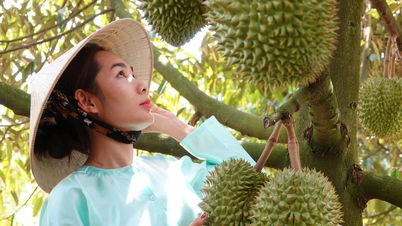
According to the Department of Crop Production and Plant Protection ( Ministry of Agriculture and Environment ), Vietnamese durian is expected to be officially exported to the Indian market from July 2026. Currently, the relevant authorities of both countries are finalizing the necessary technical procedures. If everything goes according to plan, Vietnamese durian will be the first to enter this market of over 1.4 billion people, even before Thailand. This is considered an important step for the durian industry in expanding its market.
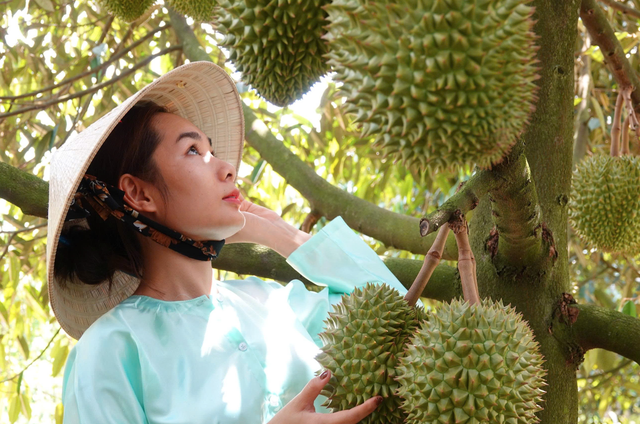
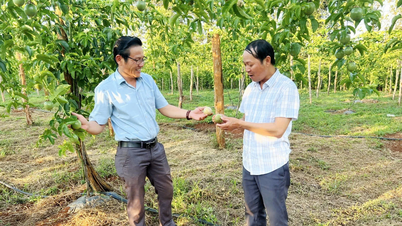
Will India be the new 'gold mine' for Vietnamese durian?
PHOTO: DUY TAN
Prior to durian, Vietnam had already successfully expanded dragon fruit exports to the Indian market. As a result, this market of 1.4 billion people is now second only to China in consuming Vietnamese dragon fruit . Building on that success, the expectation that India will become a new "gold mine" for Vietnamese durian is generating great excitement in the market.
Mr. Dang Phuc Nguyen, General Secretary of the Vietnam Fruit and Vegetable Association (VINAFRUIT), commented: "India's preparation to open its market to Vietnamese durian is certainly a welcome sign, but expecting an immediate surge in export value like with China is somewhat difficult. Because China is a market 'waiting for goods,' export value would skyrocket as soon as the market opens."
"The Indian market for Vietnamese durian is more of a long-term strategic opportunity than a 'gold mine' that can be exploited immediately. It's attractive in terms of paving the way and diversifying markets."
 Mr. Dang Phuc Nguyen - General Secretary of the Vietnam Fruit and Vegetable Association (VINAFRUIT)
As for India, Vietnam is the one opening up and rebuilding the market from scratch, so it will take a lot of effort to "train" consumers to become familiar with this fruit. If done well, Vietnamese durian will win the favor of consumers more effectively, just like the Chinese have a preference for Thai durian.
Investment is needed to develop a positive durian experience for consumers.
In reality, most Indians have never even heard of durian. Therefore, developing this market requires systematic investment in marketing and building a positive user experience. This requires significant costs and considerable time.
On the other hand, India's weak cold chain infrastructure is also a major challenge, while for fresh durian , a cold chain is indispensable. Furthermore, India's cold chain logistics system, while developing, is uneven, especially in mid-sized cities and inland areas. Frozen durian may be more suitable for initial market entry than fresh durian.
Another factor is the geographical distance; shipping from Vietnam to India by sea takes much longer than shipping from China. Fresh durian ripens quickly, requiring an extremely precise cold chain supply. High transportation costs drive up the price of durian in India to very expensive levels, inadvertently turning it into a luxury item inaccessible to the general public.
Despite numerous challenges, competitors like Thailand and Malaysia have been seeking to access this market. In particular, Malaysia, with its deep-freezing technology (for durian segments), will have an advantage in accessing distant markets. "The Indian market for Vietnamese durian is more of a long-term strategic goal than a 'gold mine' that can be exploited immediately. India may be more suitable for processed products such as frozen or dried durian than fresh whole durian, thanks to its long-term preservation advantage," Mr. Nguyen commented.
Source: https://thanhnien.vn/an-do-se-la-mo-vang-moi-cua-sau-rieng-viet-nam-185260601081537463.htm






























![[Photo] Reception to welcome General Secretary and President To Lam and his wife on their State visit to the Philippines](https://vphoto.vietnam.vn/thumb/1200x675/vietnam/resource/IMAGE/2026/06/01/1780295488620_vna-potal-chieu-dai-chao-mung-tong-bi-thu-chu-tich-nuoc-to-lam-va-phu-nhan-tham-cap-nha-nuoc-toi-philippines-8798060-7855-jpg.webp)

























































Comment (0)