


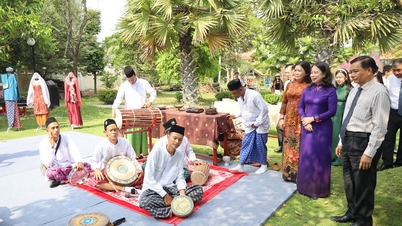
The Dù kê theatrical performance by the Ánh Bình Minh Khmer Art Troupe entertained the people at the Khmer temple in Xoài Xiêm hamlet, Trà Cú commune.
According to Nguyen Van Tam, Secretary of the Party Committee of Tieu Can commune, the commune was formed by merging Hieu Trung and Phu Can communes and Tieu Can town. The commune covers an area of 49.7 km2, comprising 7,557 households and 34,150 inhabitants, of which the Khmer ethnic group accounts for over 40% of the population. Implementing the National Target Program on New Rural Development, giai đoạn 2021-2025, the commune has mobilized over 1,570 billion VND to build a comprehensive and modern rural infrastructure, creating a bright, green, clean environment that adapts to climate change.
Following the policy of socializing education , Tieu Can mobilized organizations and individuals to support the construction of a spacious, clean, and beautiful boarding school for ethnic minorities at the junior and senior high school levels. The school has sufficient subject classrooms, functional rooms, modern equipment, and software to meet the requirements of effective teaching and learning. As a result, the school's annual student promotion rate reaches 100%, the high school graduation rate is 100%, and over 80% pass entrance exams to universities and colleges. By the end of 2023, the school met the standards and was recognized as achieving national standard level 2.
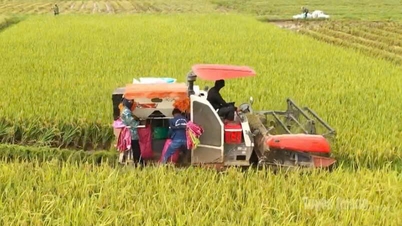
In agricultural production, Tieu Can commune has implemented many effective production models, such as: growing cantaloupe in greenhouses; growing low-emission rice linked to product buyback contracts in the concrete canal area of Cau Tre hamlet with an area of 110 hectares; harvesting coconut flower nectar; raising breeding cows, etc. By implementing the low-emission rice cultivation model, members and affiliated households of Phu Can Agricultural Cooperative have reduced the amount of rice seeds by 60%, fertilizer by 20%, achieving an average yield of 6.5-7.5 tons/ha depending on the season, and increasing profits by approximately 7 million VND/ha compared to rice fields outside the cooperative.
Farmer Thach Rene, from Cau Tre hamlet, Tieu Can commune, said that his family's 1-hectare rice field, planted with low-emission rice using an alternating wet and dry irrigation model combined with IoT technology, can reduce the number of water pumps needed by 3 per rice crop. The rice plants remain healthy, with few diseases, and the family's rice field achieves a yield of 7-7.5 tons/hectare depending on the crop. The cooperative guarantees the purchase of the output at a price 200-300 VND/kg higher than the market price.
Thanks to the New Rural Development program, all the roads in Tieu Can commune are paved and clean, houses are spacious, the economy is developing, the poverty rate is only 0.4%, and the average per capita income has reached 86.8 million VND/person/year. Currently, Tieu Can has completed the goals of an advanced and model new rural commune, moving towards building a smart new rural commune.
In Dai An commune, according to the Chairman of the People's Committee, Ngo Quoc Thanh, the commune has a population of 22,672 people, of which Khmer ethnic people account for 49.7%. Implementing the emulation movement to build new rural areas, combined with promoting the restructuring of the agricultural sector, in the period 2021-2025, the commune received hundreds of billions of VND in investment capital from the Central and provincial governments to build dozens of projects, including cultural centers, bridges, rural roads, embankments, and sidewalks; carrying out dredging of inland irrigation works, maintaining and repairing the saltwater intrusion prevention system, ensuring irrigation water supply to meet the production and aquaculture needs of the people. As a result, people in the commune have boldly converted hundreds of hectares of low-yield rice land to cultivate crops and raise aquatic products with high economic efficiency. The average production value per hectare of agricultural land in the commune reaches over 200 million VND/year.
In addition, Dai An commune has promptly and effectively implemented government projects and programs, supporting nearly 400 Khmer households with housing, production land, and clean water with a budget of over 11.7 billion VND. The commune has built and renovated nearly 400 houses for poor and near-poor households and ethnic minorities; creating conditions for households to access preferential loans to develop their family economies. As a result, the poverty rate in Dai An has been reduced to 1.65%, and the near-poverty rate to 2.9%.
Ms. Diep Thi Trang, head of the Giong Dinh hamlet's weaving cooperative, said that after participating in a vocational training course organized by the Provincial Department of Industry and Trade, more than 70 members of the cooperative have created small, exquisite woven products for decoration, which have been well received by domestic and international markets. The miniature rural household items produced by Ms. Diep Thi Trang's business were also honored by the Ministry of Industry and Trade as a typical rural industrial product.
Over the past period, communes and wards throughout the province have implemented the "Eliminating Temporary and Dilapidated Houses" emulation movement launched by the Prime Minister in a comprehensive and decisive manner. As a result, the entire province has supported the construction of 14,738 houses, including 11,604 new houses and 3,134 repairs, with a total budget of over 894.3 billion VND and 47,988 man-days of labor. The family of Mr. Thach Ngoc Tam, in Binh La hamlet, Song Loc commune, is classified as a near-poor household with three members, no land for production, and their income depends on Mr. Tam's unstable work as a construction laborer. Mr. Tam shared: "Thanks to the 60 million VND in support from the Party and the State for house construction, and the help from both sides of the family, my wife and I are very happy to have a new house. In the future, my family will strive to work hard, stabilize, and improve our living standards."
These days, the Khmer people in the province are joyfully celebrating their traditional Chôl Chnăm Thmây New Year with vibrant religious and recreational activities that strengthen the bonds between villages and communities. According to Ms. Thạch Thị Thu Hà, Director of the Department of Ethnic Minorities and Religions of Vĩnh Long province, in the coming time, the province will continue to effectively implement national target programs on socio-economic development and sustainable poverty reduction in ethnic minority areas, in conjunction with the "All People Unite to Build New Rural Areas and Civilized Urban Areas" campaign. At the same time, the province will continue to actively encourage ethnic minority households to strive for education, productive labor, overcome difficulties, and build a prosperous and happy life.
MINH KHOI
Source: https://nhandan.vn/khoi-sac-vung-dong-bao-khmer-post954201.html

























































Comment (0)