

As many universities began selecting students based on a combination of results from multiple methods, the admissions mindset shifted from measuring "scores" to assessing students' abilities.
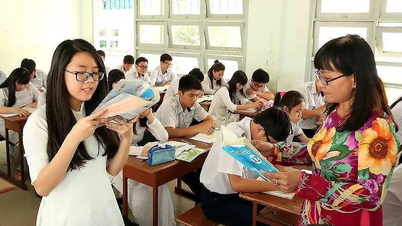
For many years, the results of an exam were almost the primary measure for gaining admission to university. This approach facilitated the admissions process, but it also revealed limitations as training requirements became increasingly diverse.
In many cases, high school education becomes "exam preparation": Students spend a lot of time familiarizing themselves with sample exam questions and practicing quick problem-solving skills to achieve high scores, but this doesn't necessarily fully reflect their thinking and application abilities. Meanwhile, a student's true competence is developed through the entire process of accumulating knowledge, honing their thinking skills, and diligently studying.
Therefore, many educational institutions are shifting to a comprehensive admissions process, combining high school graduation exam scores, results from aptitude tests, and academic performance during high school. Each data source reflects a different aspect of a student's abilities. When considered holistically, these factors help to better identify a candidate's thinking skills and learning process, rather than simply selecting those who are proficient in exam preparation.
The adjustments in university admissions are also consistent with the direction of the 2018 General Education Program – shifting the focus from knowledge transmission to the development of students' qualities and competencies. Therefore, evaluating candidates from multiple data sources is not only a technical solution in admissions, but also a necessary step to ensure consistency between program objectives, teaching methods, and university entrance selection.
Reforming the admissions process is also linked to the expansion of autonomy for higher education institutions. When given the autonomy to develop admission methods tailored to their specific training characteristics, universities are better able to select candidates who meet the requirements of each field of study more effectively.
For engineering fields, scores in subjects demonstrating logical thinking and problem-solving skills are often given higher weight. Conversely, for social science fields, a broad knowledge base and reasoning ability are valued. Combining multiple criteria makes the admissions process more flexible and helps universities find students who are a good fit for their training objectives.
More broadly, reforming the admissions process is also a step towards aligning Vietnamese higher education with global trends. In many countries, admissions are not based solely on exam scores, but also incorporate various other factors to assess students' abilities and potential. Despite differing conditions and contexts, these models share the commonality of viewing admissions as a comprehensive assessment process, rather than simply a comparison of scores.
However, reforms in the admissions process must be accompanied by transparency and stability. Admission criteria must be clear and easy to understand so that candidates can prepare proactively; the combination and conversion of data sources also need to be carefully considered to ensure fairness.
Therefore, university admissions are not just a matter for individual universities, but need to be considered within the overall reform process of the entire education system. As secondary education shifts towards developing students' qualities and competencies, university admissions methods also need to change accordingly to create consistency in training objectives.
Source: https://giaoducthoidai.vn/khong-chi-do-bang-diem-thi-post769330.html




![[Photo] Prime Minister Pham Minh Chinh meets with representatives of female leaders and managers of central agencies and presents the Kovalevskaia Award 2025.](https://vphoto.vietnam.vn/thumb/1200x675/vietnam/resource/IMAGE/2026/03/06/1772789429283_ndo_br_dsc-1149-jpg.webp)



















![[Photo] People in Ho Chi Minh City experience the green space at Ly Thai To Park No. 1.](https://vphoto.vietnam.vn/thumb/1200x675/vietnam/resource/IMAGE/2026/03/06/1772783731988_01-9003-png.webp)





















































Comment (0)