- Building a foundation to attract investment.
- Proactively attract investment in high-tech projects, clean energy, and green transformation.
- The destination for green investors.
Increase attractiveness
With its advantageous location at the southernmost tip of Vietnam , bordered by the sea on three sides, a coastline of approximately 310 km, and a sea area of over 120,000 km², Ca Mau has favorable conditions for developing large-scale marine economic sectors, logistics, energy, and agriculture.
According to Mr. Huynh Cong Quan, Director of the Department of Finance, after the merger, the province has more opportunities to effectively exploit its inherent potential and advantages, while creating a more synchronized linkage in infrastructure, resources, and markets. This is an important foundation for attracting large-scale projects, creating momentum to promote double-digit economic growth.
Not only is Ca Mau distinguished by its rare and diverse saltwater, freshwater, and brackish water ecosystems, but it also possesses significant potential for developing high-tech agriculture , aquaculture, deep processing, ecotourism , and fisheries logistics services. These advantages are opening up opportunities to form new value chains, increasing competitiveness and added value for the local economy.
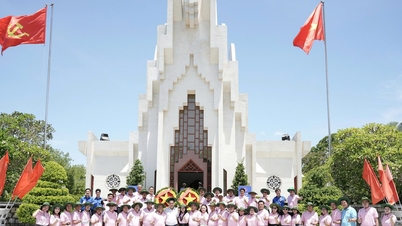
 The Ca Mau Cape National Tourist Area, featuring the Hanoi Flagpole, is a cultural and tourism highlight in the newly developed area of Ca Mau province after the merger. Photo: THANH MINH
In particular, transportation and logistics infrastructure are becoming important drivers for growth and enhancing the investment attractiveness of Ca Mau.
Currently, a series of key projects are being implemented, such as: the Can Tho - Ca Mau expressway, the Ca Mau - Dat Mui expressway, the Ha Tien - Rach Gia - Bac Lieu expressway, the route connecting the former administrative centers of Ca Mau and Bac Lieu provinces, and the southern coastal transport system. Upon completion, these projects will form a synchronized inter-regional network, shortening transportation times, reducing logistics costs, and enhancing the competitiveness of businesses.
In addition, the Ca Mau Airport upgrade project is being accelerated to meet the increasing demand for travel and cargo transportation.
The highlight is the approximately 18-kilometer-long, four-lane road project to Hon Khoai Island, along with the Hon Khoai dual-use multi-purpose port capable of receiving ships up to 250,000 tons. This is expected to become an important transshipment center for goods in the Mekong Delta region, opening up opportunities for strong development of the marine economy, logistics, and international trade.
In addition, the province is promoting many land reclamation projects, developing logistics and power transmission infrastructure, thereby expanding the land available for industrial, urban and service development along the coast in the future.
Energy creates momentum.



Energy continues to be identified as one of the breakthrough sectors, laying the foundation for Ca Mau's long-term growth.
Currently, the province possesses a gas-electricity-fertilizer complex with a 1,500 MW thermal power plant and a fertilizer plant producing over 1 million tons per year. At the same time, 16 wind power plants are in operation with a total capacity of nearly 900 MW, making a significant contribution to the national energy supply.
 The Ca Mau gas-electricity-fertilizer complex makes a significant contribution to the province's economy.
According to Mr. Huynh Cong Quan, Ca Mau has all the necessary conditions for the comprehensive development of various types of clean energy, from wind power and solar power to LNG power and new value chains such as green hydrogen and green ammonia.
The province has planned 34 wind power projects with a total capacity of over 2,300 MW; and is currently implementing the Bac Lieu LNG Gas Power Plant project with a capacity of 3,200 MW. These are strategically important projects in the process of forming a large-scale energy center for the region.
Studies show that the offshore waters of Ca Mau have an average wind speed of 6.3-7 m/s at an altitude of 80-100 m, allowing for the exploitation of over 16,000 MW of wind power potential. The average number of sunshine hours per year, ranging from 2,200-2,700 hours, along with over 454,000 hectares of aquaculture, creates favorable conditions for developing solar power combined with production, with a potential of approximately 11,500 MW.
With these outstanding advantages, Ca Mau is gradually asserting its position as an important renewable energy center of the country.
A favorable investment environment
Alongside the development of infrastructure and key economic sectors, the province places special emphasis on improving the investment and business environment for enterprises.
Mr. Huynh Cong Quan informed that the province is focusing on minimizing the time required to process procedures related to investment, land, construction, and the environment; and simultaneously implementing many policies to support businesses right from the project preparation stage.
Ca Mau proactively plans and creates clean land funds, investing in synchronous technical infrastructure such as electricity, water, and telecommunications... to help investors reduce initial implementation costs. Businesses also receive free support in carrying out business registration procedures, preparing investment projects, and accessing planning information.



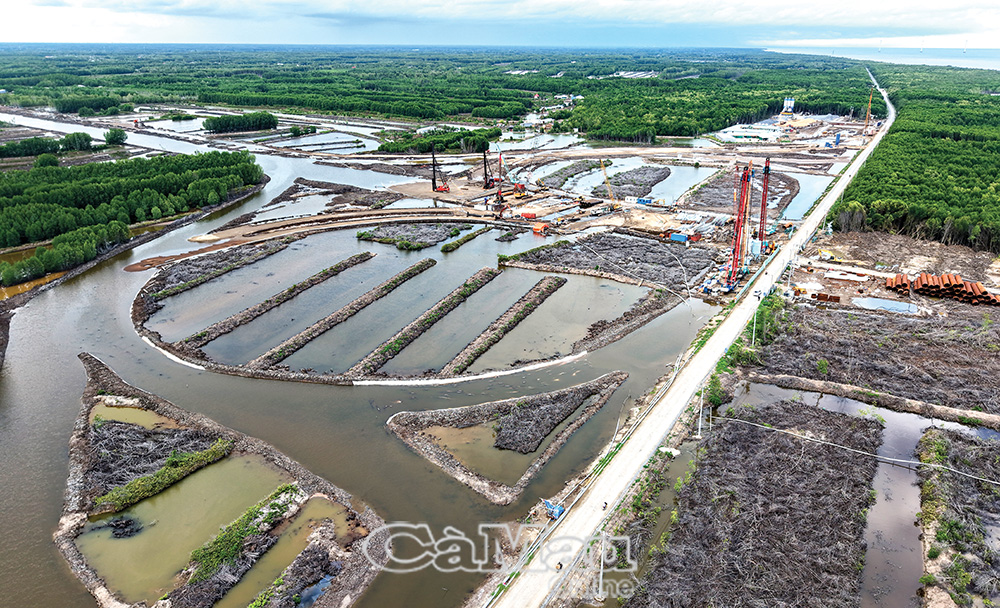 The Ca Mau - Dat Mui expressway ends at the point where the sea bridge connects to Hon Khoai Island. Photo: THANH MINH
Simultaneously, local budgets continue to be channeled through the Social Policy Bank to support small businesses, cooperatives, and household businesses in accessing preferential capital, contributing to the formation of an ecosystem of supporting businesses for large projects. In addition, the province fully and flexibly applies investment incentive policies as stipulated by the Central Government to areas with difficult and particularly difficult socio-economic conditions.
After one year of consolidation, Ca Mau is showing positive changes in development planning, infrastructure investment, and improvement of the business environment. With a determination to support businesses, proactively prepare resources, and build a favorable investment environment, this southernmost region of Vietnam is expected to become a strategic destination for high-quality capital and rise to become a new growth pole of the Mekong Delta in the new phase.
Hong Phuong
Source: https://baocamau.vn/khong-gian-moi-co-hoi-moi-a130085.html