Life's rhythm follows the ferry journey.
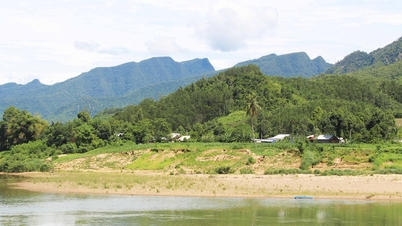
Seeing people waiting on the bank of Dong Cham village, Thuong Duc commune, the boatman quickly started the engine and steered his old boat across the Bung River to pick up passengers going to Dau Go village. Day after day, the boat silently travels back and forth, becoming the only link connecting the "island" of Dau Go with the rest of the commune. For many years, the rhythm of life for 80 households with nearly 400 people here has steadily flowed along with these boat trips.
Standing on the hillside, Mrs. Nguyen Thi Le (63 years old, Dau Go village) silently gazed across to the other side of the river. Though only separated by a stretch of river, what she had longed for for years was a bridge to connect the two banks. According to Mrs. Le, the sound of the ferry engine has become a familiar sound to the people of Dau Go for generations. Children born and raised here are also closely associated with the image of the boat rocking on the waves.

The rhythm of life in Dau Go village is closely linked to the small boat.
"The elderly, the sick, students, farmers... everyone has to take the ferry. Taking the ferry to the commune center is the only way. It's possible when the water is low and sunny, but it's impossible when the water is high. Traveling is very difficult and dangerous during the rainy season, and during floods, the entire village is almost completely isolated," Mrs. Le recounted.
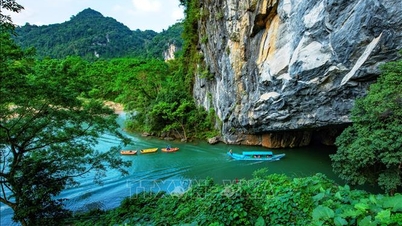
With one side nestled against the mountains and the other three sides surrounded by the Bung and Vu Gia rivers, Dau Go appears like an "oasis" isolated from the rest of the commune. Here, the people mainly live by cultivating acacia trees and pineapples. However, even the journey to bring agricultural products to market is extremely arduous.
After each harvest, each acacia tree and each truckload of pineapples is transported to the riverbank and loaded onto barges to be taken to the other side, where trucks can access and transport them for sale. This process alone significantly reduces the value of the agricultural products.
"If we sell at the same price as on the other side of the river, traders won't buy because they'll have to bear the additional transportation costs. So, we have to sell at a lower price. That's why sometimes we have a good harvest but the price isn't good," said Ms. Le Thi Bich Ngoc (66 years old).

Mrs. Le gazed towards the other side of the river, longing for a bridge to connect the two banks.

According to Ms. Ngoc, transportation difficulties also lead to income disparities. "With the same area of acacia trees, it's much easier to sell them where there's a road accessible by car. But here, you have to travel by boat, so the price is much lower. For example, 10,000 acacia trees on the other side might sell for about 100 million VND, while here they only fetch about 30-35 million VND, and even finding buyers is difficult," she explained.
Not only do children in Dau Go face the struggle for survival, but their journey to school also begins at the riverside. The village only has a combined preschool and primary school. To continue their education, they have to cross the river and travel dozens of kilometers to reach the secondary and high schools in the center of Dai Son commune, Dai Loc district, in the former Quang Nam province.
And so, at the beginning of the week, parents take their children to the ferry dock to return to the commune center to stay and attend school. At the end of the week, they return to the same dock, anxiously waiting for their children to come home. For many years, the journey to school for countless generations of students in Dau Go has begun with the sound of the ferry engine echoing through the early morning mist.
Waiting for the bridge to connect dreams.
The man who keeps the ferry running is Mr. Mai Van Thanh (44 years old). For nearly 20 years, his life has been intertwined with the water and the sound of the engine of his small boat. He hardly ever takes a day off, whether it's early morning or late at night; whenever the villagers call, he's there. "There's only one ferry in the whole village. When they call, it means there's an urgent matter, or someone is sick and needs to be taken to the hospital, so I can't be late," Mr. Thanh said.

A corner of Dau Go village
What worried him most were the days of heavy rain. The river swirled, muddy, and the rising water level almost paralyzed transportation. At those times, Dau Go became a literal "island." "Once, the ferry broke down right when people needed to cross the river. At that time, almost everything was turned upside down. Goods couldn't be transported out, and people who needed to cross could only stand and wait on the bank," Mr. Thanh recalled.
Having worked as a village health worker for many years, Ms. Ngoc still cannot forget the nights she spent helping villagers transport patients across the river for emergency care. Each ferry trip was a race against time. "Every time we took a patient down to the ferry, it was a moment of anxiety. We had to call the ferryman, get the patient across the river, and then continue on to the hospital. Each time, I felt so heartbroken," Ms. Ngoc said, her voice choked with emotion.
Ms. Ngoc believes that a bridge would not only shorten travel distances but also open up many opportunities for change for the people of Dau Go. With a bridge, ambulances could reach the village, agricultural products could be sold more easily, and children would have a safer journey to school.

Ms. Ngoc believes that a bridge opens up many opportunities for change for the people in the village.



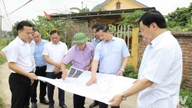
Mr. Phan Trung Phi, Chairman of the People's Committee of Thuong Duc commune, said that this area is at risk of flooding and landslides, so the local authorities have planned a resettlement area on the other side of the river to ensure long-term safety for the people. However, the people of Dau Go have wished to remain attached to the land where they have lived for more than 50 years, because it is where they have land for production and a livelihood.
"In the long term, once the people are resettled and settled, the local authorities will propose to higher levels of government to allocate resources to invest in building a bridge, creating conditions for people to go to Dau Go to resume normal production," Mr. Phi added.
In the middle of the Bung River, a ferry still silently crosses back and forth every day, but what the people of Dau Go are waiting for is not just the next ferry, but a bridge strong enough to connect the unfulfilled dreams of generations on the other side of the river.
Source: https://phunuvietnam.vn/khuc-tran-tro-ben-kia-song-bung-23826070209500616.htm