

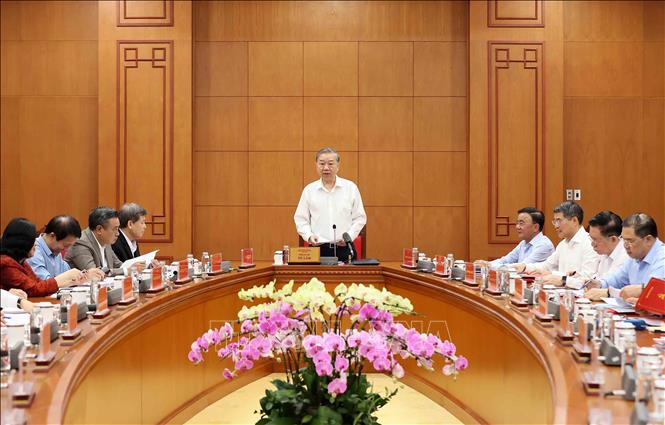
But now, as we enter a new phase, the demand for rapid and sustainable development requires a new approach that not only addresses issues strictly but also prevents them at their root, and protects those who dare to think and act, unlocking resources for national development.
Twenty years of consistent implementation of the Resolution of the 3rd Plenum of the 10th Central Committee of the Communist Party of Vietnam has shown that the fight against corruption, waste, and negative phenomena has shifted from awareness to action, from approach to method of handling, with clear, concrete, and measurable results. While in the early stages there were difficulties in proving acts of corruption, determining motives for personal gain, and recovering lost assets, the detection, investigation, prosecution, and trial processes have become increasingly systematic, coordinated, and effective. Many large, particularly serious and complex cases in sensitive areas such as land, finance, banking, securities, healthcare, and education have been handled rigorously, clearly affirming the principle of "no forbidden zones, no exceptions."
A notable development is the strengthening of discipline and order within the Party, and the tightening of power control. For the first time, the Party issued five regulations on controlling power and preventing and combating corruption and negative practices in personnel work; in Party inspection, supervision, and disciplinary enforcement; in investigation, prosecution, trial, and execution of judgments; in lawmaking; and in the management and use of public finances and assets.
These are not just individual regulations; they constitute an increasingly stringent system of "barriers" to prevent problems early and from afar, contributing to maintaining political stability, promoting socio-economic development, and strengthening public trust.
In terms of handling cases, the approach has also evolved. From primarily emphasizing strict penalties, it has now shifted to a combination of "strictness but also humanity and persuasion." Classifying and differentiating offenders, clearly demonstrating their motives for personal gain, and encouraging violators to proactively remedy the consequences have helped improve asset recovery and reduce losses for the State.
Another significant shift is the strong spread of influence from the central to the local level. The establishment of provincial-level Steering Committees has overcome the "hot at the top, cold at the bottom" situation, creating synergy throughout the entire system. Experience shows that where Party committees and leaders are decisive and exemplary, there is clear change and tangible, positive results. At the same time, the policy of trying fugitives who have fled abroad in absentia clearly demonstrates the determination to prevent criminals from escaping justice, increasing deterrence and warnings.
Besides combating corruption, the fight against waste is also given equal importance. The policy of decisively resolving the 12 underperforming and long-standing loss-making projects in the Ministry of Industry and Trade is a clear example.
Based on that experience, the Politburo has recently issued numerous documents and conclusions aimed at resolving obstacles for projects, especially those related to land. Notably, the requirement to complete the review and handling of delayed projects by the second quarter of 2026, assigning specific responsibilities to each locality, clearly demonstrates the spirit of "actions speak louder than words," clearly defining "the address, responsibility, and deadline," preventing resources from being tied up, and resolutely serving the goal of double-digit growth in the coming period.
These results show that the fight against corruption, waste, and negative practices over the past twenty years has become a "highlight" in the work of Party building and rectification. However, entering a new phase, the requirements do not stop there. The country has set a goal of high and sustainable growth, aiming to become a developed, high-income nation by 2045. Therefore, the requirement is not only to continue "cleaning up" but also to serve the goal of socio-economic development.
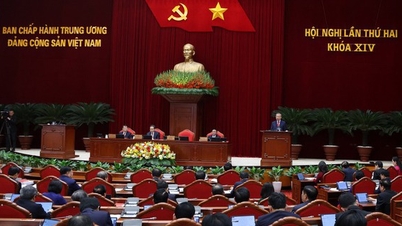
Therefore, Resolution No. 04-NQ/TW of the Second Plenum of the 14th Central Committee of the Communist Party of Vietnam determined that it is necessary to both "resolutely and persistently prevent, control, deter, and repel" corruption, waste, and negative phenomena, while simultaneously "promoting socio-economic development" to serve the goal of high and sustainable growth. Thus, combating corruption is not only a political task but also a driving force for development.
Another crucial and rigorous guideline set by the Central Committee for handling violations is "strict, timely, humane, and persuasive," while also "carefully considering the specific historical context," and basing decisions on political, economic, social effectiveness and national interests. This approach aims to protect innovators and creative individuals who dare to think and act for the common good, avoiding the situation of "fear of making mistakes and therefore not daring to act."
In the context of science and technology, innovation, and digital transformation as central driving forces, the Central Committee has set requirements for perfecting the legal framework to appropriately address objective risks. The policy of excluding or reducing criminal liability for cases without profit motives and proactively mitigating consequences is a necessary step to encourage innovation while maintaining strict discipline.
Notably, the Central Committee has decided to shift strongly from primarily "combating" corruption to "preventing it at its root," with four key solutions to address corruption in a way that is "unwilling," "impossible," "unafraid," and "necessary." This is a systemic, comprehensive approach aimed at tackling the root causes. The focus is on improving institutions and laws, enhancing transparency, controlling power, and building a culture of integrity throughout society. In particular, combating waste requires a strong breakthrough and is an urgent requirement. This involves not only saving on expenditures but also preventing the waste of material resources, time, and development opportunities. Reviewing and addressing stalled projects and removing obstacles to "unlock resources" directly linked to growth targets is a new and practical approach.
Resolution 04 of the Central Committee clearly emphasizes the crucial role of the leader. Practical results show that the effectiveness of preventing and combating corruption depends greatly on the responsibility and integrity of Party committees, Party organizations, and leaders. Therefore, it is not only necessary to strictly punish those who allow violations to occur, but also to have mechanisms to protect and encourage leaders to proactively detect and handle violations early and from afar.
Another noteworthy point is the implementation method. The resolution goes beyond mere direction, concretizing it with 8 key tasks and 114 specific tasks, each linked to a clear roadmap, deadline, and expected outcomes. This represents a step forward in leadership methods, ensuring that policies are put into practice and avoiding vagueness and formality.
It is evident that the fight against corruption, waste, and negative practices has entered a new phase of development. This phase involves both resolute and persistent struggle, proactive prevention, and the creation of an environment conducive to development.
We know that fighting "internal enemies" is never easy. But with determination proven in practice, with increasingly systematic, scientific, and specific approaches, and with the unity of the people, we have reason to believe that this struggle will continue to achieve more solid results, contributing to building an honest, transparent, and modern governance system and a sustainably developed country.
Source: https://baotintuc.vn/thoi-su/kiem-soat-quyen-luc-chan-tham-nhung-tu-goc-20260502071014456.htm



















































































Comment (0)