According to economic experts, 2025 will present certain pressures on exchange rate trends, mainly due to the continued strength of the US dollar and the persistent interest rate cuts by central banks in many countries to stimulate economic growth. Therefore, controlling exchange rate stability throughout the year is seen as continuing to face significant difficulties and challenges for the State Bank of Vietnam.
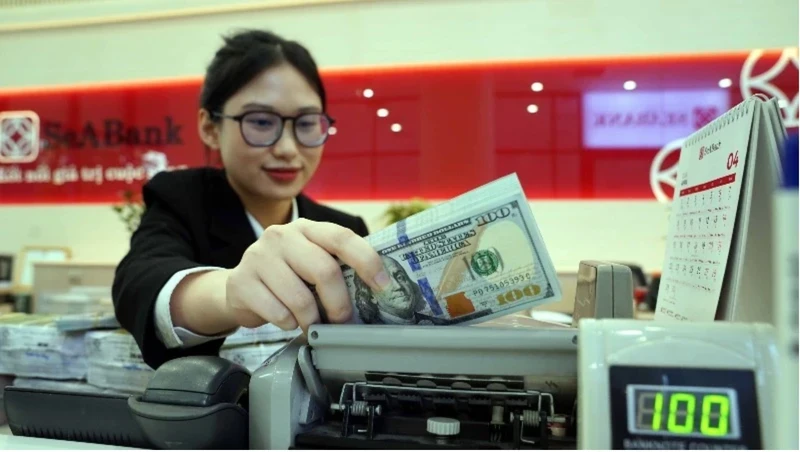
International analysts believe the recent sharp rise in the value of the US dollar is due to... US Federal Reserve The Federal Reserve (FED) is expected to cut interest rates by a total of only 1 percentage point twice in 2025, instead of the four cuts announced in September 2024. Notably, the DXY index (a measure of USD strength) on the international market has surpassed 108.6 points and is at its highest level in over two years... Global pressures have been putting significant pressure on the domestic exchange rate.
Flexible management
At the beginning of 2025, the State Bank of Vietnam made significant adjustments to the foreign exchange market. Accordingly, in the trading sessions on January 3rd and 6th, instead of only selling spot USD at the exchange rate of 25,450 VND, the State Bank of Vietnam offered forward contracts (with cancellation options) at the same price. Credit institutions and branches of foreign banks were allowed to cancel forward contracts entirely or partially before the maturity date. Contracts valued at 100 million USD or more could be canceled a maximum of 3 times, while those under 100 million USD could be canceled a maximum of 2 times.
According to some analysts, this price is reasonable as there is no significant difference from the market price. On the other hand, experts also appreciate the adjustment move by the State Bank of Vietnam, especially in the context of a volatile market at the end of 2024. The provision of forward foreign exchange sales contracts (with cancellation) sends a strong message from the regulator in maintaining exchange rate stability around VND 25,450/USD, while dispelling market expectations that the State Bank of Vietnam would increase the intervention selling price.
Looking back at the whole of 2024, the exchange rates of Vietnam and other emerging and frontier markets were under pressure, with some markets experiencing a 10-12% decline compared to the beginning of the year. |



Looking back at the whole of 2024, the exchange rates of Vietnam and other emerging and frontier countries were under pressure, with some markets experiencing declines of 10-12% compared to the beginning of the year. Vietnam is one of the markets with a very high degree of economic openness in terms of exports and imports. From June to December 2024, the interbank exchange rate consistently hit its ceiling. However, overall for the year, Vietnam's exchange rate decreased by about 5%, much less than other countries in the region, which is a success.
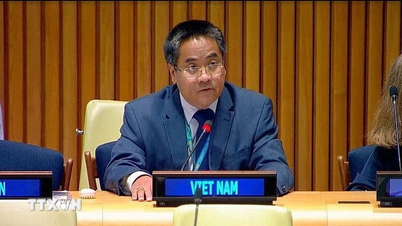
According to Deputy Governor of the State Bank of Vietnam, Dao Minh Tu, in 2024, the State Bank managed the exchange rate flexibly and appropriately, contributing to absorbing external shocks; at the same time, coordinating monetary policy tools in a synchronized manner. As a result, the foreign exchange market remained stable, foreign exchange liquidity was smooth, and the foreign exchange needs of the economy were fully met; the exchange rate fluctuated flexibly in both upward and downward directions, in line with market conditions. “By the end of 2024, the exchange rate increased by approximately 5.03%, maintaining stability, harmony, and balance of foreign exchange in the economy, ensuring that exports, imports, businesses, and investors have nothing to worry about in terms of speculation or hoarding foreign currency,” Mr. Tu stated.
Proactive response to changes
Economic experts believe that the US entering a new term, along with global trade tensions and potential risks, could affect the Vietnamese Dong (VND) due to the country's tax policies. A macroeconomic report published by Rong Viet Securities Joint Stock Company (VDSC) estimates that in 2024, the State Bank of Vietnam will sell approximately US$9.4 billion to stabilize the exchange rate.
Looking ahead to 2025, many uncertainties regarding the tariff policies of President-elect Donald Trump's administration could increase the value of the USD and put pressure on the exchange rate. Nguyen Thi Phuong Lan, Director of Research at VDSC Analysis Center, believes that in 2025, with the continued erosion of foreign exchange reserves and the unsustainable ability to attract/retain foreign currency flows, the VND/USD exchange rate will fluctuate within a range of +/-5% and end the year at 26,200 VND/USD.
“A review of factors affecting the strength of the USD indicates that the USD may continue to be strong in 2025. Therefore, controlling exchange rate stability in 2025 will be more difficult than easy for the State Bank of Vietnam. The biggest challenge is that foreign direct investment (FDI) disbursements are only just enough to cover profits repatriated, and the pressure on USD demand remains high as US interest rates remain high while foreign exchange reserves have decreased sharply,” said Ms. Nguyen Thi Phuong Lan.
Sharing the same view, Vietcombank Securities Company (VCBS) believes that there will be certain pressures on the exchange rate trend this year, stemming from the continued strength of the US dollar and the possibility that central banks of many countries will persist in their policy of lowering interest rates to stimulate economic growth. However, the extent of the cuts will depend on the context of each country. In addition, geopolitical conflicts will cause investors to seek safe-haven assets, including the US dollar.
But overall, there are still many positive factors for Vietnam's foreign exchange market in 2025, namely attracting FDI and remittances. |



However, overall, there are still many positive factors for the Vietnamese foreign exchange market in 2025, namely attracting FDI and remittances. At the same time, strong growth in exports and imports, with a projected continued large trade surplus amidst the recovery of major economies, is also a "plus" for the exchange rate this year.
Furthermore, under pressure from international markets, coupled with the fact that the VND/USD exchange rate at banks remains high, analysts predict that to reduce exchange rate pressure and control inflation, the State Bank of Vietnam may have to raise the policy interest rate in 2025 to avoid putting pressure on foreign exchange reserves, having already sold a large amount of USD in 2024.
According to economic expert Dr. Nguyen Tri Hieu, if the exchange rate rises sharply, inflationary pressure in Vietnam will also increase. Given this situation, the State Bank of Vietnam needs to shift its monetary policy, including raising interest rates, along with other policies to reduce pressure and control inflation. This shift may be a necessary step to stabilize the macroeconomic situation amidst global volatility.
A representative from the State Bank of Vietnam stated that the bank is always ready to sell foreign currency, but this depends on market developments, especially the VND/USD exchange rate in the interbank market. Commercial banks will register to buy USD from the State Bank of Vietnam and then resell it to customers as needed. “In 2025, the State Bank of Vietnam will continue to closely monitor market conditions to manage the exchange rate flexibly and appropriately, coordinating synchronously with monetary policy tools, contributing to controlling inflation and stabilizing the macroeconomy,” Mr. Dao Minh Tu affirmed.
Source