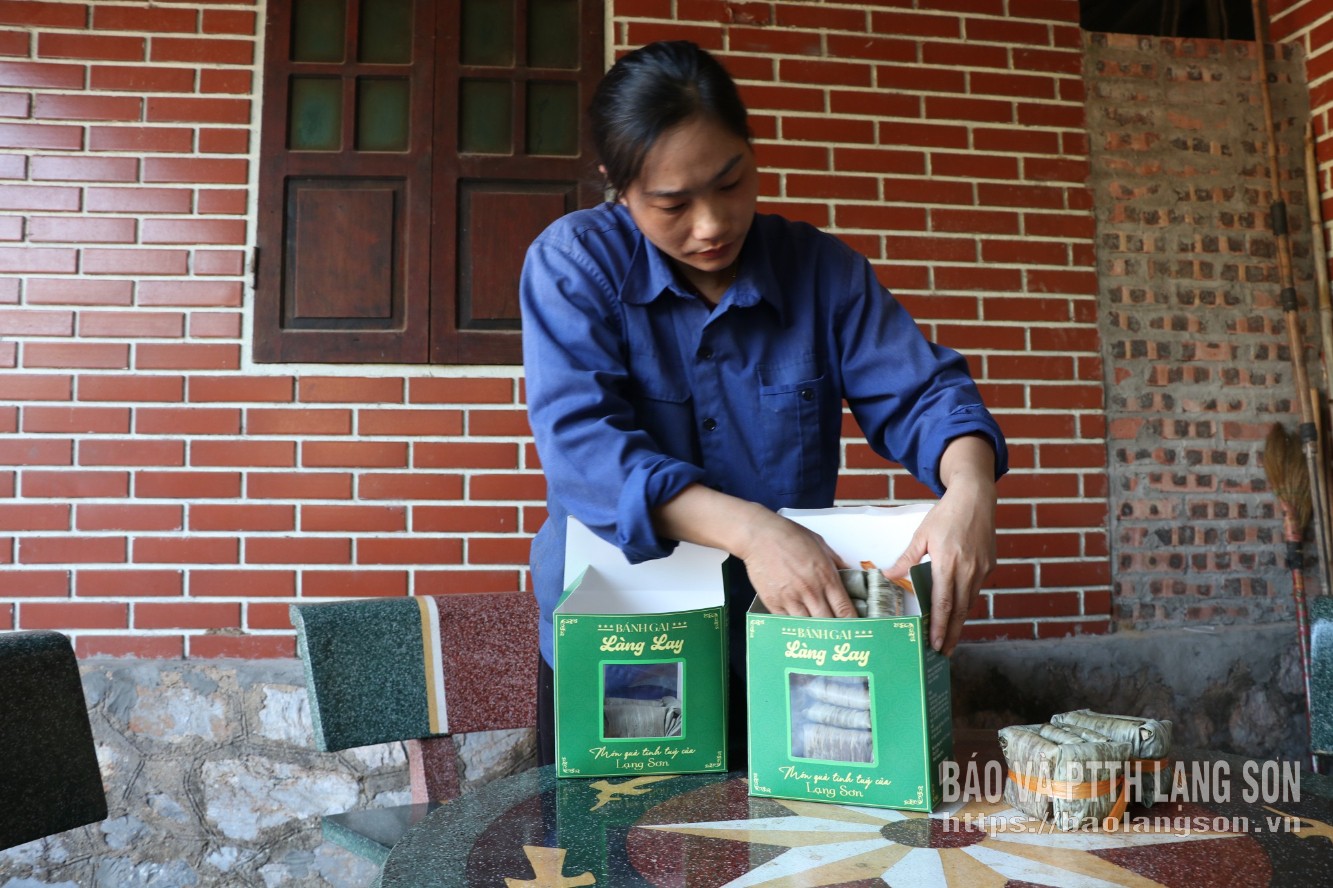
Banh chung (Vietnamese sticky rice cake) is an indispensable traditional dish during every holiday and Tet (Lunar New Year) celebration in the province. Recognizing the increasing market demand, in recent years, the family of Ms. Nguyen Thi Hang in That Khe commune has developed the banh chung making business towards commercial production.
Ms. Hang shared: "I've been making traditional banh chung (Vietnamese sticky rice cake) since 2010, but only in small quantities. For the past five years, I've added banh chung with peanut filling and banh chung with gac fruit and honey. To improve quality and build a brand for the product, in 2024, I proactively participated in the OCOP program. Accordingly, I focus on the ingredients used, ensuring food safety and hygiene, and investing in a vacuum packaging machine to preserve the product for longer. In addition, we've developed complete packaging and labeling for the product. After the banh chung product received OCOP certification, the number of customers increased significantly. Currently, on average, my family produces and sells 6,000 banh chung annually, generating an income of over 120 million VND after deducting expenses."
Besides sticky rice cakes (bánh chưng), the "khau sli" product of Ms. Ha Thi Diem from Yen Phuc commune is also gradually establishing its brand in the market. Ms. Diem shared: "With the desire to build a brand for my product, in 2024, I proactively completed the criteria to have the product meet OCOP standards. When participating in the program, I received support in brand building, packaging design, and product promotion. Previously, 'khau sli' cakes were mainly sold to customers within the province, but now they have been introduced at many fairs and trade promotion events inside and outside the province. In the past two years, the production and sales of more than 50,000 packages (an increase of about 15-20% compared to the time before participating in the OCOP program) have reached a revenue of 700 million VND."
According to statistics from specialized agencies, to date, 12 traditional cakes in the province have been recognized as 3-star OCOP products, including: gio cake, gai cake, baked cake, nga toi cake, khao cake, ngai cake, etc. In reality, brand building has created a positive shift for traditional cake products. Previously, many products were produced on a small scale with simple packaging, making them difficult to compete in the market. Now, there has been a clear change. According to assessments by specialized agencies, traditional cake products that have achieved OCOP standards have seen an average increase in value of about 10% compared to before.
In addition, many businesses have applied information technology in advertising and sales on digital platforms, helping to expand their consumer market.
Mr. Hoang Van Chieu, Deputy Director of the Department of Agriculture and Environment, said: "For traditional confectionery products, being recognized as an OCOP product not only contributes to increasing economic value but also helps preserve and promote the unique cultural features of the locality. In the coming time, the department will continue to coordinate with the commune authorities to guide producers in perfecting production processes, improving product quality, boosting trade promotion, and expanding consumption markets."
It can be said that developing traditional confectionery products that meet OCOP standards is not only an effective direction in rural economic development but also contributes to preserving long-standing cultural values and promoting the image of the homeland to tourists inside and outside the province.



Source: https://baolangson.vn/khi-banh-truyen-thong-co-thuong-hieu-5097460.html