

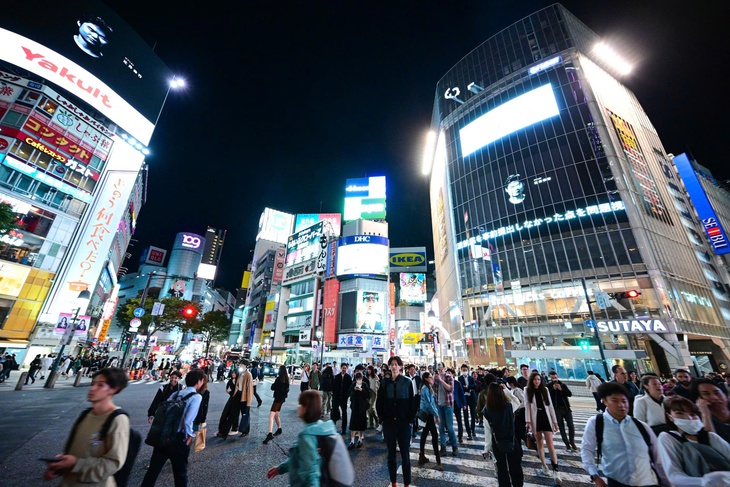
Japanese nightlife districts are "noisy with lights and crowds" rather than "noisy with sound" - Photo: QUANG DINH
Unlike the noisy and bustling scenes in many countries, nightlife areas in Japan are developed in an orderly, well-controlled manner and in harmony with the lives of the local population.
Major cities in the Land of the Rising Sun have built diverse nightlife ecosystems: from food and entertainment to shopping and traditional culture.
It's a street for drinking, but why isn't it too noisy?!
Shinjuku is one of the busiest entertainment districts in central Tokyo, offering a wide range of services: from restaurants and izakaya (Japanese pubs) to small bars, nightclubs, and entertainment venues.
In the narrow streets of this area, visitors can easily find small, private bars (Golden Gai) or shops specializing in traditional Japanese cuisine, all in small spaces but with a distinct Japanese cultural atmosphere. Customers line up orderly in front of the bars, waiting for their turn to be served; there is no crowding or commotion.
According to travel companies, Japan's tourism industry is developing its night-time economy by enhancing cultural experiences through festivals, traditional night-time performances, and applying technology in management and services to improve visitor experience and management efficiency.
In the context of increasingly popular independent travel , coupled with strong support from digital platforms, if a city has truly well-developed and attractive night-time economic products, tourists will naturally seek them out because they can easily access them through online service sales platforms. The problem is that currently, after around 7-8 PM, many tourists, including those on organized tours, still find themselves without a clear path to go or do anything other than eating, drinking coffee, or visiting bars recommended on online communities.
Singapore, a country close to Vietnam, has also demonstrated successful development of its night-time economy by creating destinations for major music festivals (concerts). Almost every month, this island nation hosts concerts featuring international artists. This is the basis for Singapore being ranked 6th among the world's most attractive destinations and second in East Asia according to HelloSafe's Attractivity Index 2026.
Mr. Nguyen Huu Y Yen, chairman of Saigontourist Travel, pointed out the reality: "Why do Hoi An, Phu Quoc, and Nha Trang all have impressive night shows that become highlights in tourists' itineraries, while Ho Chi Minh City, a large city rich in identity and creativity, lacks iconic night cultural products?"
According to Mr. Y Yen, evening cultural and artistic performances not only generate direct revenue but are also the most effective form of destination marketing, helping tourists conclude a day of sightseeing with memorable and emotionally rich experiences.
"We need to abandon the simplistic idea that simply opening more small food and beverage establishments constitutes the night-time economy. For the night-time economy to succeed, it requires a comprehensive plan, a leading brand, and accompanying cultural programs to create its own unique identity."
"For now, we need to utilize existing resources and prioritize their exploitation instead of letting resources be dispersed or waiting for too long as has happened in the past," Mr. Yen suggested.
What can we do to make customers "spend all their time and money"?

Ho Chi Minh City tourism is bustling with restaurants and shops lining the streets, inviting visitors - Photo: QUANG DINH
Ms. Tran Thi Bao Thu, Director of Marketing and Communications at Vietluxtour Travel, stated that there is a current situation where some programs and products that could attract tourists at night are not offered regularly, and even night cruise tours, despite being new, are still considered not particularly outstanding.
For domestic tourists, nighttime tourism programs need to have a compelling message and unique features to attract participation; otherwise, tourists may participate on their own, but only in a few isolated nighttime services.
"We also strive to create unique offerings so that tourists who enjoy river cruises will experience a different Saigon, while those who prefer strolling through the streets will see a different side of Saigon. In addition, tourists who love nightlife, those who appreciate culture and art, those who enjoy relaxing their minds and bodies through activities like yoga, meditation, and therapeutic massage, and those who enjoy shopping... all need diverse and attractive products to help them make the most of their time and budget during their trip to Ho Chi Minh City," Ms. Thu shared.
Tourism and travel businesses say they expect greater diversity and consistent quality of new tourism services and infrastructure in the city to fully develop nighttime tourism products.
According to a proposal from the Ho Chi Minh City Institute for Development Studies (HIDS), developing night-time tourism in the city center requires a specialized agency for the night-time economy to coordinate policies and ensure collaboration among stakeholders. However, each locality needs to develop a model that suits its specific economic and cultural characteristics and development priorities, rather than mechanically copying existing models.
"It is necessary to establish flexible mechanisms to mobilize the contribution of ideas and resources from the entire society. Through this, a sustainable, harmonious, and inclusive night-time economic ecosystem can be formed," the institute representative stated.
Developing the night-time economy - A driving force for Ho Chi Minh City's growth.
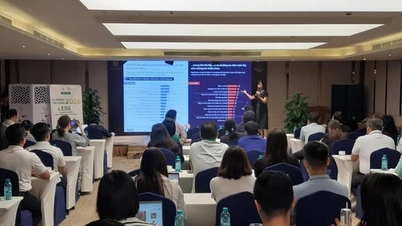
To identify "bottlenecks" and unlock resources for the night-time economy, Tuoi Tre newspaper and the Ho Chi Minh City Culinary Association jointly organized an in-depth seminar on the topic "Developing the Night-Time Economy - A Driving Force for Ho Chi Minh City's Growth" on March 25th in Ho Chi Minh City.
The event took place against the backdrop of Ho Chi Minh City's ongoing development of a Law on Special Urban Areas, along with a resolution on special mechanisms, creating opportunities for the city to proactively plan, attract investment, and develop its night-time economy.
The seminar was attended by leaders of departments and agencies, policymakers, leading economic experts, the Ho Chi Minh City Culinary Association, and representatives of major businesses such as Saigontourist Group, Satra, Vietravel, Viettel, etc.
Here, experts will focus on discussing spatial planning challenges, diversifying cultural and artistic products with unique identities, and listening directly to recommendations from businesses regarding policies for developing the night-time economy.
This important forum also introduced successful night-time economy models around the world, thereby proposing an effective pilot roadmap to help make the night-time economy a growth driver for Ho Chi Minh City.

Source: https://tuoitre.vn/kinh-te-dem-o-tp-hcm-dung-de-cho-doi-them-20260325123353027.htm
























































































Comment (0)