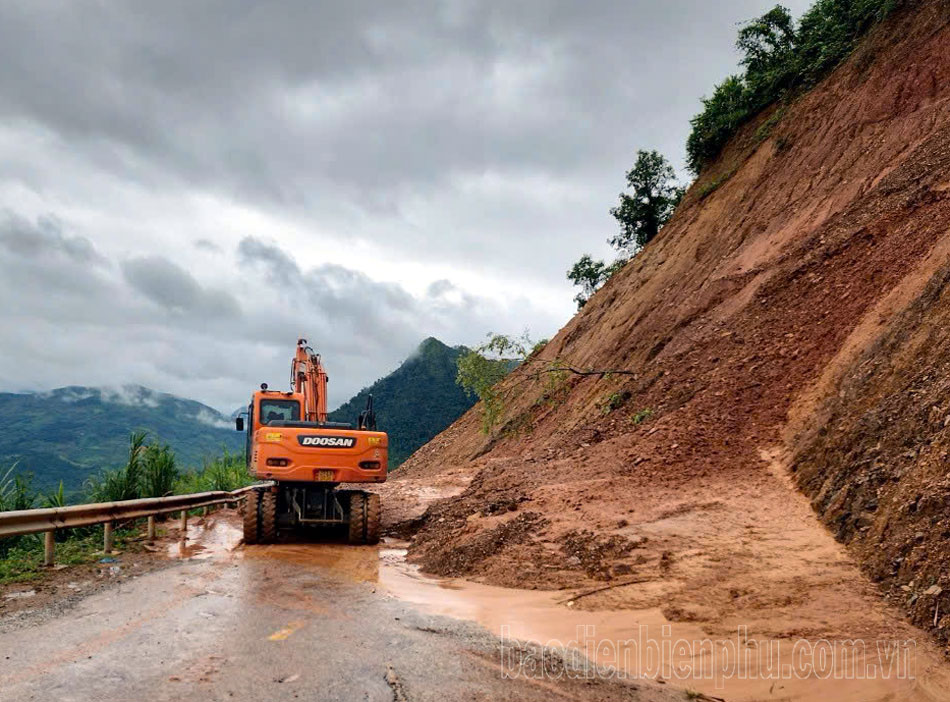
As a mountainous province with a fragmented terrain, steep slopes, and many roads crossing submerged bridges and culverts over streams, landslides and road blockages frequently occur during the rainy season. In the two recent storms, in addition to flash floods that killed and left seven people missing in Muong Pon commune, Dien Bien district, the province also suffered significant damage to its transportation infrastructure (national highways, provincial roads, district roads, etc.). Hundreds of locations along these routes experienced landslides, blocked drainage ditches, eroded bridges and culverts, and damaged road surfaces, resulting in losses of hundreds of billions of dong.
Proactively addressing and ensuring traffic flow in all situations, the Department of Transport has implemented numerous solutions and directed road maintenance and management units in the province; district-level People's Committees; and businesses and contractors currently constructing roads to proactively prepare machinery, materials, and personnel to ensure traffic safety. As a result, during recent heavy rains, especially at the end of July, despite the impact of the remnants of Typhoon No. 2, widespread heavy rains, and serious landslides on most roads, traffic flow remained stable. Vehicles and goods circulated normally; there were no shortages of essential goods serving the lives of people in mountainous and border areas.
During recent heavy rains and floods, in addition to landslides involving hundreds of cubic meters of soil and rocks, which were promptly addressed by road maintenance units and district authorities, dozens of major landslides occurred across the province (on national and provincial roads), resulting in the declaration of a natural disaster emergency. The most severe damage occurred on National Highway 6 (Tuan Giao - Muong Lay), National Highway 12 (Muong Cha - Muong Lay), and National Highway 4H (Muong Cha - Muong Nha)... Road maintenance units such as Road Construction Joint Stock Company 226 and Road Construction Joint Stock Company II have mobilized numerous vehicles, machinery, and personnel to be on duty 24/7 to ensure road reopening as quickly as possible. They have also proposed solutions. We propose that the higher authorities promptly allocate additional funds to construct the project components, ensuring they are sturdy and secure, and to avoid impacting people using the roads or households and communities living along the transportation routes during prolonged periods of heavy rain and flooding.


Transportation is likened to the bloodstream that nourishes the body. A smooth-flowing bloodstream, free from blockages, means a healthier and stronger body. "Unobstructed roads and trade" mean the economy doesn't stagnate but instead thrives, aligning with the province's annual GRDP growth targets. Therefore, in all situations, the transportation sector and the governments of districts and towns need concrete and clear solutions to avoid localized traffic congestion that occurs on a large scale and lasts for many days.
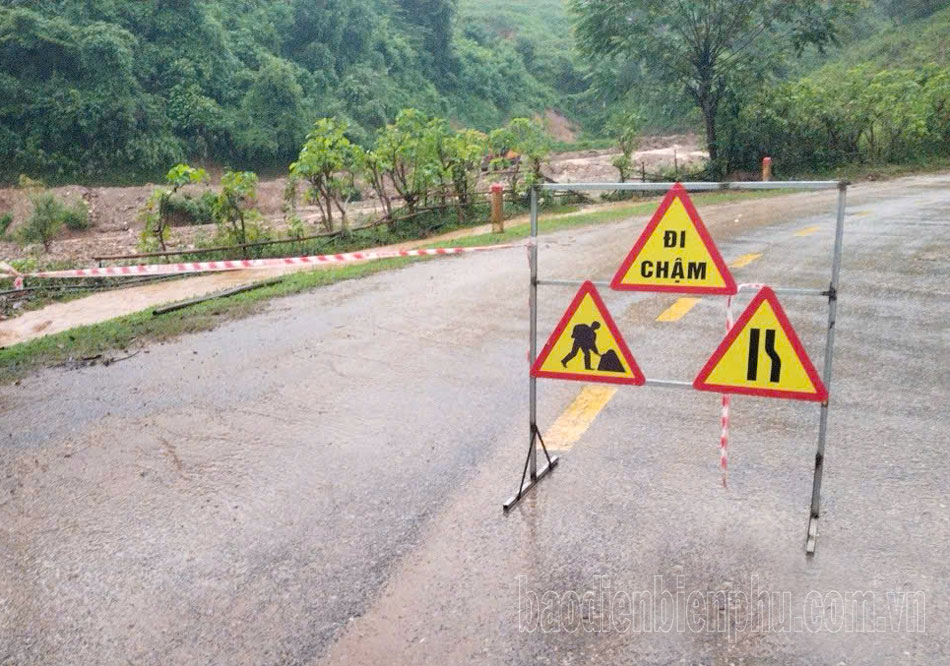
At the beginning of the rainy season, before, during, and after potential storms affecting our province, the Department of Transport needs to effectively implement the "four on-the-spot" principle, promptly directing relevant units and contractors responsible for regular maintenance and management to assign personnel to man checkpoints, erect barriers and warning signs at both ends of damaged sections and flooded areas, and immediately carry out disaster relief and traffic congestion management.
In areas with major landslides and severe damage, it is requested that the competent authorities promptly declare a state of emergency due to the natural disaster; issue an order for the construction of emergency works to mitigate the consequences of the natural disaster, thereby providing a basis for implementing subsequent steps in accordance with the law.



Currently, on national highways, provincial roads, district roads, etc., there are still many locations with landslides on both the positive and negative slopes, and cracks appearing in the road surface; the situation of soil and rocks rolling down onto the roadbed and surface occurs frequently. Therefore, the Department of Transport; the People's Committees at the district level; and road maintenance units need to proactively develop plans, flexibly implement solutions, promptly stockpile and gather sufficient materials and specialized machinery, and deploy personnel appropriately to ensure traffic safety in all situations.
Source: https://baodienbienphu.com.vn/tin-tuc/kinh-te/218293/kip-thoi-khac-phuc-su-co-giao-thong































![[Photo] Thousands of people participate in a run to show their support for the campaign "Sharing a common determination to build drug-free communes, wards, and special zones".](https://vphoto.vietnam.vn/thumb/1200x675/vietnam/resource/IMAGE/2026/06/27/1782554475933_0673e2a3df7b5e25076a-8283-jpg.webp)