Although the Muong people are not as numerous as in Hoa Binh or Thanh Hoa provinces, with only a small community of over a thousand people, the craft of weaving and the patterns on their products are still preserved. This affirms the presence of their culture within the multi-ethnic landscape of Quang Nam province. It also demonstrates cultural exchange: Muong patterns blend with the influences of the Co Tu and Xe Dang people, creating a unique character.
Traditional weaving
When people think of the Muong people, they often picture stilt houses, Muong folk songs, and vibrant folk festivals. But there is a less-mentioned aspect of their heritage, yet deeply imbued with their cultural essence: the craft of weaving – a traditional craft that has been intertwined with the lives of the people for generations.
Artist Phan Cam Thuong believes that, according to the ancient Muong language, Muong (Muang) means a land, an area inhabited by the Muong people. During the French colonial period, Hoa Binh province was called Muong province. Hoa Binh had four famous large Muong: Nhat Bi, Nhi Vang, Tam Thang, and Tu Dong – that is, Muong Bi (Tan Lac), Muong Vang (Lac Son), Muong Thang (Cao Phong), and Muong Dong (Kim Boi). He argues that the Muong people lived entirely dependent on nature; most of their tools were made from bamboo, wood, and clay. There was very little iron in their tools, and their iron-making skills were not highly developed.
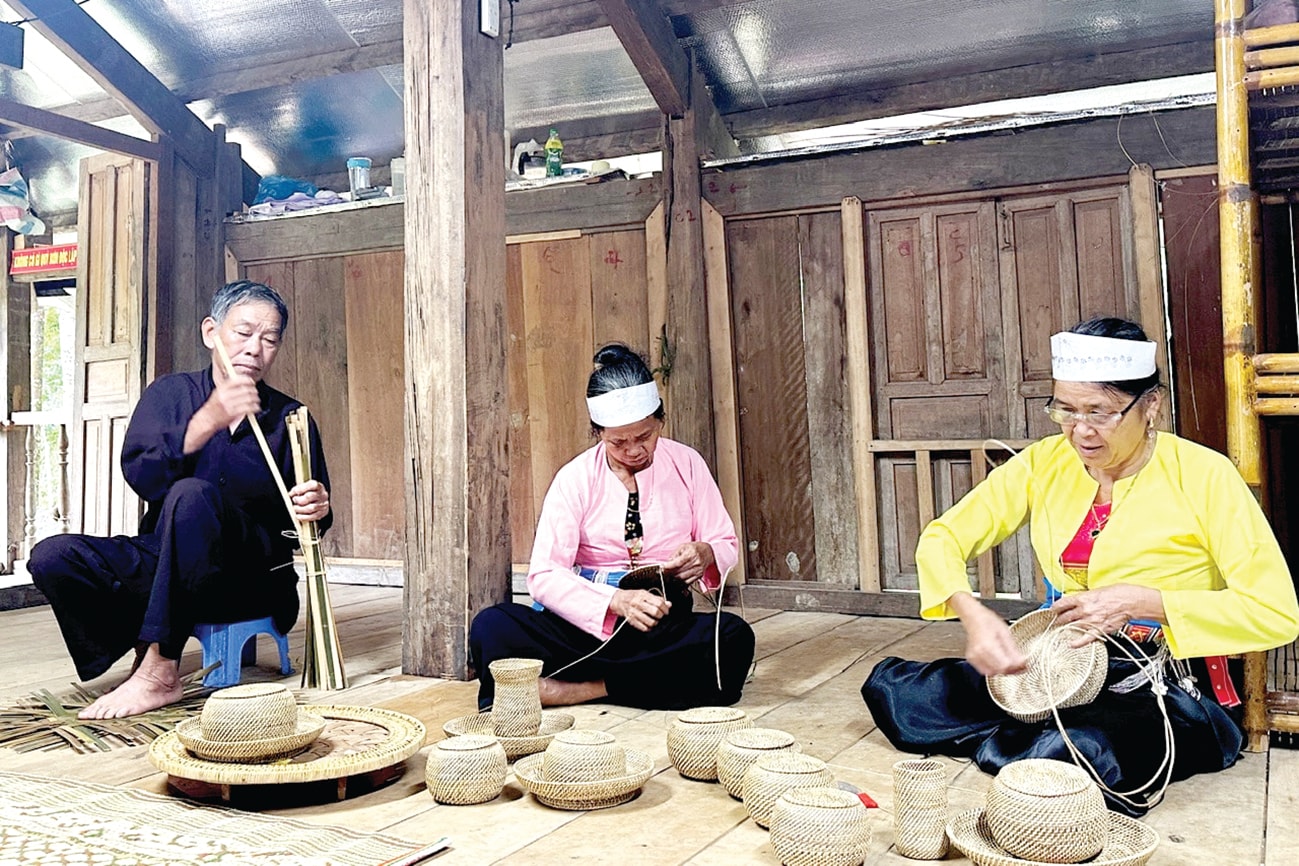
In the life of the Muong people, bamboo and rattan are essential materials for everything from baskets, mats, and winnowing trays to rice containers and hunting tools. Basket weaving has become a popular craft in the Muong communities. The pinnacle of weaving is the summer tray, which is used only for offerings. The rim of the tray is woven from rattan.
Basket weaving is usually done by elderly farmers; the older they get, the better their weaving skills become, until they are too weak to do it anymore. From a young age, Muong children are taught to weave naturally.
"Once the woven items are finished, they are usually hung in the attic above the kitchen – the central hearth in the house, where the fire is never extinguished – to dry and absorb smoke and soot until they become black and shiny. These smoked woven items are highly durable, water-resistant, and termite-proof," wrote artist Phan Cam Thuong.

Pattern - Message
In Quang Nam province, home to the Muong ethnic community, woven products not only meet daily living needs but also carry a unique language of patterns, reflecting their worldview , philosophy of life, and rich cultural memories.
Nature, fruits, pottery... inspire the shapes of Muong woven goods. Researcher Phan Cam Thuong believes this is the result of thousands of years of contact with plants in the forest, with rivers and streams, and with the land. The shapes of the woven goods seem to have been born naturally from the forest.
But what makes it unique is not just its functionality, but the intricate patterns interwoven on its surface.
The patterns of the Muong people are often geometric. The rhombus symbolizes terraced rice fields, representing the hope for abundant harvests. The zigzag lines evoke the image of towering mountains, representing the protective power of nature.
The mesh and netting symbolize cleverness and vigilance, and are also considered a "charm" to ward off evil spirits in folk beliefs. Floral and animal motifs express belief in fertility and continuity. Each motif is a message, a substitute for words, reminding descendants of their origins and the harmonious relationship between humanity and nature.
The Muong people's weaving craft not only creates everyday objects but also serves as a means of religious practice. Many products with unique patterns are used in festivals and rituals. For example, at weddings, a basket with a diamond pattern is a gift symbolizing prosperity. In agricultural festivals, winnowing baskets are carved with waves, praying for favorable weather. In fertility rituals, woven patterns of pairs or repetitions express belief in procreation and the continuation of the lineage.
The Muong people in Tra My often choose mature bamboo, sturdy reeds, and flexible rattan from the forest for weaving. The process of shaping the strips and splitting the fibers requires patience. To create patterns, the craftsman must calculate the number of strips and fibers and how to interlock them.



When knitting, they change the direction and cross-weave of the yarn to create diamond, lattice, or interweave colors (yarn dyed from tree bark and forest leaves) to highlight the patterns. It's a combination of technique and aesthetics – transforming rustic objects into products that are both durable and artistically valuable.
Today, the woven products of the Muong people not only serve daily life but are also incorporated into community tourism, becoming popular handicrafts among tourists. Many young people are also creating innovative products such as handbags, decorative lamps, and interior furnishings.
The bamboo strips thus tell the story of the Muong people in Quang Nam province...
Source: https://baodanang.vn/ky-hieu-cua-ban-sac-muong-3305238.html

![[Image] National conference summarizing one year of operation of the overall organizational model of the political system, the three-tiered government model.](https://vphoto.vietnam.vn/thumb/1200x675/vietnam/resource/IMAGE/2026/07/01/1782882811691_ndo_br_1-jpg.webp)