

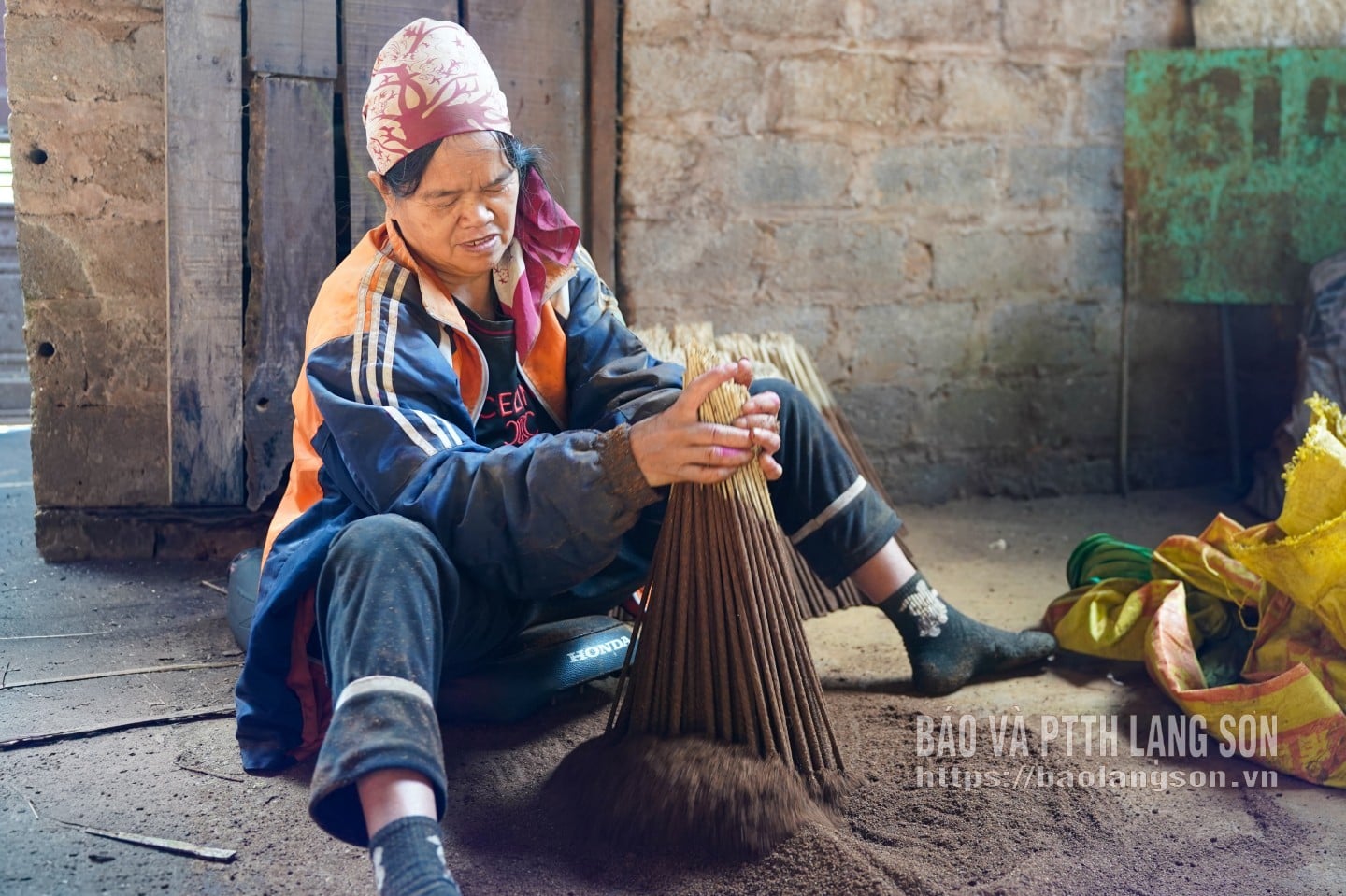
We had the opportunity to visit the North Nga area, Ky Lua ward, in the days leading up to the Lunar New Year. The atmosphere there was bustling and busy, with everyone preoccupied with their work.
Ms. Luong Thi Cuong, a resident of Bac Nga hamlet, said: "My family has been involved in incense making for over 20 years. As Tet (Lunar New Year) approaches, the workload increases, and all stages must be carried out continuously to meet delivery deadlines."
Incense production is done entirely by hand. The main ingredients are sourced from nature, such as bamboo, apricot blossoms, sticky leaves (also known as butter leaves), and various types of wood chips readily available in nature, such as pine, teak, mahogany, and jackfruit wood. The incense-making process does not use chemicals, ensuring safety and preserving the characteristic natural fragrance.
Observing the women in the incense-making village, from the elderly ladies to the younger ones, their hands working rhythmically, opening the bamboo strips into funnel shapes to mix the powder, then neatly closing them, many might mistakenly think this work is simple. However, to roll bundles of incense sticks that are straight, round, and uniform, the craftsmen must undergo a long training process, mastering each movement and possessing skill and patience in every step.
Ms. Nong Thi Bich, a resident of Lien Hoa block, Ky Lua ward, shared: "On average, my family makes about 3,000-4,000 incense sticks per day. This is a family tradition, passed down through many generations. The incense-making work is mainly done by women, as each step requires skill, meticulousness, and patience. We maintain this profession year-round, and especially during the period leading up to Tet (Lunar New Year), the production pace becomes even more urgent to meet market demand."
Sharing with reporters, Ms. Vu Bich Ngoc, a tourist from Thai Nguyen province, said: "I'm originally from Lang Son , and every time I visit my family, I stop by Ky Lua market to buy incense. The incense production process here uses entirely natural ingredients, without any chemical preservatives, so I feel reassured and confident when choosing their products."
According to our research, over 50 households in Ky Lua ward still maintain the traditional incense-making craft, mainly concentrated in Bac Nga hamlet. The finished incense products are sold through various channels, with some retailed at traditional markets and the rest wholesaled to traders. The price of finished incense currently ranges from 20,000 to 50,000 VND per bundle, depending on quantity and type, contributing to a stable income for many families involved in the craft.
Mr. Nguyen Thanh Nguyen, Head of the Economic and Infrastructure Department of Ky Lua Ward, said: "During the Lunar New Year every year, the demand for incense increases significantly, so people in the area focus on boosting production to meet market demand. In the coming time, Ky Lua Ward will continue to pay attention to, create favorable conditions, and accompany people in maintaining and developing the traditional incense-making craft, contributing to job creation and increasing income for the people."
Amidst the increasingly hectic pace of modern life, the image of women diligently rolling incense sticks persists as a testament to the vitality of this traditional craft. Each incense stick not only fulfills spiritual needs during Tet (Lunar New Year) but also embodies the hard work, dedication, and commitment of generations to this inherited profession.
Source: https://baolangson.vn/vao-vu-huong-tet-5075626.html


![[Photo] Enchanted by the deciduous forest during the leaf-changing season.](/_next/image?url=https%3A%2F%2Fvphoto.vietnam.vn%2Fthumb%2F1200x675%2Fvietnam%2Fresource%2FIMAGE%2F2026%2F02%2F04%2F1770196861704_2066642_8ffd5f25c3c9433be0e644abe71613ae.jpeg&w=3840&q=75)


Comment (0)