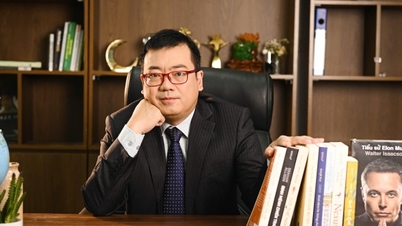
Do Trong Khoi, a remarkable figure from the rice-growing region, can be considered a special case in Vietnam's literary circles. A folk rhyme from Thai Binh province goes, "The rice-growing region is full of unexpected stories / Writers write standing up, poets write lying down," and the "poet who writes lying down" is none other than Do Trong Khoi.

Do Trong Khoi, a remarkable man from the rice-growing region. Photo: Archival.
Why is there a legend of "the poet who writes while lying down"? Born in 1960 in Hung Ha, Do Trong Khoi had a childhood full of misfortunes. He was orphaned at the age of 6 when his father, Do Xuan Khe, died on the battlefield in Southern Vietnam. However, cruel fate did not spare the only son of a fallen soldier. Just as he was starting school, Do Trong Khoi contracted rheumatoid arthritis. The progression of joint stiffness and muscle atrophy worsened, forcing Do Trong Khoi to drop out of school in the 4th grade. Accepting his paralyzed condition, Do Trong Khoi studied on his own while lying in bed, and with a pen in hand, he became a special member – the poet who writes while lying down – of the Vietnam Writers Association .
The poetry collection "The Sacred Bird Still Flies," published in 1992, marked the emergence of the extraordinary writer Do Trong Khoi from the rice-growing region into the literary world. Since then, dozens of other works, including poetry, short stories, and literary criticism, have continuously been published by Do Trong Khoi. He joined the ranks of the Vietnam Writers Association without ever hoping to have the opportunity to set foot in the common home of that literary organization.
Do Trong Khoi's will to live and his passion for writing touched the heart of librarian Thu Oanh in Bac Lieu. She decided to move to Thai Binh in 2009 to marry the disabled poet, and they have two sons.

Having spent his entire life connected to his rice-growing homeland, and despite his less-than-favorable personal circumstances, poet Do Trong Khoi felt that "even when the dew is bitterly cold, the wind sometimes roars, the flowers remain the same, and they endlessly spread along the fence." However, he always observed and pondered. Taking advantage of the writing contest "Vietnamese Rice - Origins and Future" organized by the Vietnam Rice Industry Association, he entered and won first prize in the prose category with his essay "The Rice Plant Overflowing with Human Affection in the Rice-Growing Homeland."
Poet Do Trong Khoi wrote: “Vietnam is known as the land of rice civilization, and my hometown of Thai Binh (now merged with Hung Yen ) is a typical agricultural region. Seen from afar, the rice fields stretch out like an endless green carpet. There's the season of lush green rice seedlings, the season of rice heading, and then the season of golden rice. The people here grow up with rice, familiar with the smell of mud and soil, familiar with the rhythm of the seasons, familiar with the hardships but also full of joy. People from the rice-growing region not only farm with physical strength, but also with experience and intuition.”
If in poetry, the extraordinary figure from the rice-growing region murmurs, "My homeland is in the land of dreams / For a long time I have been unable to leave my homeland / The golden bamboo preserves the voice of Truong Chi / The golden cup remains unbroken, the vow of Mi Nuong is still unbroken," then he clearly analyzes in prose: "Only those who have experienced exile can see how deeply each rice field, each canal, each rice season has imprinted itself on them. A bowl of rice in a foreign land, however abundant, can never be the same as a bowl of rice from home. Because it lacks the smell of fresh straw, the taste of alluvial soil, and even the image of those scorching midday suns when mother planted rice in the fields, or the bustling afternoons of harvesting filled with laughter. It is only during those days of return that one looks at the rice fields of their homeland with a different eye. No longer a place of hardship, but a source of support. No longer something to be abandoned, but a place to return to."
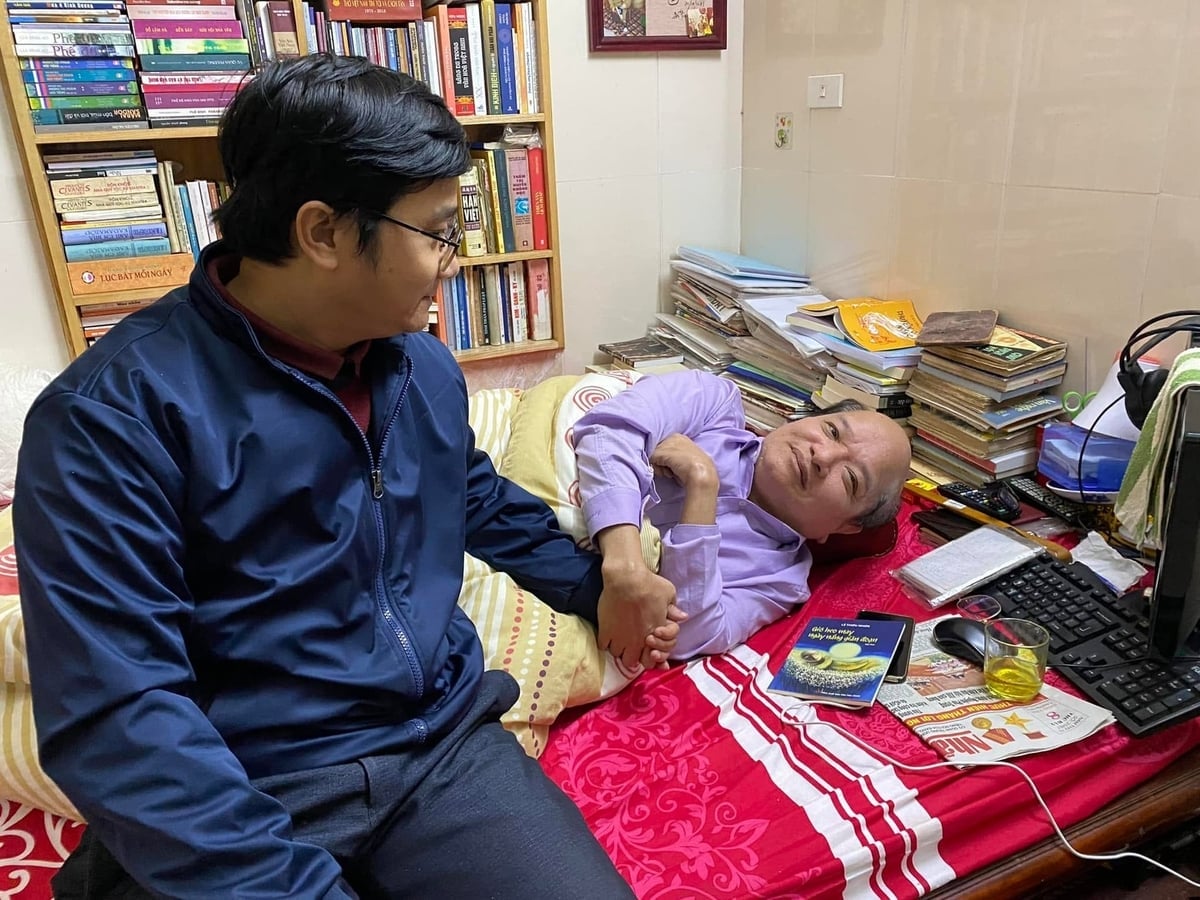
Reporters from NNMT newspaper visit Do Trong Khoi, a prominent figure from the rice-growing region, at his home in Thai Binh. Photo: Provided.
With a life like a legend, the humble poet Do Trong Khoi wrote, "I often ponder over the sun and moon, reflecting on the mossy depths of my heart," but he held a very serious view of literature: "Living out real life on the wings of the yearning for love, freedom, and beauty. Through this, literature carries within it the exemplary driving force of truth and the true values of life, helping the development of society and humanity to become more perfect. It explores and creates ontological models and the laws governing human nature; therefore, through artistic models, real life and society are manifested in accordance with the true values of human existence. These human values are immortalized within their present reality."
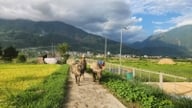

The essay "Rice Plants Overflowing with Human Affection in the Rice-Growing Homeland" by the extraordinary figure of the rice-growing region, Do Trong Khoi, raises many reflections on the value of Vietnamese agriculture. At the age of 66, he ponders: "The story of 'leaving farming but not leaving home' is not just about making a living. It's also a story of roots, of attachment, of how people navigate change while still retaining a place to remember, a place to return to. How to move forward without losing what has shaped one's identity—perhaps that is what truly troubles and inspires people."
The rice plant stands there, silently enduring countless seasons of sun and rain, saying nothing yet having said it all. The people of the rice-growing region are the same: persistent, patient, and quiet, just like the rice plant itself. And as long as rice grains are present in every meal, the stories of the rice plant and the people of the rice-growing region will continue to be told endlessly, like a distant, affectionate memory: "The sun rises, ripening the rice / For him to harvest, for her to bring him food."
Source: https://nongnghiepmoitruong.vn/ky-nhan-que-lua-thau-hieu-cay-lua-dat-dao-tinh-nguoi-d815798.html
![[Photo] General Secretary and President To Lam attends the Central Public Security Party Committee Conference](https://vphoto.vietnam.vn/thumb/1200x675/vietnam/resource/IMAGE/2026/06/24/1782302063612_a1-bnd-9302-9166-jpg.webp)
![[Photo] The 13th National Congress of the Youth Union conducts personnel work.](https://vphoto.vietnam.vn/thumb/1200x675/vietnam/resource/IMAGE/2026/06/24/1782299943080_ndo_br_1-6868-jpg.webp)
![[Photo] Opening Ceremony of the 13th National Congress of the Ho Chi Minh Communist Youth Union](https://vphoto.vietnam.vn/thumb/1200x675/vietnam/resource/IMAGE/2026/06/24/1782286753905_ndo_br_1-8510-jpg.webp)