


The emergence of AR interactive books from SPACES has opened the door to bringing paper pages "to life," while also offering a solution to the challenge of balancing digital devices and traditional reading habits. When technology is used in its rightful role—as a catalyst rather than a replacement—a child's reading journey is no longer passive reception, but an active exploration where imagination is awakened and knowledge is accessed through multiple senses.
The "boost" that brings children back to paper books.
Recently, at the Ho Chi Minh City Book Street, the SPACES brand officially launched a pair of AR (augmented reality) interactive books titled "Galactic Adventure " and "The Wonderful Forest. " Designed as a "gateway" to the world , SPACES' first two publications focus on topics that strongly spark children's curiosity.
With Galactic Adventures, children not only read about planets but also witness the vibrant rotation of the solar system, touch the stars, and listen to the magical sounds of the universe right at home.
Meanwhile, the " Magical Forest " recreates the ecosystem of the zoo, bringing rare animals, birds, and plants to life from the pages with realistic movements, helping children learn to understand and love nature in the most natural way.
The highlight of the event was an in-depth talk show themed "Opening the Book - Awakening Wonders," with the key objective of addressing parents' concerns about balancing technology and reading culture, while also guiding them on how to use AR as a tool to help children break free from dependence on passive entertainment electronic devices.
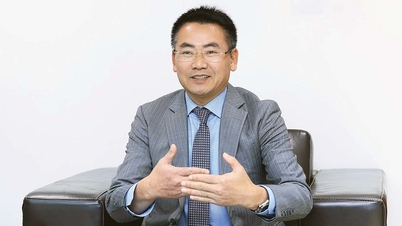
From the perspective of a seasoned technology expert, Mr. Nguyen Huy, Chief Technology Officer of NewEra Inc., stated: “AR is not meant to replace books, but to awaken the pages, transforming reading from a passive act of reception into a multi-sensory experience. Children no longer just read about the ocean but can dive among schools of fish thanks to AR. When knowledge has size and depth in real space, the brain will remember it as a real experience, not just digital information.” This interaction helps children's brains naturally remember knowledge, making abstract concepts about the universe or nature more accessible and understandable than ever before.
Sharing the same view, Dr. Trinh Cam Ly, who has dedicated nearly 30 years to primary education , affirmed that integrating technology into printed books is the "cure" to address the current situation of passive reading among children. "Books are one of the key elements in unlocking potential and nurturing children's boundless imagination. The bookmakers at SPACES have been very clever in integrating technology into printed books – fostering both reading habits and reading interest. When the eyes see movement, the ears hear realistic sounds, and the hands interact directly, reading becomes a journey of discovery, with each dimension concealing many fascinating things," she shared.
Ms. Doan Phuong Thoa, Founder of SPACES, stated: “SPACES doesn't use AR as a game, but rather to help children read more deeply, understand more thoroughly, and naturally love knowledge. AR is a sweet starting point to lead children into the labyrinth of knowledge, but it is the profound content and language in the books that truly captivate and nurture their souls.” By using paper books as the foundation and AR as a leverage, each SPACES publication becomes a multi-dimensional gateway, helping children not only access knowledge but also learn to focus and think deeply in a tranquil space rich in traditional values.

From "watching together" to "playing together"
One of the most insightful aspects of the seminar was addressing parents' persistent concerns about their children being isolated or "surrounded" by electronic devices. Mr. Nguyen Huy offered a crucial principle: technology shouldn't be used as a "babysitter," but rather as an emotional bridge. "The connection isn't in the screen, but in the eye contact and the questions we ask our children when we enter that technological space together. Instead of handing the device to the child to figure things out on their own, parents should be the ones asking questions. Technology, in this case, becomes the pretext for initiating a quality conversation."
From an educational perspective, Dr. Trinh Cam Ly suggests that to foster a sustainable reading habit, parents should focus on emotional experiences rather than coercion: “A child will read not because they need to, but because they want to; they read when they find joy, empathy, or a sense of expanding their world through the pages of a book. The door to a child’s potential wonder only opens with the right key – that is, subtle, patient, and understanding companionship from adults.” She encourages parents to select meaningful content and create space for children to “co-create” with the author instead of letting ready-made images completely replace their imagination.
Ms. Doan Phuong Thoa further shared her concerns about how to prevent children from getting lost in the digital world: “We open the right door when we use paper books as the foundation and AR as a catalyst. To help children open the right door without getting lost, we need to transform technology into a humane guiding tool, not a wall. When reading brings intrinsic joy and parents show empathy, children will confidently step into the digital world with a solid compass of knowledge.”
At the talk show, the speakers all expressed strong belief in a future where paper books and technology blend to serve future generations. The aspirations of those involved in the book industry extend beyond vivid visual effects of the universe or animals, aiming to transform cultural values, historical data, and folk games into interactive 3D formats. Ms. Phuong Thoa stated: “Whether it’s AR, folk games, or cultural publications, everything revolves around a single core value: nurturing children to understand their roots, be resilient in the present, and confidently step out into the world.”
Indeed, when technology is properly integrated into the educational framework and supported by empathetic family involvement, it ceases to be a barrier and becomes an effective tool to help Vietnamese children both deeply rooted in their heritage and confidently reach out to the world.
SPACES' pioneering approaches demonstrate a clear humanistic philosophy: technology is not meant to replace traditional values, but to breathe life into books, making the journey of acquiring knowledge for future generations more vibrant and inspiring than ever before.
Source: https://baovanhoa.vn/xuat-ban/ky-quan-buoc-ra-tu-trang-sach-219508.html
![[Photo] National Assembly Chairman Tran Thanh Man attends the opening session of IPU-152](https://vphoto.vietnam.vn/thumb/1200x675/vietnam/resource/IMAGE/2026/04/16/1776277863731_ctqh5-jpg.webp)
![[Photo] National Assembly Chairman Tran Thanh Man arrives in Türkiye to attend IPU-152](https://vphoto.vietnam.vn/thumb/1200x675/vietnam/resource/IMAGE/2026/04/15/1776261003665_tnk10-jpg.webp)
![[Photo] The General Secretary, President and his wife meet with Vietnamese-Chinese friendship leaders.](https://vphoto.vietnam.vn/thumb/1200x675/vietnam/resource/IMAGE/2026/04/15/1776264829725_vna-potal-tong-bi-thu-chu-tich-nuoc-to-lam-gap-mat-nhan-sy-huu-nghi-viet-nam-trung-quoc-8703641-3130-jpg.webp)
![[Photo] Mrs. Ngo Phuong Ly meets and exchanges views with Mrs. Peng Li Yuan](https://vphoto.vietnam.vn/thumb/1200x675/vietnam/resource/IMAGE/2026/04/16/1776277858080_phu-nhan-1-jpg.webp)
![[Photo] My Son at night: A thousand-year-old heritage site amidst the Milky Way](https://vphoto.vietnam.vn/thumb/1200x675/vietnam/resource/IMAGE/2026/04/15/1776261039184_ndo_br_chon6-jpg.webp)



























































Comment (0)