

Recently, at the Pediatric Cardiology Department, Cardiovascular Center, E Hospital, there were two more cases of pediatric patients undergoing transcatheter pulmonary valve replacement after complete repair of Fallot 4 with severe pulmonary valve regurgitation.
To date, the Pediatric Cardiology Department, Cardiovascular Center, E Hospital has successfully performed and implemented transcatheter pulmonary artery valve replacement (TAVR) in many cases, bringing many practical benefits to numerous pediatric patients.
 |
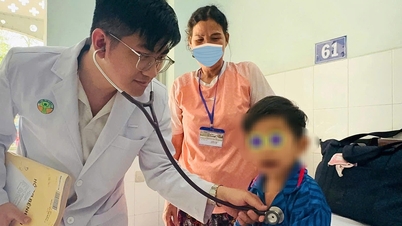
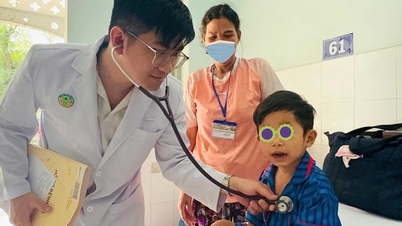
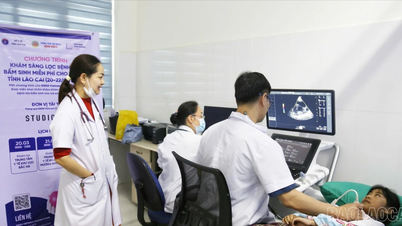
| Dr. Tran Dac Dai, Head of the Pediatric Cardiology Department, Cardiovascular Center, E Hospital, examines a child patient. |
The first case involves a 12-year-old patient, NHV, from Luc Ngan district, Bac Giang province, who was diagnosed with Tetralogy of Fallot at 4 months of age.
Subsequently, the child underwent a first corrective surgery for Tetralogy of Fallot at the Cardiovascular Center, E Hospital in 2013, and their health improved significantly. However, recently, the child has experienced shortness of breath during exertion and limited physical activity, prompting the family to bring them back for a follow-up examination at the Cardiovascular Center, E Hospital.
The results of the child's echocardiogram and MRI showed that pulmonary artery valve regurgitation caused blood to flow backward from the pulmonary artery into the right ventricle.
According to the doctors, this is a common and natural progression after surgery to treat Tetralogy of Fallot. In this patient's case, pulmonary artery valve replacement was indicated, and after consultation, the doctors determined that the patient met the criteria for transcatheter pulmonary artery valve replacement.
Mr. NVC (father of patient NHV) said that after doctors from the Pediatric Cardiology Department, Cardiovascular Center, E Hospital explained the patient's condition and the reasons for choosing the transcatheter pulmonary artery valve replacement (TAVR) technique for his child, the family felt very reassured because their child did not need open surgery and sternotomy.
Recalling the first surgery, which still haunts the whole family, the child had to undergo a very painful procedure involving opening the chest and sawing through the sternum.
The father could deeply empathize with his child's pain after surgery. This time, upon receiving information that the child could be treated with this new method, he and his family were determined to find a way to restore a healthy heart for their child, the father added.
Patient NVHP (9 years old, from Vinh Bao district, Vinh Phuc province) is also a case of congenital heart disease, specifically Tetralogy of Fallot, and underwent complete Tetralogy of Fallot correction surgery at the age of 2 using open-heart surgery.
Recently, the child was diagnosed with pulmonary artery leakage and subsequently underwent transcatheter pulmonary valve replacement (TAVR) surgery at the Pediatric Cardiology Department, Cardiovascular Center, E Hospital.
Dr. Tran Dac Dai, Head of the Pediatric Cardiology Department, Cardiovascular Center, E Hospital, explains that Tetralogy of Fallot, also known as Fallot 4, is one of the common cyanotic congenital heart diseases.
This is a relatively complex congenital heart disease with four types of heart defects: ventricular septal defect, right ventricular outflow tract obstruction, overriding aorta, and right ventricular hypertrophy.
These heart defects reduce blood flow to the lungs, delivering oxygen-deficient blood to other organs in the body. As a result, children suffer from prolonged oxygen deprivation, fatigue, cyanosis of the skin and mucous membranes, etc. If left unmonitored and untreated, the natural progression of the disease often leads to an increased rate of complications, reduced life expectancy, and even death.
Dr. Tran Dac Dai analyzed the advantages of this technique compared to the traditional open surgery method, which requires patients to undergo major surgery: prolonged anesthesia and resuscitation, sternotomy, cardiac arrest… and resection of the pulmonary artery trunk, resection of the right ventricular infundibulum to replace the pulmonary artery conduit, with a high degree of invasiveness and a high risk of complications.
Furthermore, percutaneous pulmonary valve replacement (PCV) helps patients avoid major open-heart surgery, leading to faster recovery, shorter hospital stays, and reduced risk of complications.
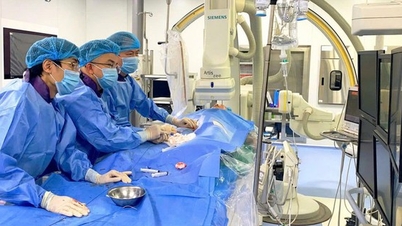
During the procedure, the doctors only made an incision in the femoral vein and then threaded a catheter up the inferior vena cava to the right atrium, down to the right ventricle, and up to the pulmonary artery.
Doctors perform procedures to select the appropriate size of the pulmonary artery valve, insert the artificial pulmonary artery valve through a catheter from the femoral vein into the pulmonary artery, and then release the valve into the patient's original pulmonary artery trunk. Afterward, the artificial valve expands and functions like a normal heart valve.
Dr. Tran Dac Dai shared that, based on the medical condition and physical state of each child patient, the doctor will prescribe the most appropriate treatment plan and timing for intervention or surgery.
For a successful percutaneous pulmonary valve replacement (PCV) procedure, the deciding factor depends on the expertise of the surgeons, who must have many years of experience in interventional cardiology.
Currently, the Cardiovascular Center at E Hospital is a complete cardiovascular facility encompassing surgery, medical treatment, cardiovascular interventions, anesthesia and resuscitation, etc., with synchronized and modern equipment to ensure the examination and treatment of heart, vascular, and thoracic diseases for patients.
Therefore, during the procedure of percutaneous pulmonary valve replacement, a cardiovascular surgical team is prepared to respond promptly and handle any complications that may arise.
Dr. Tran Dac Dai affirmed that the transcatheter pulmonary valve replacement method not only opens a new direction in treatment but also offers hope for patients with pulmonary valve regurgitation after surgery to repair Tetralogy of Fallot and similar conditions.
In the coming period, pediatric cardiologists will continue to promote the transcatheter pulmonary valve replacement technique in the treatment of patients, helping more and more patients to access this advanced method.
However, the high cost of performing a percutaneous pulmonary artery valve replacement (PCV) is a major barrier limiting the number of patients who choose this technique.
Therefore, doctors recommend that social insurance agencies consider including this technique in health insurance coverage so that more patients can access and benefit from this advanced technology.
Following the intervention, the health of the two children stabilized, and they were able to walk the next day. Echocardiogram and electrocardiogram results were good. Currently, the children have recovered, no longer experience shortness of breath, no longer feel tired when exerting themselves, have been discharged from the hospital, and can return to their normal studies and activities.
Upon discharge, the families of the two child patients received advice from the pediatric cardiology department doctors on post-operative care and regular follow-up appointments to monitor for complications.
Source: https://baodautu.vn/ky-thuat-moi-giup-tre-mac-tim-bam-sinh-it-dau-don-d224230.html


![[Image] National Assembly discusses the implementation of the socio-economic development plan.](https://vphoto.vietnam.vn/thumb/1200x675/vietnam/resource/IMAGE/2026/04/20/1776696707422_ndo_br_img-20260420-185419-jpg.webp)


![[Photo] General Secretary and President To Lam meets with National Assembly delegates from ethnic minorities.](https://vphoto.vietnam.vn/thumb/1200x675/vietnam/resource/IMAGE/2026/04/20/1776696701056_a1-bnd-8331-3342-jpg.webp)



























































































Comment (0)