

The children of the South in Uncle Ho's embrace
At over 80 years old, in their small house in Vung Tau ward (Ho Chi Minh City), Mr. and Mrs. Nguyen Tuan Dung still cherish old photographs that have faded with time. Every time they open the family photo album, the former police officer 's eyes fall silent as he stops at images of the beloved President Ho Chi Minh.
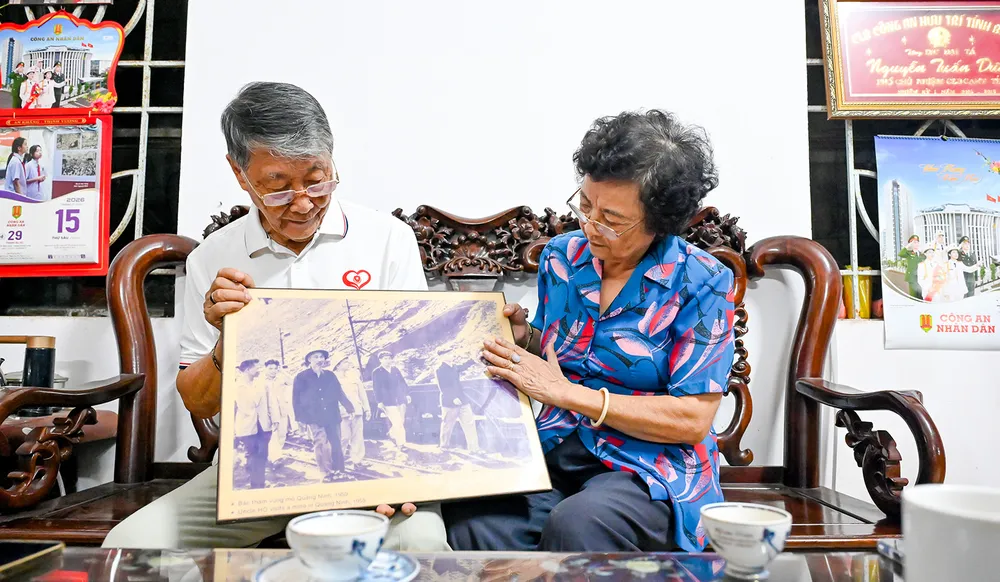
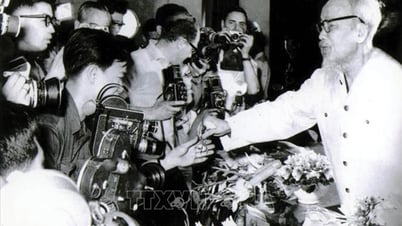
Born in 1943 into a family with a rich revolutionary tradition in Khanh Hoa , Mr. Dung is the second generation in a family of four generations who have served in the People's Public Security Force. His father, Mr. Nguyen Binh, participated in protecting President Ho Chi Minh on many occasions. His father's most memorable experience was President Ho Chi Minh's visit to the Quang Ninh mining region in 1959. Mr. Dung's most vivid memory, however, is of the times he met President Ho Chi Minh when he was a student from the South who had relocated to the North for studies. It was 1959, at a conference at the Ba Dinh Club. During the break, upon hearing that President Ho Chi Minh had arrived, the students rushed to surround him. “We children swarmed around him. I pushed through the crowd to get close and hug him tightly…,” Mr. Dung recalled emotionally. He smiled gently as he recounted his “mischievous” behavior at the time: “I kept glancing at the President's coat to see if any silver hairs had fallen out so I could pick them up as souvenirs.”
Then Uncle Ho embraced each child, kissed their forehead, and affectionately asked, "Do you miss your homes and families while you're here?" That simple yet loving question stayed with Mr. Dung throughout his life. For these children far from home, Uncle Ho's affection was like the warmth of a father's love for his young children. Not only did he ask about their well-being, but he also urged the students from the South to study hard so that they could return later to serve the revolution and the people of the South.
During his years studying in the North, Mr. Dung vividly remembers the times Uncle Ho visited the school. Even though the school organized a formal reception in the assembly hall, Uncle Ho often didn't go straight in but instead went down to the kitchen and dormitory area to see how the students were eating, living, and doing. This simple act of concern made the students from the South, far from home, deeply feel the special affection of the President.
In the heart of the young Nguyen Tuan Dung, there was always a longing to keep a memento of Uncle Ho. He treasured the three lotus seed candies that Uncle Ho had given him. He carried them throughout his adulthood until 1973, when, while marching across a treacherous stream in the Truong Son Mountains, the candies were swept away by the water. Even now, he still feels a deep sense of regret when he recalls it.
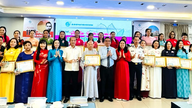
It's not just Mr. Dung; Mr. Tran Cao De (born in 1945, former Director of the Department of Transport of Ba Ria - Vung Tau province) also carried throughout his life the advice of Uncle Ho from his time as a student from the South studying at the Nanning Central University Campus (China).
In 1957, after a working trip to attend the commemoration of the Russian October Revolution, President Ho Chi Minh visited Vietnamese cadres and students in Nanning. That day, thousands of students cheered with emotion when they saw him appear in the large square.
During a heartfelt conversation, Uncle Ho advised the students to study diligently, be thrifty, value public property, and take care of every piece of paper and every piece of clothing because "our country is still poor, and our people are still facing difficulties and hardships." These simple teachings became a guiding principle for Mr. Tran Cao De throughout his working life.
Uncle Ho's love lasted throughout his life.
If the memories of the students from the South were of a fatherly affection, then for the soldiers of the "ships without numbers," it was the empathetic sharing of a leader who always yearned for his beloved South.
Now over 90 years old, Mr. Huynh Van Tien (born in 1937, from Ben Tre - now Vinh Long province, residing in Phuoc Thang ward, Ho Chi Minh City) no longer hears as well as before due to the lingering effects of injuries from a bomb explosion during the Vung Ro battle in 1965. Those were the days of fierce fighting from February 16th to 24th, 1965, when the C-143 ship of the 125th Brigade of the Vietnam People's Navy was unloading weapons to support the Southern battlefield and was spotted and heavily attacked by American aircraft.
However, every time he recalls the honor of meeting President Ho Chi Minh, the former soldier on the nameless ship is still moved as if it were just yesterday. His eyes light up with pride, and his voice is slow but full of emotion as he remembers the simple figure, the kind inquiries, and the warm affection that President Ho Chi Minh showed to the soldiers from the South back then.
Mr. Huynh Van Tien recounted: it was in August 1961, after a sea voyage from Ben Tre to the North, he and his comrades met President Ho Chi Minh at the Presidential Palace. Wearing a faded khaki uniform, President Ho Chi Minh kindly inquired about their fatigue from the sea voyage, the progress of the struggle of the people in the South, and whether children in the liberated areas had schools to attend.

The most moving moment was when Uncle Ho asked, "Do you have any requests for the Central Committee or for me?" The soldiers replied, "We are here to ask you, Uncle Ho, and the Central Committee, to give each province a boatload of weapons… weapons that can demolish the enemy's reinforced concrete bunkers." Hearing this, Uncle Ho fell silent, then wiped away his tears with a handkerchief. The tears of the President, in the face of the hardships of the people of the South, became the driving force that spurred the soldiers to be ready to fight whenever the Fatherland needed them.
More than half a century has passed, and the stories of Mr. Nguyen Tuan Dung, Mr. Tran Cao De, and Mr. Huynh Van Tien are not just the personal memories of a generation. They are also authentic and moving glimpses of President Ho Chi Minh's boundless love for his compatriots in the South. And from that love, many generations of our forefathers have grown up and dedicated themselves to the country, as a way of remembering and following Uncle Ho's teachings throughout their lives.
Source: https://www.sggp.org.vn/ky-uc-nhung-lan-duoc-gap-bac-ho-post855809.html





![[Video] The 14th Congress of the Vietnam Trade Union elects 135 members to the new Executive Committee.](https://vphoto.vietnam.vn/thumb/402x226/vietnam/resource/IMAGE/2026/06/04/1780588098789_cong-doan-jpg.webp)























![[Video] Sunset at Lap An Lagoon – Where the sun sets over the fishing nets](https://vphoto.vietnam.vn/thumb/1200x675/vietnam/resource/IMAGE/2026/05/31/1780192137701_beach-landscape-sea-water-nature-grass-745871-pxhere-com.jpeg)















Comment (0)