

"MAY BE MIXED INTO THE DOUGH UNTIL IT'S TIGHT"
People's Artist Hoang Thi Nhu Huy, when writing about the jam-filled rice cake, made a rather interesting observation: when sliced and eaten, each piece of the cake contains "all the flavors of late spring." This is because, besides the outer layer of sticky rice flour simmered with sugar syrup, the filling is a mixture of various jams. Each type of jam has a different color, and the skillful arrangement by the baker creates a beautiful array of colors and patterns for this type of rice cake.
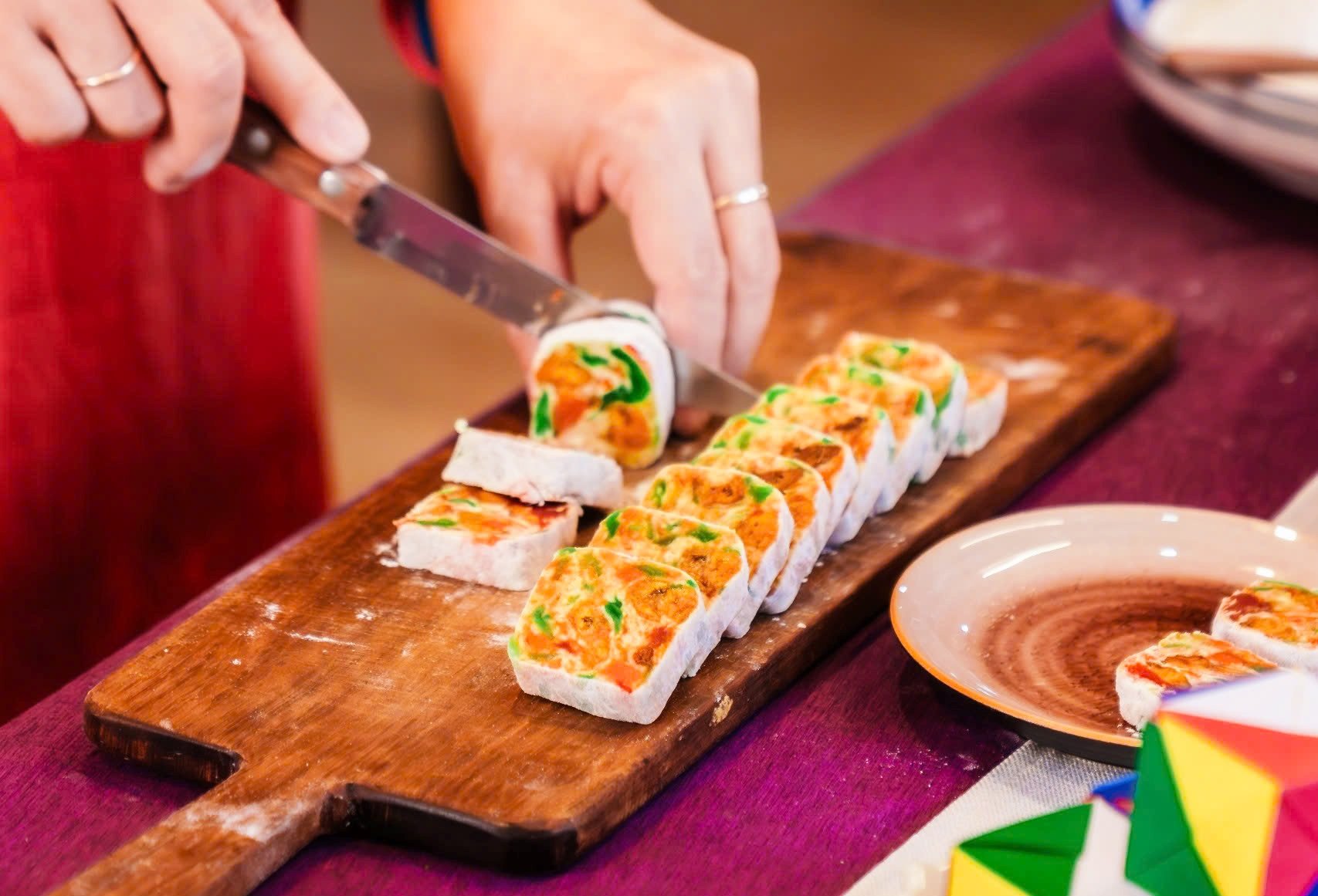
The colorful jam-filled rice cake evokes memories of Tet in Hue of yesteryear for many.
I met with Ms. Phan Nu Phuoc Hong (a culinary arts lecturer at Hue College) and heard the story of the origin of the "half cake, half jam" dish. "Before appearing in mansions and even in the royal court, the 'banh bo jam' (a type of cake wrapped in jam) was a folk cake that reflected the valuing of food by the women of Hue in the past," Ms. Hong began her story. In the past, many kinds of fruit trees were grown in the gardens of Hue. Each season brought its own ripe fruits: jackfruit, bananas, papayas, pineapples… all ripened abundantly. The mothers and sisters, feeling wasteful, dried or made jam to preserve them. On anniversaries, anniversaries, and Tet (Lunar New Year), they would take these fruits out, mix them with roasted glutinous rice flour, and store them in banana leaves.
In the past, people would simply open the package, cut it into slices, and enjoy it as a dessert with tea, which was delicious. Later, housewives elevated the banh bo (a type of Vietnamese rice cake) by adding fruit preserves such as ginger preserve, kumquat preserve, winter melon preserve, carrot preserve, tomato preserve, etc. "The lifestyle and customs of Hue people have created a banh bo with preserves that is both visually appealing with the colors of the preserves and fragrant with ripe fruit, offering a perfect balance of sour, spicy, tangy, and sweet flavors," Ms. Hong said.
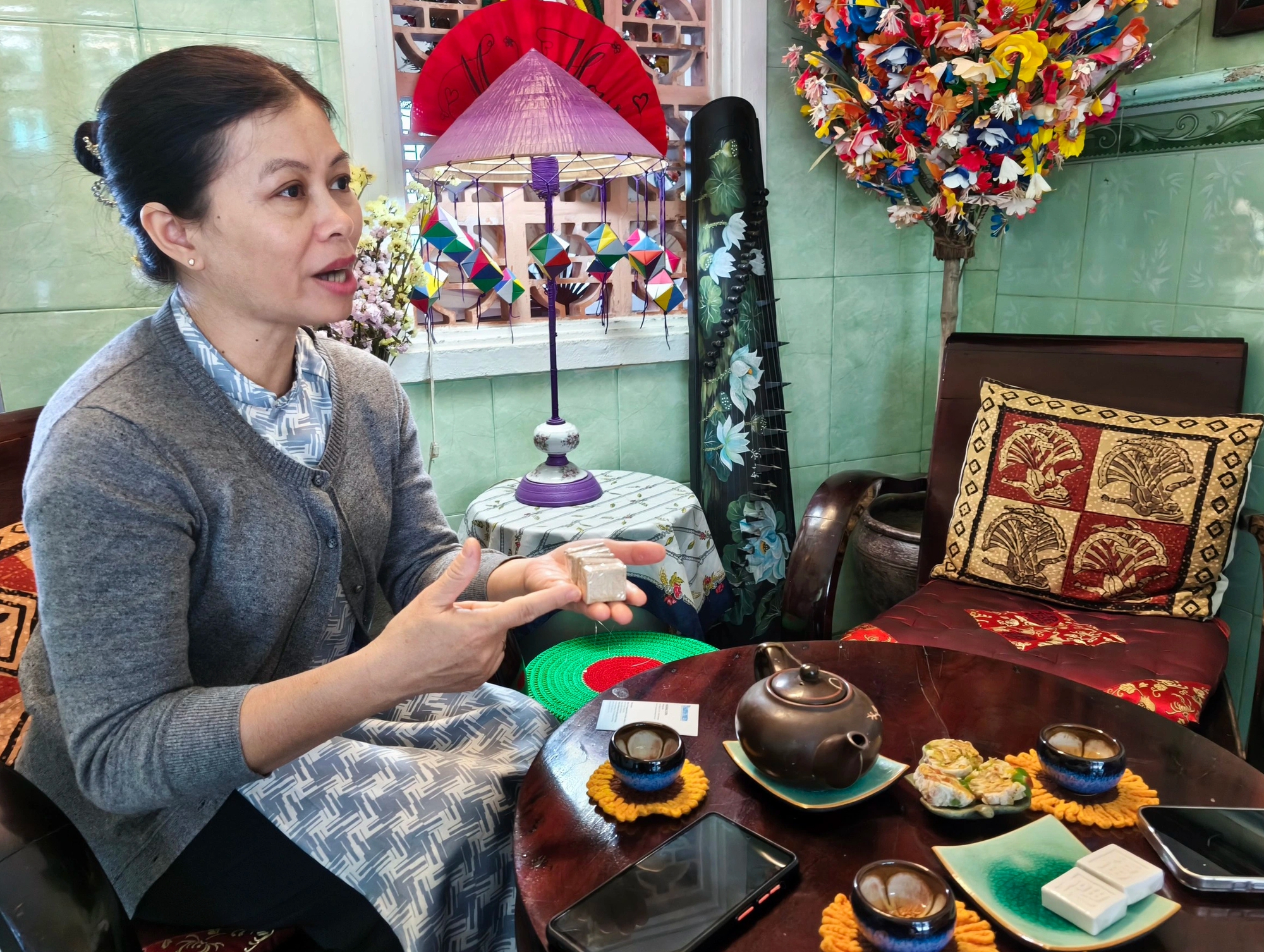
Ms. Phan Nu Phuoc Hong introduced traditional Hue cakes, including the jam-filled rice cake.
According to the renowned Hue culinary artist, Mrs. Mai Thi Tra (91 years old), sticky rice cakes wrapped in jam are usually consumed within 2-3 days and are a type of soft, chewy cake. This type of cake is commonly made during Tet (Lunar New Year) and contains various kinds of jam. "These chewy sticky rice cakes were made by women of the past, who, with their intelligence and frugality, used jams that didn't meet the required shape and size," Mrs. Tra remarked. Regarding the method of making sticky rice cakes wrapped in jam, Mrs. Tra has an easy-to-remember poem: "Flour ground from roasted glutinous rice/Cut carrots in equal amounts to the ginger/Mix sliced jujube jam/Add sugar and simmer until thick/Knead well; the dough becomes smooth and soft/The dough becomes pliable, add sweet jam/The jam is tightly packed into the dough/Cut into pieces, wrap beautifully, and shape it."
K. Variations of Banh Bo (Vietnamese steamed rice cake)
As a specialist in teaching Hue's signature dishes, artisan Mai Thi Tra provided detailed instructions on how to make this seemingly lost traditional cake for those who wanted to learn how to enjoy it during Tet (Lunar New Year). To make two pieces of cake, each about 15 cm long, the chef needs to prepare 500 grams of roasted glutinous rice flour, 300 grams of white sugar, 20 grams of candied winter melon, 20 grams of candied jujube, 20 grams of candied ginger, 20 grams of candied carrot, 20 grams of candied winter melon dyed with fragrant pandan leaf extract, and clear parchment paper. "First, cut the candied fruits into small pieces and mix them together. Then, put the sugar in a saucepan with 200 ml of water, stir well, and bring to a boil, stirring until the sugar dissolves completely. Remove from heat and let cool. Put the flour into a tray, make wells in the flour, then pour the sugar syrup into the center of each well and knead until smooth and pliable," Ms. Tra explained.
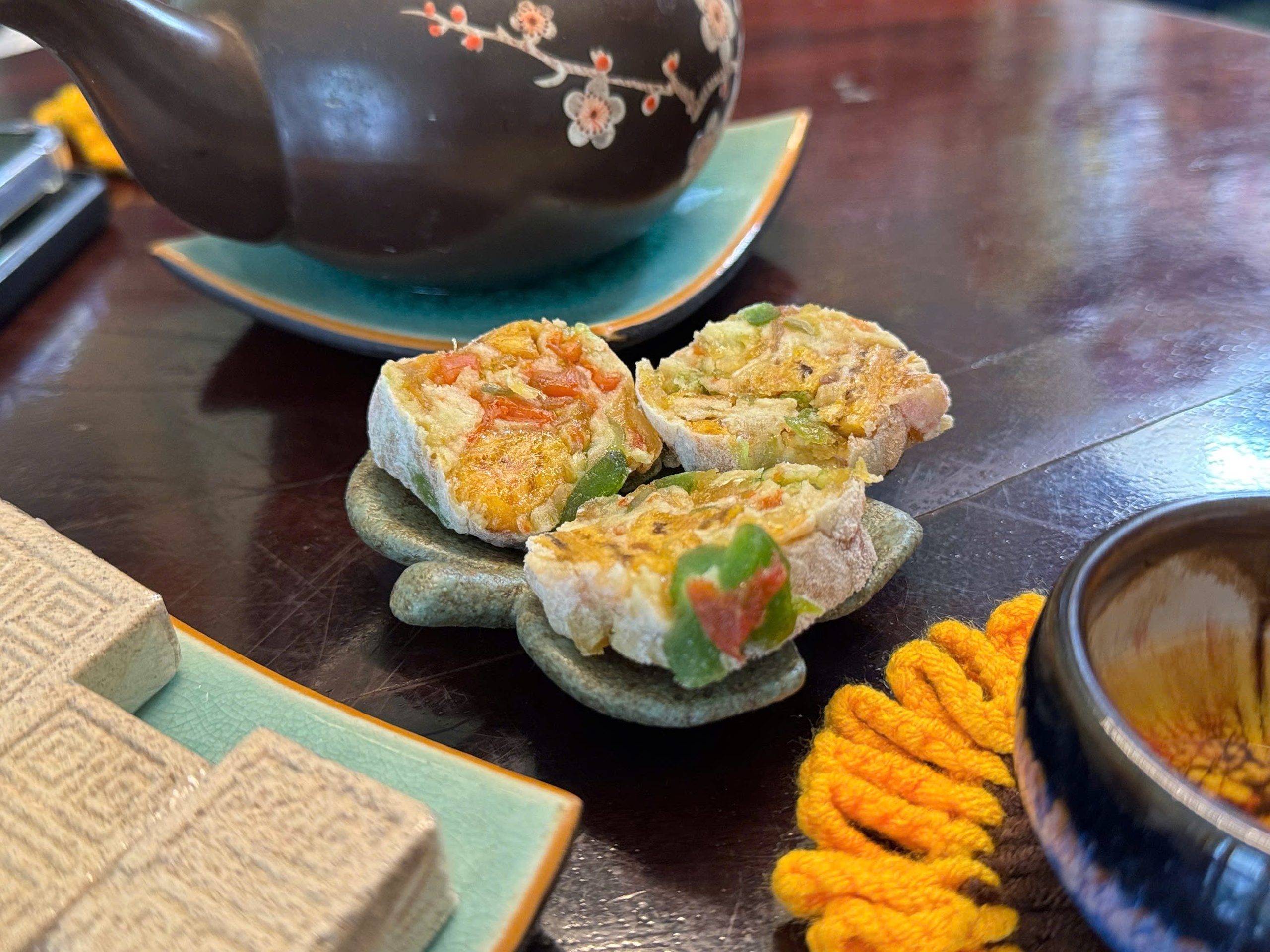
Jam-filled rice cakes made by foreign tourists after their experience at Ms. Phuoc Hong's house.
The next step is to spread the dough out and add the jam, then roll it up, pressing the jam inwards to form a square shape. Afterward, the baker needs to dust the outside with flour to make it smooth and free of any lines. Let it sit for about half a day to firm up before cutting it into 1 cm thick slices, wrapping them in clear cellophane so the jam's color is clearly visible. According to Ms. Tra, the reason for choosing these jams is to enhance the aesthetic appeal of the cake. Each horizontal cut across the cake will produce a slice that looks like a multi-colored, three-dimensional painting, including green, red, yellow, and white…
But if that were the case, the jam-filled rice cake would still remain just a traditional folk cake. Lecturer Phan Nu Phuoc Hong explained that the cake was elevated to a higher level when it entered the imperial palace or accompanied by concubines, thanks to the use of more precious ingredients, such as fragrant glutinous rice flour mixed with premium rock sugar. The filling consisted of luxurious jams only found in the imperial court, such as dried persimmons, raisins, jujube jam, Buddha's hand jam, and tangerine peel jam… "Another special point is that the ancients adapted the jam-filled rice cake according to the weather. The fruit jams used in the cake were divided into two types: fresh and cool with winter melon, carrot, jackfruit… Warm and comforting with ginger jam, kumquat jam, and mandarin orange jam… The amount of jam in a cake was adjusted depending on whether it was sunny or cold," Ms. Hong shared.
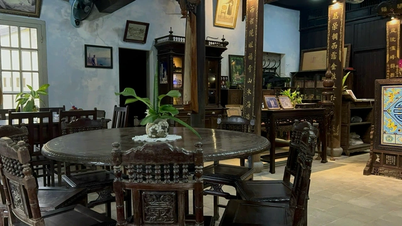
After saying that, Ms. Hong gently poured a cup of hot tea and invited me to taste the steamed rice cake she had made a few days earlier. This cake was a slightly "upgraded" version she had prepared by drying it, to offer to guests visiting her home in the ancient town of Bao Vinh. Steamed rice cakes with jam are entering a new phase, becoming an experiential tourism product attracting both Western and Vietnamese tourists. Enjoying tea and cakes in the elegant atmosphere of the ancient house, the flavor of the traditional Hue Tet felt so close… (to be continued)
Source: https://thanhnien.vn/giu-huong-tet-xua-la-lam-banh-bo-mut-185250117225955561.htm
![[Photo] National Assembly Chairman Tran Thanh Man working with the Standing Committee of the National Assembly's Delegation Affairs Committee.](https://vphoto.vietnam.vn/thumb/1200x675/vietnam/resource/IMAGE/2026/05/20/1779294340023_ndo_br_1-1691-jpg.webp)
![[Image] "Journey of Hope" promotes the organ and tissue donation movement in Vietnam.](https://vphoto.vietnam.vn/thumb/1200x675/vietnam/resource/IMAGE/2026/05/20/1779294400833_1-8910-jpg.webp)

![[Photo] General Secretary and President To Lam works with the Party Committee of the Ministry of Health on the work of Vietnamese traditional medicine.](https://vphoto.vietnam.vn/thumb/1200x675/vietnam/resource/IMAGE/2026/05/20/1779294323718_a1-bnd-2978-3319-jpg.webp)


























































Comment (0)