

A boy with rosy cheeks and red lips
For the past few years, it has become a tradition that after the Lunar New Year, Mr. Nguyen Huy Tuyen, the head of the Trieu Khuc village's Bong dance club, prepares the dance troupe for the village's festival. Normally, the troupe members must be present for a final rehearsal on the 6th day of the Lunar New Year, but Mr. Tuyen meticulously calls each member early to remind them. Around midday, after the whole team has practiced for about an hour and everything is ready, he lets them go home to rest. On the afternoon of the 8th, Mr. Tuyen returns to the club to check the remaining preparations one last time. Although everything has been neatly arranged before the New Year, he still meticulously checks each costume, each pair of socks, each piece of makeup. "Everything must be thorough so that on the afternoon of the 9th, the club members can change into new costumes, do their makeup on the spot, and then move down to the temple to perform the dance for the deity," Mr. Tuyen said.
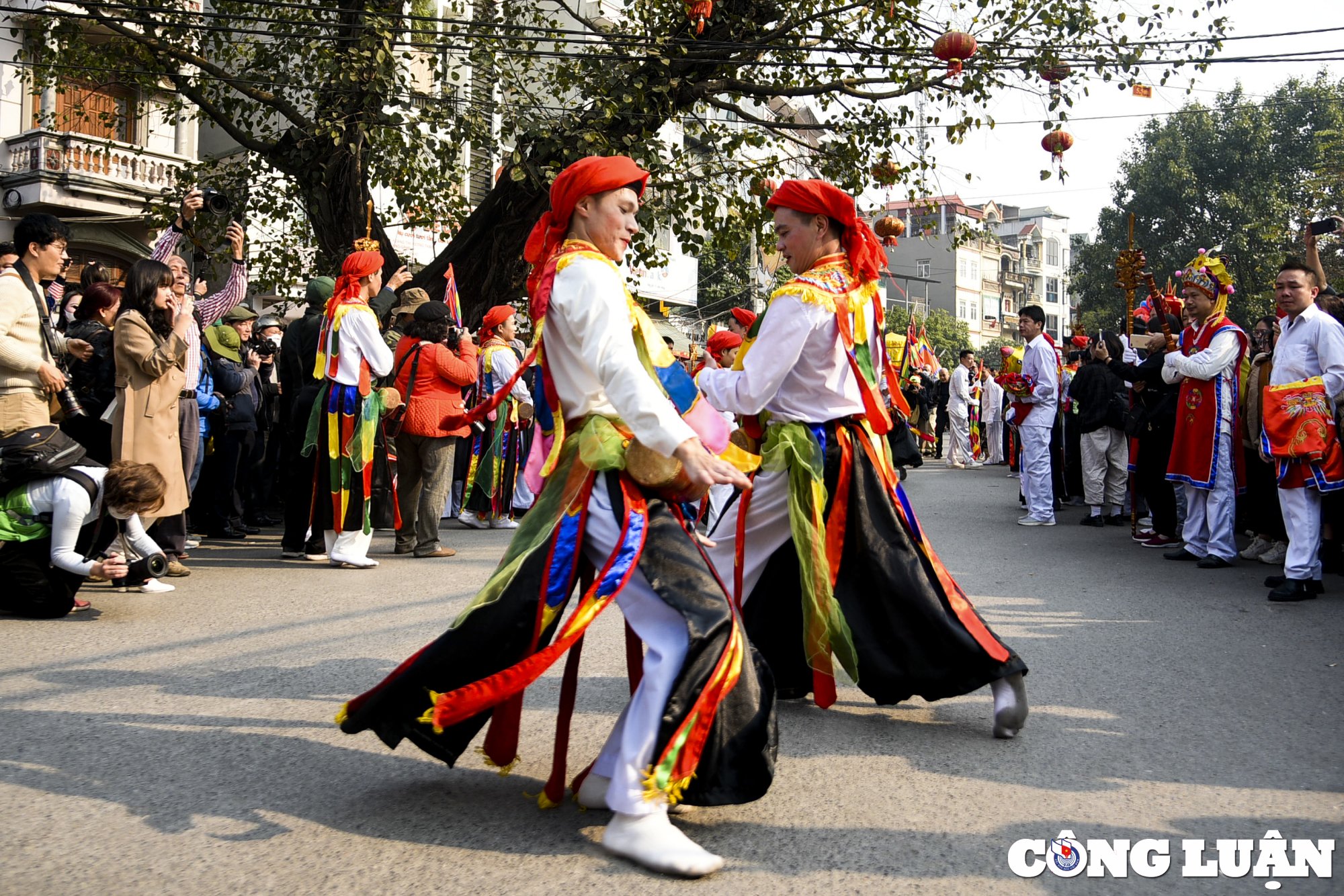
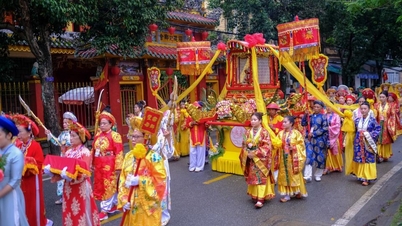
The procession was solemn and dignified, while the "prostitute" was frivolous and sometimes played tricks to tease people.
Since the Bong dance was recognized as one of the 10 best and most famous ancient dances of Thang Long (Hanoi), Trieu Khuc village has become more widely known. Mr. Trieu Khac Sam, now 85 years old, recounts that the Bong dance is an indispensable part of the traditional festival of Trieu Khuc village, which takes place from the 9th to the 12th of January. Legend says that when King Phung Hung defeated the Tang Dynasty army, he stopped in Trieu Khuc to feast his troops. During the ceremony, he had men disguise themselves as women to dance and boost the morale of the soldiers. The dancers wore small drums in front of their stomachs, dancing and playing the drums simultaneously, hence the name Bong drum dance.
The most distinctive feature of the Triều Khúc Bong dance is the men's impersonation of women. Unmarried men wear long skirts and bodices, with small silk scarves embroidered with stylized flowers and leaves around their necks, headscarves, and painted lips and cheeks. The Bong drum is a long, small drum painted red, which the men wear in front of their stomachs with a red silk sash tied at the back.
During the festival, the Bong dance is performed right in the pavilion, between the ritual ceremonies. When the palanquin is carried, the dance troupes must walk in front of the palanquin to perform for the Saint. While dancing, the young men simultaneously beat drums and perform graceful, rhythmic movements with each step and sway of their bodies. In particular, during the dance, their eyes must flirtatiously glance from side to side. Hence the folk saying , "flirtatious like a prostitute dancing Bong." The difficulty of the Bong dance lies in the dancers simultaneously portraying the flirtatious nature of a woman and the free-spirited, strong, and chivalrous spirit of a man. Along with the dancers, the lively band plays gongs and drums, creating an atmosphere that is both vibrant and bustling, yet sacred and mysterious.
“Many people ask why the drum dance is also called ‘the prostitute beating the drum .’ Actually, the original name of this dance was the drum dance, but later the folk name became ‘the prostitute beating the drum . ’ ‘Prostitute’ here is an archaic word meaning ‘girl,’ implying praise and not vulgarity as many people mistakenly believe, ” Mr. Sam explained.
According to researchers, the Bong dance exists in many places, but in Trieu Khuc, it has preserved its original essence and spirit. "Con Di Danh Bong" (The Prostitute Playing Bong) is considered the most authentically Vietnamese ancient dance, with movements that mimic the agricultural life of the ancient inhabitants. It is also a dance with a genuine folk life, serving both ceremonial and entertainment functions. Through ups and downs, this ancient dance has been preserved by the villagers of Trieu Khuc, becoming a unique cultural feature of this land.
The heavy burden of conservation
Now, everyone recognizes the Trieu Khuc Bong dance as a precious heritage. The Trieu Khuc Bong dance club has more than 30 members, not only performing the dance in honor of the deity during village festivals but also practicing in various other settings. The person responsible for the strong revival of the Bong dance was none other than the late artist Trieu Dinh Hong. Sadly, Mr. Hong passed away a few years ago. All the "burden" of preserving the Bong dance now falls on the shoulders of the younger generation – who are already too busy.
Club leader Nguyen Huy Tuyen admitted that since Mr. Hong's death, the dance troupe has been "like a snake without a head." Although he was personally chosen by Mr. Hong to "succeed," he cannot compare to his predecessor, especially in terms of talent and even enthusiasm. While Mr. Hong was alive, he only "assisted," but now, the members participate "just adequately," lacking initiative. The club leader has to do almost everything, from performances to organization and logistics, which is often exhausting. Then there's the delicate issue of remuneration, which is quite a headache. Very frankly, Mr. Tuyen said that many club performances go unpaid. There's no fund to cover the expenses, so he has to persuade and " beg" the members to happily participate.
"Although we have dozens of members in the club, for many events we struggle to even gather three dance pairs. Freelancers can take a day or two off, but how can those working in companies or still in school take time off? We have to be understanding because of their jobs and the need to earn a living."
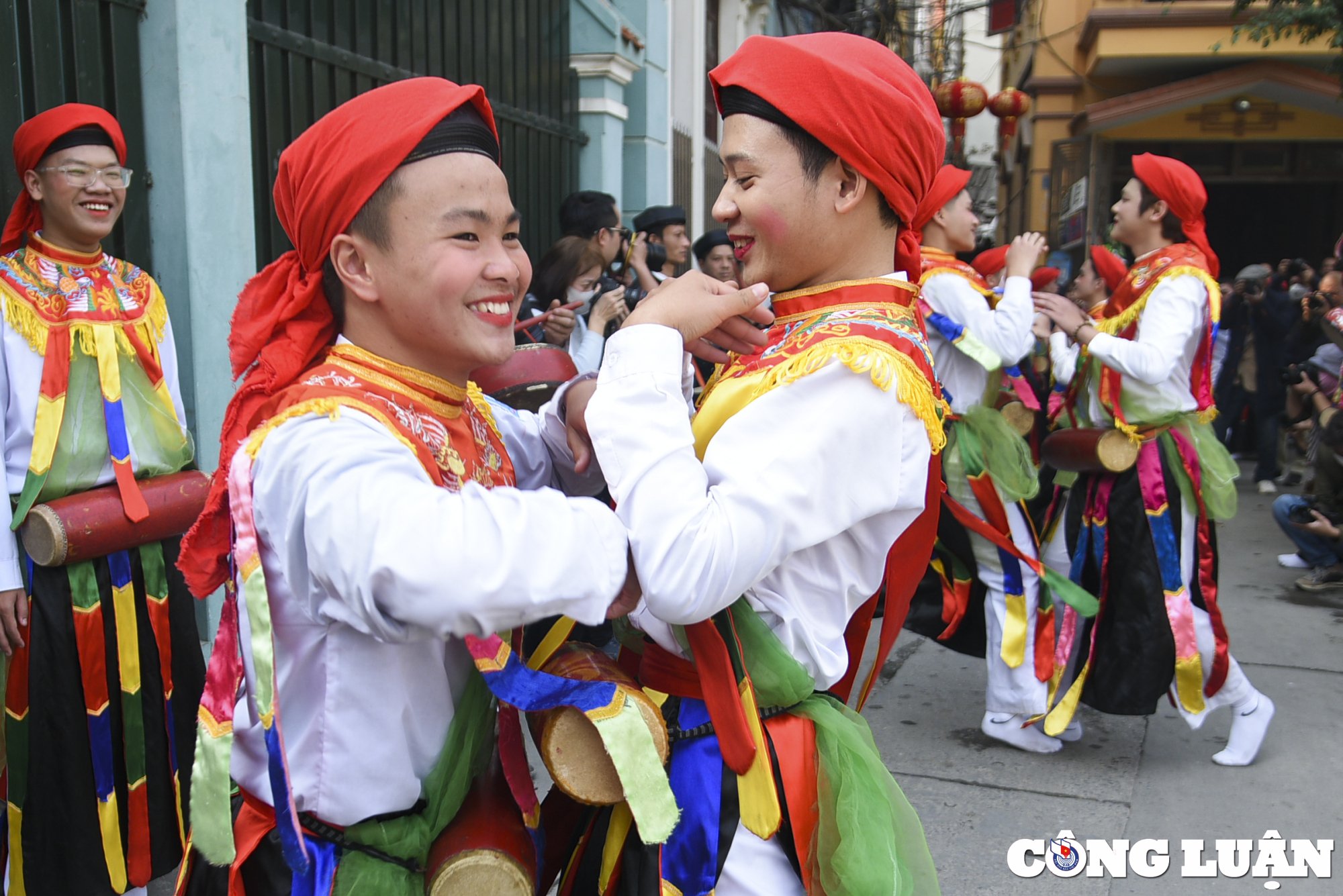
The "belly-toeing" move is a characteristic feature of the Bong dance.
Mr. Tuyen reflected that since the passing of artisans Trieu Dinh Van and Trieu Dinh Hong, the Trieu Khuc Bong dance has been without artisans. While it's true that "old bamboo gives way to new shoots," those preserving the Bong dance heritage still feel a pang of sadness, especially when comparing it to other folk traditions. Furthermore, scientists recommend allowing ancient dances to exist naturally within their original environment and community, the very places where they originated and were passed down… But who can be happy when the club hasn't received adequate attention from the commune and even Thanh Tri district? The club's activities still largely rely on the village community and the enthusiasm of a few individuals…
However, a positive sign is that the traditional Bong dance class, opened by artisan Trieu Dinh Hong years ago, is still being well-maintained. Some talented children who dance well will gradually be able to perform at village festivals. In addition, two children are being trained to play the cymbals, showing promise of replacing their predecessors. According to Mr. Tuyen, training new cymbal players is difficult because it requires both talent and physical strength; "out of ten people you teach, maybe only one will succeed," so this is a very promising sign.
"The Lunar New Year is almost here again. We perform all year round, but for us, dancing on the feast day of the Saints is still the most exciting and sacred experience. Putting on our costumes, listening to the sound of gongs and drums, we forget all our worries and become engrossed in the thousand-year-old dance of our homeland," Tuyển shared.
Khanh Ngoc
Source



![[Photo] National Assembly Chairman Tran Thanh Man attends the policy seminar to promote Vietnam-Türkiye cooperation.](https://vphoto.vietnam.vn/thumb/1200x675/vietnam/resource/IMAGE/2026/04/16/1776351415367_vna-potal-chu-tich-quoc-hoi-tran-thanh-man-du-toa-dam-chinh-sach-thuc-day-hop-tac-viet-nam-tho-nhi-ky-8705791-jpg.webp)






























































Comment (0)