

The 2,000th surgical procedure also affirms the growing strength of the surgical sector within Ho Chi Minh City's healthcare system, bringing high brand value to the national healthcare industry in general and extending its reach to the ASEAN region.
The formula for success
In an interview with Thanh Nien newspaper, Associate Professor Dr. Tran Vinh Hung, Director of Binh Dan Hospital, highlighted the outstanding achievements of Ho Chi Minh City's surgical sector. These include robot-assisted endoscopic surgery for the treatment of urinary tract, digestive, liver, gallbladder, pancreas, and thoracic diseases; endoscopic surgery of the shoulder, hip, and knee joints; endovascular interventions for the treatment of cerebrovascular, heart, liver, kidney, intestinal, and limb diseases; and surgeries performed within natural structures such as the nasal sinuses and digestive tract, enabling patients to receive optimal treatment using minimally invasive methods.
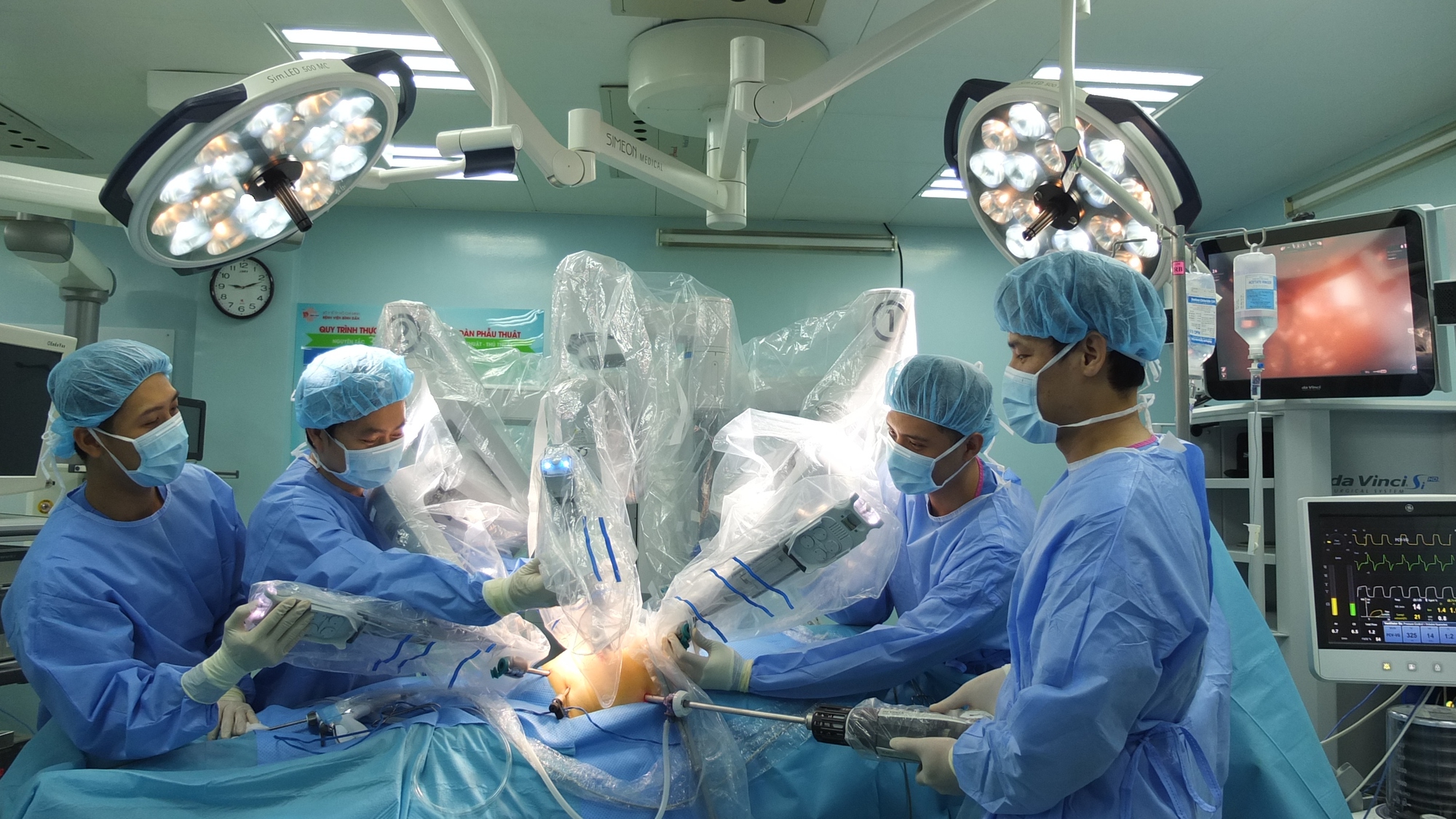
Robotic surgery at Binh Dan Hospital
The application of new techniques to expand the treatment capabilities of surgeons in surgery demonstrates a pioneering spirit and a desire to apply technology to bring even better treatment outcomes for patients.
"The success of robotic surgery, a new pinnacle of endoscopic surgery worldwide , successfully implemented at Binh Dan Hospital and many other hospitals in the country, is a prime example of how we may be behind but can catch up with some countries in the region and the world. Compared to some countries in Southeast Asia (ASEAN), robotic surgery in Vietnam has quickly achieved success in both quantity and professional quality," said Associate Professor Dr. Hung.
Associate Professor Hung added that the number of successful robotic surgeries at Binh Dan Hospital has reached 2,000. This is a number highly appreciated by the robotic surgery manufacturer in the US and surgeons at international scientific conferences. According to him, the surgical sector in Ho Chi Minh City has risen to become one of the training centers for doctors from several countries to learn about robotic surgery.
"To achieve these accomplishments, we owe it first and foremost to Ho Chi Minh City's development orientation and the support of stimulus loan packages from the Ho Chi Minh City People's Committee for healthcare development," Associate Professor Hung shared.
Resonance power
Regarding whether robotics is the most important technology in surgery today, Associate Professor Hung believes that robotic-assisted surgery, using specialized technology, expands the capabilities of surgeons' hands. This allows surgeons to perform surgical procedures in deep, hard-to-reach surgical fields or narrow areas of the body through smaller incisions.
"Specialized technology also allows for precise movements down to the smallest detail. The robotic arm rotates 540 degrees, offering greater flexibility than a human wrist, and provides 12x magnification with 3D image display. Robotic surgery is a progressive development, optimizing standard endoscopic surgery to increase the ability to completely dissect diseased organs and preserve the maximum function of healthy organs. This new technique helps patients experience reduced bleeding, less pain, smaller incisions, and faster post-operative recovery," Associate Professor Hung further shared.
Invest heavily in the field of surgery.
According to Associate Professor Dr. Tran Vinh Hung, to develop the field of surgery, it is necessary to train high-quality human resources with a dedication to the health of the people. At the same time, it is crucial to create favorable conditions for capable doctors to contribute and apply advanced technology in healthcare.
Simultaneously, it is necessary to promote international exchange and training of personnel, including anesthesiologists and resuscitation specialists. Investment in modern equipment and the construction of medical facilities, including operating rooms capable of performing large and complex surgeries, are crucial. Technical and management procedures should be standardized. In particular, for difficult and complex cases, interdisciplinary and inter-hospital collaboration is essential.
In July 2000, the U.S. Food and Drug Administration (FDA) approved the da Vinci robotic surgical system, the first robotic surgeon. In 2001, the FDA approved robotic prostatectomy. According to a 2022 report, nearly 6,000 da Vinci robotic systems are currently in operation, having performed 8.5 million surgeries worldwide. Globally, the highest proportion of robotic surgeries are performed in general surgery, urology, and gynecology.
Vietnam is one of the first countries in Asia to successfully perform robotic surgery on pediatric patients. In 2014, the National Children's Hospital inaugurated a center for robotic pediatric endoscopic surgery. In 2016, Binh Dan Hospital implemented robotic surgery for adults for the first time. In subsequent years, robotic surgery was applied at Cho Ray Hospital, K Hospital in Hanoi, and Vinmec Hospital in Hanoi. Recently, Tam Anh General Hospital also applied robots and AI (artificial intelligence) to neurosurgical procedures. Tam Anh Hospital will soon be bringing in the da Vinci robotic system.
According to Associate Professor Hung, robots and AI will help doctors diagnose, assess, and perform procedures with greater accuracy and speed... However, these are still only tools to assist surgeons. As humanity progresses, we will invent smarter tools. Conversely, as we improve these support tools, the diagnostic and treatment capabilities of doctors will expand.
"I am very happy, proud…"
Upon receiving the invitation to transfer robotic surgery techniques for gastrointestinal cancer treatment to doctors in the Philippines, I felt happy, proud, and also a little pressured. Happy and proud because I continued to be trusted and chosen by our neighboring country to provide training and technical support in robotic surgery following the technology transfer in 2019.
The pressure lies in the fact that the cases this time are more severe, requiring doctors to perform more complex techniques. But overall, I am confident that I can perform the task well because of my experience after 6 years of robotic surgery with more than 260 robotic surgeries for gastrointestinal cancer.
I myself have mastered the techniques and gained a lot of practical experience to share and guide my colleagues in the Philippines. The technical transfer trip concluded successfully, and through this trip, I also connected with more international cooperation activities, so that the transfer of techniques from Binh Dan Hospital in the Philippines, as well as the opportunity for Filipino doctors to come to Binh Dan Hospital to learn about surgical techniques, will be more widespread in the future.
Dr. Nguyen Phu Huu (Deputy Head of the Department of Gastrointestinal Surgery, Binh Dan Hospital)
"During the initial phase of deploying robotic surgery for adults at Binh Dan Hospital, some patients asked us whether they were operated on by a robot or a doctor. I replied that without a team of doctors sitting at the control panel, the robotic system could not simulate the doctor's hand movements to operate on the patient. To be able to control the robotic surgery system, each doctor must first be a surgical specialist with many years of experience and must undergo hundreds of hours of practical training on operating the robotic system," Associate Professor Dr. Hung said.
According to Associate Professor Hung, robots or machines do not possess the warm heart, compassion, and adaptability of humans in all situations. These are also essential qualities for a doctor. Therefore, in the future, we need more skilled and dedicated surgeons to operate surgical robots and master other supporting technologies.
Introducing surgical techniques to the international community.
According to Associate Professor Hung, in the field of surgery, Ho Chi Minh City has many specialties and techniques that can be introduced to countries in the region and internationally. For example, at Binh Dan Hospital, one of the hospitals specializing in urological, general, and thoracic and vascular surgery, there are groups of surgeons demonstrating and supporting the transfer of techniques abroad, such as in India, the Philippines, and Thailand.
"The trend in surgery is increasingly developing, with minimally invasive procedures offering maximum treatment results and optimal post-operative function preservation. We urgently need to develop further in the direction of minimally invasive diagnosis and surgery, alongside mastering classic, standardized techniques as a solid foundation," said Associate Professor Dr. Hung. (to be continued)
Source link
![[Photo] Prime Minister Pham Minh Chinh receives the Chinese Ambassador to Vietnam](https://vphoto.vietnam.vn/thumb/1200x675/vietnam/resource/IMAGE/2026/04/05/1775397481797_ndo_br_dsc-5512-jpg.webp)








































































































Comment (0)