

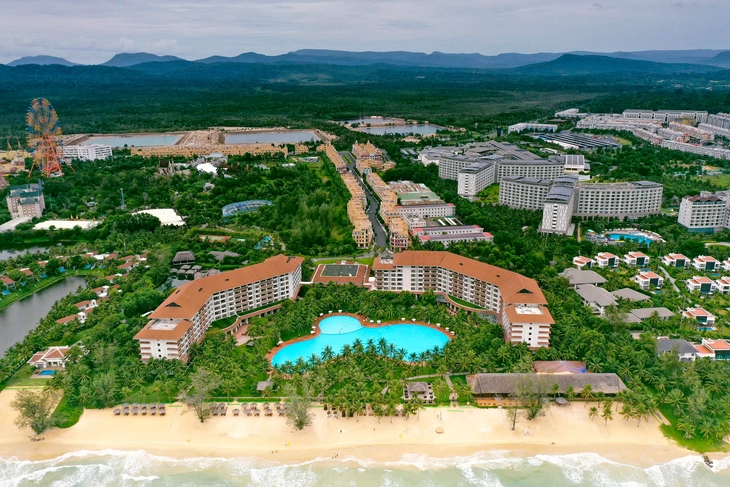
Phu Quoc Special Economic Zone, An Giang province (formerly Kien Giang province) - Photo: QUANG DINH
Following the merger of 13 provinces and cities in the Mekong Delta into 6, a new development space has opened up. This is not just a change in administrative boundaries, but also a pivotal moment to exploit the potential, strengths, and mobilize resources of each locality.
Overall, the Mekong Delta is facing not only three "downward spirals" as indicated in the annual Mekong Delta economic report: the spiral of insufficient investment from the budget, the burden of food security on the region's economic structure, and the spiral of declining human resource quality.
The Mekong Delta also faces three major obstacles: the depletion of natural resources and the environment, with increasingly severe erosion, saltwater intrusion, and climate change; the weakening of its economic strength, with fragmented agriculture , slow industrial development, and inadequate infrastructure; and the decline in human resources as young workers leave their hometowns and the quality of training does not meet the demands.
To rise, the Mekong Delta must overcome these obstacles and downward spirals. But what path forward should the provinces of the Mekong Delta take?
Over the next five years, following the Party congresses at all levels, it is necessary to decisively implement four key groups of solutions.
First, it is necessary to reposition localities on the national and regional development map. After the merger, it is necessary to review the planning and identify the competitive advantages of each province.
Central cities like Can Tho and Phu Quoc must be placed within the Southeast Asian urban network, not just confined to the region. Proper positioning to effectively mobilize and utilize resources and develop key products is the foundation for genuine regional linkages.
Next comes institutional, policy, and administrative reform. Local authorities must create a favorable investment and business environment, in line with the central government's reforms.
Qualified localities like Can Tho should boldly propose special mechanisms, but they must be implemented effectively, avoiding the recurring delays seen in the six previous groups of special mechanisms that the National Assembly approved for pilot implementation but which, after many years of implementation, "still yielded no results." Mechanisms are only meaningful when they are truly put into practice.
Transportation, urban, and rural infrastructure continues to be the "key to unlocking" the potential of localities. Regional connectivity cannot be discussed if transportation remains fragmented, urban development is haphazard, waste accumulates, and flooding occurs frequently.
National key projects such as the North-South Expressway (Western section), the Chau Doc - Can Tho - Soc Trang Expressway, the Can Tho - Ca Mau Expressway, Hon Khoai Port, etc., must be accelerated and completed on schedule.
At the same time, newly established provinces and cities must select the right key projects, linked to new development spaces, to create an infrastructure boost and pave the way for investment.
Human resources are the decisive factor in success or failure. Resolution 71-NQ/TW on education and training has opened the way for innovation.
Provinces need to reorganize their university, college, and high school systems to be more streamlined and improve quality.
The Mekong Delta cannot simply train personnel for agriculture; it must also have a workforce capable of mastering technology, adapting to digital transformation, serving the marine economy, urban areas, services, and international integration.
After the merger, the Mekong Delta not only has a larger scale but also greater opportunities for breakthroughs. If the region knows how to take advantage of its new development space and implements four groups of solutions synchronously, it can certainly rise strongly and become an important growth pole of the country.
Source: https://tuoitre.vn/lam-gi-de-cac-tinh-mien-tay-vuon-minh-2025100808591944.htm
![[Photo] General Secretary and President To Lam meets with National Assembly delegates from ethnic minorities.](https://vphoto.vietnam.vn/thumb/1200x675/vietnam/resource/IMAGE/2026/04/20/1776696701056_a1-bnd-8331-3342-jpg.webp)



![[Image] National Assembly discusses the implementation of the socio-economic development plan.](https://vphoto.vietnam.vn/thumb/1200x675/vietnam/resource/IMAGE/2026/04/20/1776696707422_ndo_br_img-20260420-185419-jpg.webp)







































































Comment (0)