

Many predictions for 2024 suggest that the rice market will remain vibrant as countries increase imports to ensure food security.
In 2024, Vietnamese rice will still prevail.
In 2023, Vietnamese rice prices witnessed successive surges, reaching the highest level in the world at the end of the year. According to the Vietnam Food Association (VFA), starting in June, Vietnam's rice exports continuously increased. In the last month of 2023, the price of Vietnamese rice consistently remained at $663 per ton, a very high price in recent years.
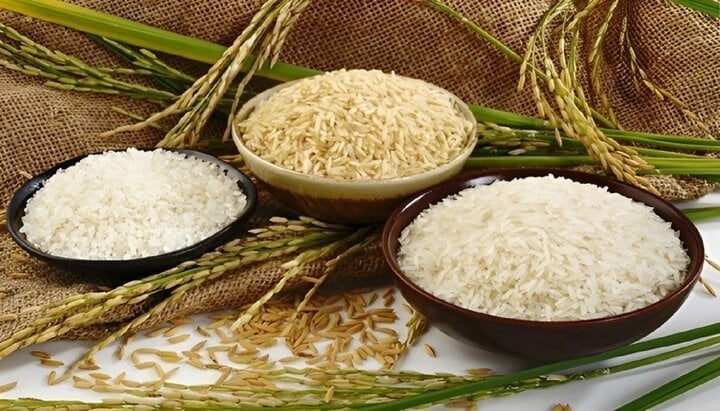
Vietnamese rice has been recognized as the best rice in the world.
Forecasting the rice export situation in 2024, experts analyze that rice prices will remain high and are unlikely to fall below 640-650 USD/ton. The reason for this is the increasing scarcity of rice worldwide, while Vietnam holds a significant opportunity in rice exports.
Professor Vo Tong Xuan stated that the current context indicates that the global food supply will become increasingly scarce. India has not resumed rice exports, and Thailand has also reduced its rice exports. Meanwhile, China consistently faces rice shortages, and other countries such as the Philippines, Indonesia, Türkiye, and Chile are all competing to buy Vietnamese rice. Furthermore, countries in the Asian region are affected by El Niño and climate change, leading to reduced rice production in almost all of them.
Professor Vo Tong Xuan believes that the areas bordering Cambodia, including the northern parts of Kien Giang, An Giang , Dong Thap, Long An, etc., could potentially cultivate about 1.5 million hectares of rice. These are areas that never lack fresh water and are not susceptible to saltwater intrusion, making them potentially food security zones for the nation.
In other coastal areas, we don't grow rice during the dry season, as it wastes freshwater—which is already scarce during the dry season—and is not very efficient. However, rice cultivation is very successful during the rainy season. After the rain stops, saltwater is introduced to raise shrimp and fish, reserving freshwater for food security.
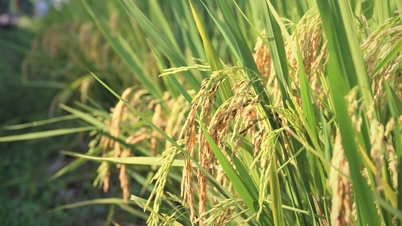
In the central region, farmers still grow three rice crops per year. “In other countries, their rice varieties are long-duration, taking four months to harvest, so they can only grow two rice crops. In Vietnam, thanks to techniques for arranging cropping patterns, planning areas for one, two, or three crops per year, and having many short-duration rice varieties that can be harvested in about 90-100 days, we can grow three crops with high yields.”
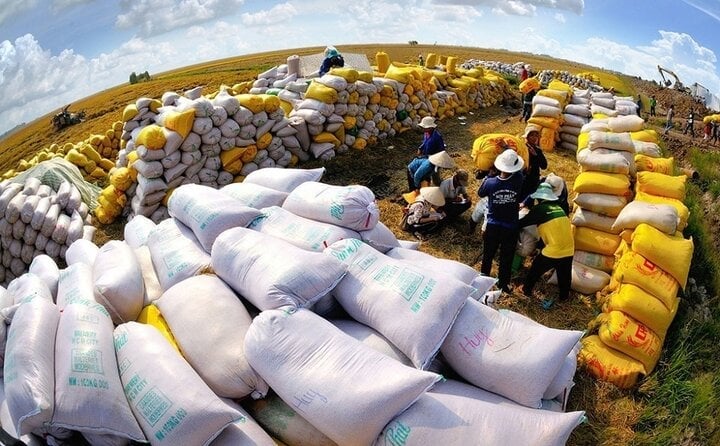
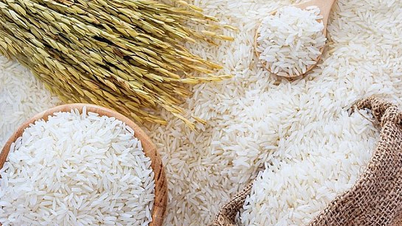
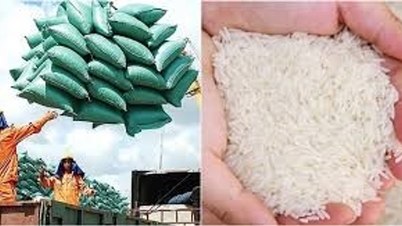
Export rice prices have reached a record high and are expected to remain high in the near future. (Illustrative image).
"In recent years, we have added genes for delicious rice to rice plants, resulting in even better quality, so we are completely confident in the competitiveness of our products. With these advantages, I believe this is a rare opportunity to elevate Vietnamese rice globally, and we should not and cannot miss it," said Professor Vo Tong Xuan.
What should you do to seize this golden opportunity?
While 2024 is predicted to be a key year for rice exports and elevating the status of Vietnamese rice, Mr. Huynh Van Thon, Chairman of the Board of Directors of Loc Troi Group, stated that the current market is very favorable for selling, but not yet favorable for domestic rice purchasing businesses.
According to him, unsustainable business practices still exist in Vietnam between producers and purchasing companies. When rice prices rise, many farmers are willing to break their agreements and sell to other traders at higher prices instead of the companies they agreed to.
This not only causes losses for purchasing and processing businesses due to advance payments, but also creates difficulties in export supply. More than ever, this situation needs to be urgently addressed for sustainable development.
Mr. Nguyen Van Don, General Director of Viet Hung Co., Ltd., also commented that 2024 is a year with great potential for rice exports. Domestically, the beginning of the year will see the start of the Winter-Spring harvest, with a very large output, providing an abundant supply for businesses.
This is a major advantage for Vietnam in exporting rice. However, if there is a lack of or weak linkage between businesses, farmers, and cooperatives, as is currently the case, export businesses will be left without initiative, and the supply of raw materials will also be difficult to sustain.
“Currently, some rice exporting businesses are still hesitant to sign export orders with partners at the beginning of the year because they haven't secured their supply sources. This limitation needs to be overcome immediately, otherwise it will hinder the boom in rice exports. Our experience is that businesses must source from many different places, such as buying directly from producers, or establishing partnerships with businesses and cooperatives, to avoid being caught off guard by signing sales contracts first and then purchasing goods later,” Mr. Don said.
Meanwhile, Mr. Pham Thai Binh - Chairman of the Board of Directors of Trung An High-Tech Agriculture Joint Stock Company (Trung An Rice) - predicts that, given the extreme climate change and some political events and conflicts around the world, rice shortages will continue in 2024. However, some rice-exporting countries are actively seeking solutions to overcome rice shortages in the coming years.
Therefore, in 2024, if we want Vietnamese rice to continue to be the world's best, we must make good use of the opportunity, quickly address shortcomings to seize the "golden" opportunity, and set rare records in history like in 2023.
PHAM DUY
Source


![[Photo] Prime Minister Pham Minh Chinh receives the Chinese Ambassador to Vietnam](https://vphoto.vietnam.vn/thumb/1200x675/vietnam/resource/IMAGE/2026/04/05/1775397481797_ndo_br_dsc-5512-jpg.webp)





































































Comment (0)