

With its hilly terrain, climate, and large forest areas, the province is suitable for developing economic models under the forest canopy such as cultivating medicinal plants, growing native fruit trees, raising livestock and poultry, beekeeping, as well as developing ecotourism and community-based tourism associated with the forest...
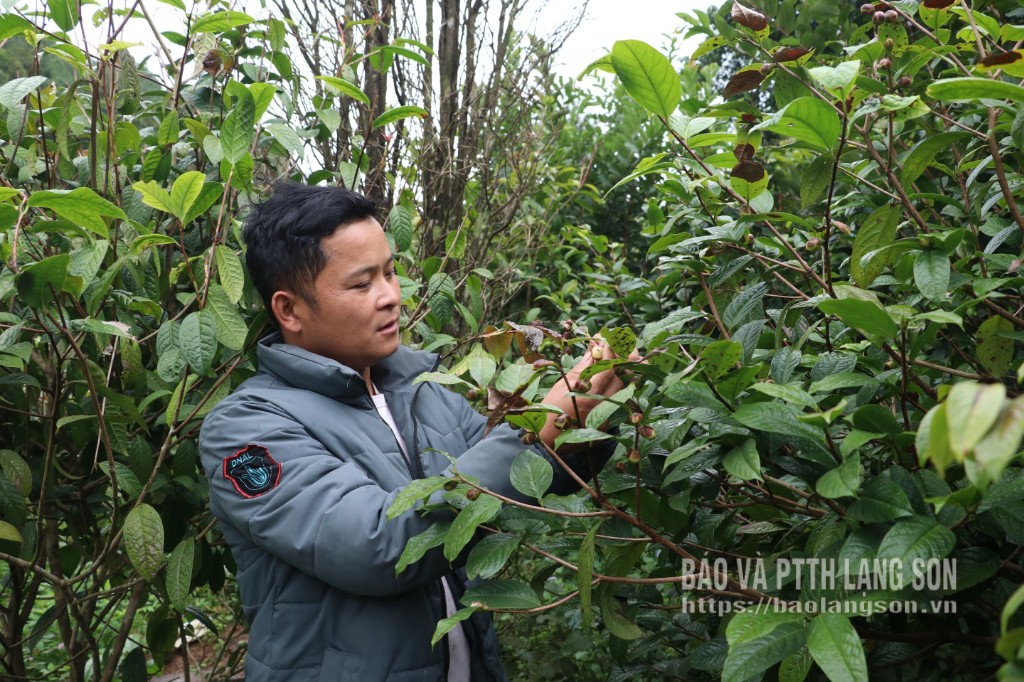
The family of Mr. Trieu Huu An, in Na Xom village, Loi Bac commune, is one of the exemplary households that have effectively developed the model of growing golden camellia trees under the forest canopy. Mr. An shared: "Taking advantage of the family's mangrove forest area, since 2019, my family has started planting golden camellia trees under the forest canopy. Currently, my family has about 2,000 golden camellia trees, of which 400 are ready for harvest. On average, my family harvests about 2 quintals of dried golden camellia tea each year, bringing in an income of over 100 million VND/year."
Similarly to Mr. An's family, Mr. Vi Van Cuong's family in Dong Nhat village, Chau Son commune, also utilizes their acacia and eucalyptus plantation land to develop a model of raising Tien Yen chickens under the forest canopy. Mr. Cuong said: "Since 2001, my family has improved the land to plant acacia and eucalyptus trees on an area of about 10 hectares. In 2020, my family invested in raising chickens under the forest canopy. On average, my family raises two batches per year, each batch ranging from 3,000 to 4,000 chickens, bringing in an income of 300 million VND."
According to statistics from specialized agencies, the province currently has over 580,000 hectares of forested land, a significant advantage for people to develop production under the forest canopy. Specifically, many families have utilized the land under the forest canopy to cultivate medicinal plants such as cardamom, rehmannia, golden flower tea, and codonopsis, covering an area of 960 hectares. In addition, people have also developed models such as beekeeping, raising chickens, raising goats, and growing tea plants, bringing in an average income of 80 to 300 million VND per household per year.
To effectively exploit the development potential of models under the forest canopy, in recent years, the provincial specialized departments and local authorities have focused on training and guiding people to apply scientific and technical advancements in planting, caring for, and harvesting medicinal plants and specialty crops under the forest canopy; building and replicating model projects for people to learn from and follow; and supporting the development of collective economic models to promote production along the value chain...
Mr. Le Van Cha, Head of the Forest Utilization and Development Department of the Provincial Forest Protection Sub-Department, said: Economic development models under the forest canopy contribute to improving the efficiency of forest land use, increasing value per unit area, creating sustainable livelihoods, and raising people's income. In addition, economic development under the forest canopy also contributes to protecting the ecological environment and responding to climate change. In the coming time, the unit will continue to promote and implement policies supporting the development of economic models under the forest canopy, especially expanding the model of cultivating medicinal plants.
It is evident that developing the economy under the forest canopy has opened up a new and sustainable direction for the forestry sector. With the coordinated efforts of all levels and sectors, and the active participation of the people, economic models under the forest canopy not only contribute to increasing people's income but also preserve the "green lungs" of the forest, creating a foundation for the long-term socio-economic development of the province.
Source: https://baolangson.vn/khai-thac-tiem-nang-kinh-te-duoi-tan-rung-5068655.html
![[Photo] Prime Minister Pham Minh Chinh receives the Chinese Ambassador to Vietnam](https://vphoto.vietnam.vn/thumb/1200x675/vietnam/resource/IMAGE/2026/04/05/1775397481797_ndo_br_dsc-5512-jpg.webp)


































































Comment (0)