


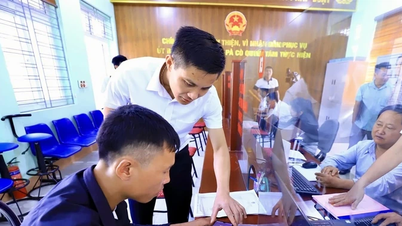
Residents come to the Long Coc Commune Public Administrative Service Center to provide information for the construction of the land database.
The Provincial People's Committee assigned the Department of Agriculture and Environment (ARD) as the focal point to oversee and compile the results of the campaign; provide technical guidance on collecting, updating, correcting, and supplementing land information and unique land parcel identification codes. At the same time, the Provincial Police Department was tasked with coordinating the provision of personal identification numbers of land users and homeowners to the People's Committees of communes, the ARD Department, and coordinating with the Department of Administrative Management of Social Order ( Ministry of Public Security ) to cross-check and verify the information and data of land users.
The construction of the land database is absolutely guaranteed in terms of information security and cybersecurity during the organization, implementation, operation, and connection and sharing of the national land database. The People's Committees of communes and wards have established steering committees and working groups to implement the campaign; collecting land ownership certificates and identity cards of land and housing users that have not yet been included in the land database and scanning/capturing them for transfer to the Department of Agriculture and Environment. The Department of Agriculture and Environment has established a working group to carry out the campaign to enrich and clean the land database in the province, including organizing training, reviewing, and cross-checking data in 100% of communes and wards; completing the updating, standardization, and handover of the cleaned data.
Phu Tho province identified the campaign to enrich and clean up the national land database as a particularly important task, with a large volume and tight deadline, but the province has implemented it decisively, synchronously, and achieved outstanding results. Specifically, the province successfully synchronized 100% of its data with the national land database, covering 3,041,511 land parcels, including 315,815 parcels that have been completed to be "correct - complete - clean - active," accounting for 10.4% of the total number of land parcels; 2,725,696 parcels have been reviewed and standardized according to group 2 for further cleaning in the next phase; 611,171 out of 947,038 land use right certificates that need to be collected have been collected, reaching 64.5%; and data has been scanned and entered into 301,072 land parcels that previously did not have a database. Verifying the population and cross-referencing 1,437,444 land users with the national population database will serve as the basis for cleaning up personal information across the entire system. This is a huge undertaking, especially in the context of the post-provincial merger, with scattered data, maps from various periods, different operating software, and years of accumulated paper records.
The results were achieved thanks to the decisive involvement of the entire political system. The Provincial People's Committee issued a plan, established a steering committee and working groups at the provincial and grassroots levels, issued a series of documents to urge and inspect progress weekly; established a centralized command center, mobilized 20 internal processing machines, 5 synchronized machines, and a 24/7 operating team to ensure continuous processing. All levels and sectors organized extensive communication campaigns to every village and residential area, mobilizing people to provide certificates and citizen identification cards, and cooperating in verifying residents – a crucial factor in the speed of data cleaning.
The Department of Natural Resources and Environment is working closely with the police, tax, science and technology, and telecommunications sectors to verify residents, cross-check data, and connect and share information through a streamlined one-stop process. Simultaneously, it is applying modern technologies to digitize online data, support data creation, and conduct trials, preparing the foundation for a smart land management system for the next phase.
Comrade Hoang Xuan Hoan - Deputy Director of the Department of Agriculture and Environment, said: Thanks to these solutions, the campaign has ensured the completion of the Central Government's key requirement on the first-ever synchronization of the national database and the standardization of the province's land data after the merger. The results of the campaign have brought about four core values, which serve as a foundation for the Department of Agriculture and Environment to improve the efficiency of state management of land in the 2026-2030 period. This has created a standardized data set – the foundation for modern land management.
For the first time, the province has a complete picture of over 3 million land parcels across 148 communes and wards after the merger. Spatial data, attributes, and scanned records have been compiled and standardized, creating a foundation for continued annual cleaning. The system has also established over 1.9 million land parcel identification codes, creating a foundation for integration with digital addresses and the national population database in the future.
This is a crucial condition for accelerating administrative procedure reforms, reducing processing time by 30-50%; and enhancing the efficiency of land management and supervision. In addition, a clean land database helps to quickly detect violations such as encroachment, illegal land use changes, and loss of public land; supports planning, compensation, land clearance, inspection, and auditing; and provides an accurate basis for calculating and constructing land price tables, determining financial obligations, and bank appraisals.
The campaign also laid the groundwork for building a smart land management operating system platform, enabling land parcel lifecycle management and promoting the socialization of database creation... in line with the direction of the Ministry of Finance and the province. This also serves as a foundation for the province to implement multi-sectoral connectivity.
Connecting and sharing land databases with the provincial administrative procedures and electronic tax systems helps shorten processing times, reduce errors, and increase transparency. This improves the quality of public land services, reforms administrative procedures related to land for citizens and businesses in an electronic environment. Simultaneously, it helps the Department of Agriculture and Environment shift from manual management to data-driven management, enhancing operational efficiency and better serving citizens and businesses.
Turquoise
Source: https://baophutho.vn/lam-giau-lam-sach-co-so-du-lieu-dat-dai-248429.htm



![[Image] Bridges and roads connecting the eastern part of Ho Chi Minh City](https://vphoto.vietnam.vn/thumb/1200x675/vietnam/resource/IMAGE/2026/04/16/1776328595108_ndo_br_bh-vt5-jpg.webp)





















































![[Infographic] Details of the Hanoi-Quang Ninh High-Speed Railway Project](https://vphoto.vietnam.vn/thumb/402x226/vietnam/resource/IMAGE/2026/04/16/1776338188424_anh-man-hinh-2026-04-16-luc-18-16-10.png)
![[Photo] National Assembly Chairman Tran Thanh Man meets with the Speaker of the Georgian Parliament](https://vphoto.vietnam.vn/thumb/402x226/vietnam/resource/IMAGE/2026/04/16/1776338494029_anh-man-hinh-2026-04-16-luc-18-21-21.png)


















Comment (0)