

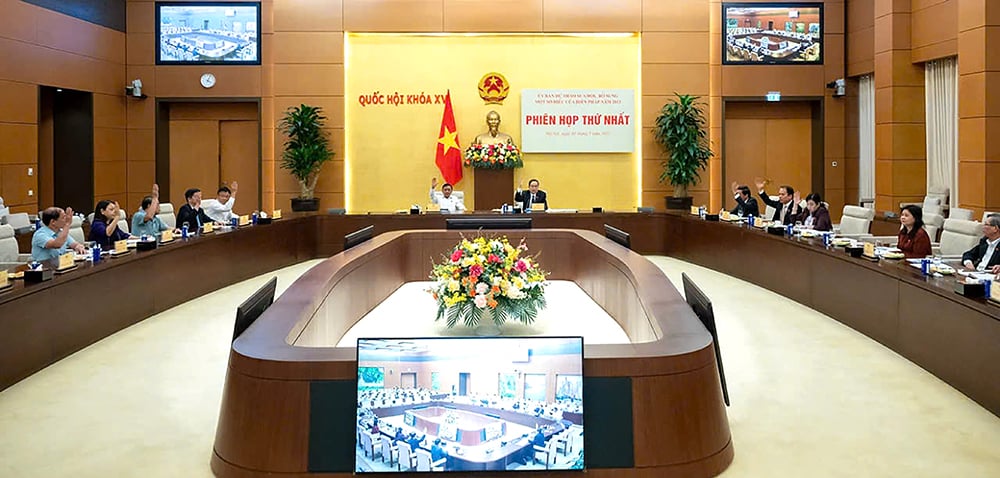
The Constitution is the fundamental and most important law of every nation, the highest legal document regulating the main, principled, and fundamental relationships of social life, with a very strict process of creation and amendment. However, the Constitution is not immutable but needs to be amended and supplemented to suit the development of society and the interests of the people. Since the founding of the country, Vietnam has amended its Constitution five times.
The 1946 Constitution was the first Constitution of the Democratic Republic of Vietnam, marking a significant turning point in the country's development. The 1959 Constitution marked a new stage of development for the Vietnamese State during the period of socialist construction in the North. The 1980 Constitution marked a new stage in the construction of socialism after the country achieved complete independence. The 1992 Constitution is considered the early Constitution of the reform process, reflecting a new stage of development for the State during this period. The 2013 Constitution reflects the continued development of the country during the reform and international integration period.
In 2025, the Constitution will continue to be amended, but in a limited manner, expected to only affect about 8 out of 120 articles of the 2013 Constitution, with a focus on two main areas. Specifically: regulations related to the Vietnam Fatherland Front and socio-political organizations; regulations in Chapter IX to implement the two-tiered local government model; and transitional provisions to ensure the smooth and uninterrupted operation of local governments, in line with the planned restructuring and merger roadmap.
The Standing Committee of the National Assembly comprehensively assessed the implementation of the 2013 Constitution, the 2015 Law on the Vietnam Fatherland Front, and the 2015 Law on the Organization of Local Government (amended and supplemented) over the past 11 years. It also clearly identified achievements, existing shortcomings and limitations, and their causes; thereby proposing amendments and supplements to several articles of the 2013 Constitution. The Standing Committee of the National Assembly emphasized the need to amend and supplement the Constitution in the context of building a modern national and local governance system, applying digital technology , and integrating internationally. The goal is to streamline and centralize administrative functions, reduce intermediate levels, improve the efficiency of administrative procedures, mobilize the masses, and reduce overlaps. Reform must go hand in hand with improving the quality of officials, applying technology, and combating waste. The amendments also aim to implement the spirit of the Party's resolutions on reforming the organizational structure of the political system and building a socialist rule of law state.
Specifically, the Standing Committee of the National Assembly proposed amending and supplementing Article 9 to provide a more comprehensive and all-encompassing definition of the position, role, functions, tasks, and powers of the Vietnam Fatherland Front and its member organizations under the new organizational model after restructuring. At the same time, it affirmed that the Vietnam Fatherland Front is a part of the political system led by the Party, the political foundation of the People's Government, and represents and protects the legitimate rights and interests of the people. Article 9 is expected to be amended and supplemented to provide a general definition of socio-political organizations (trade unions, farmers' associations, youth unions, women's unions, veterans' associations) directly under the Vietnam Fatherland Front, operating uniformly within the Vietnam Fatherland Front, while maintaining relative independence.
It is planned to amend and supplement Article 10 to ensure the continuation of the position and role of trade unions, in accordance with the amended and supplemented Article 9, which stipulates the role of representing workers at the national level in labor relations and international relations. Article 84 will be amended and supplemented to no longer stipulate that central agencies of member organizations of the Vietnam Fatherland Front have the right to submit draft laws and ordinances.
Regarding local government, the Standing Committee of the National Assembly proposes amending and supplementing Article 110 as follows: Instead of specifying the detailed system of administrative units with the names of each type of unit at three levels, only a general definition of two levels (provinces, centrally-administered cities; and administrative units below the level of provinces and centrally-administered cities) will be provided. The Law on Organization of Local Government will specifically define administrative units below the provincial level (communes, wards, special zones) to meet the requirements of administrative unit restructuring and ensure the long-term stability of the Constitution.
Proposed amendments and additions to some technical content in Articles 111, 112, 114, and 115 aim to avoid using the term "local government level" to reflect the uniformity of the model (including the People's Council and the People's Committee), prevent confusion, and adjust regulations to suit the new organizational model. This will promote decentralization and delegation of power between central and local government agencies, creating greater autonomy for local governments based on the principle of "local authorities decide, local authorities act, and local authorities are responsible"...
The timeframe for amending and supplementing certain articles of the Constitution must be completed before June 30, 2025, to take effect from July 1, 2025. It is expected that approximately one month (from May 6 to June 5) will be allocated for public consultation on the proposed amendments through various channels, ensuring that the process of amending Vietnam's supreme legal document adheres strictly to legal regulations, is legally sound, and enjoys high levels of consensus. This will serve as the basis for further steps in the journey of "reform within reform," "breakthrough within breakthrough," marking a significant transformation for the country.
Source: https://baoangiang.com.vn/lan-sua-hien-phap-dac-biet-a420417.html


![OCOP during Tet season: [Part 1] Ba Den custard apples in their 'golden season'](/_next/image?url=https%3A%2F%2Fvphoto.vietnam.vn%2Fthumb%2F402x226%2Fvietnam%2Fresource%2FIMAGE%2F2026%2F01%2F26%2F1769417540049_03-174213_554-154843.jpeg&w=3840&q=75)




Comment (0)