

Two months ago, Minh Tung called his cousin to ask for help finding a cheap room to rent so he could return to Hanoi for work, after nearly four years back in his hometown.
Previously, Mr. Tung, 37, and his wife, from Quang Binh, worked as office employees in Hanoi, earning a combined income of approximately 20 million VND. After deducting living expenses and raising two young children, they saved over 5 million VND each month.
But ever since the two children were born, Mr. Tung has always felt guilty for letting them live in the cramped and suffocating conditions of the city. The father feels most guilty when driving his children through congested traffic during Hanoi's peak hot days.
They decided to return to their hometown to "live a simple but happy life." Nguyen Thi Hong, his wife, found a job at a company more than 20 km from their home, earning half the salary of her previous job. Tung rented a space to open a rice trading agency.
There used to be three rice dealers in the village. They were all related, so they only bought from acquaintances. His relatives also came to support them, but mostly bought on credit. After four years of closing the dealership, he still hadn't collected all the money from the rice sales.
Living near the sea, Mr. Tung switched to opening a beverage stall, enlisting his wife, mother, sister, and cousins to help with serving. After deducting all expenses, he earned 500,000 dong a day. But the stall only stayed open for three summer months.
He followed his friend to work as a real estate agent. After a few months, Tung's job ended because the real estate boom quickly passed. For many months, the whole family relied solely on Hong's meager 5 million dong salary. The children grew older, needing more than just play; they had to study and eat more. Family conflicts arose from this.
"It's better to live in cramped accommodation than to struggle financially ," he concluded.
The man left his wife and children behind in his hometown and went to the city alone to make a living. Currently, Mr. Tung is starting his days in Hanoi as a taxi driver, with an unstable income, but he still has enough to send back to his wife.
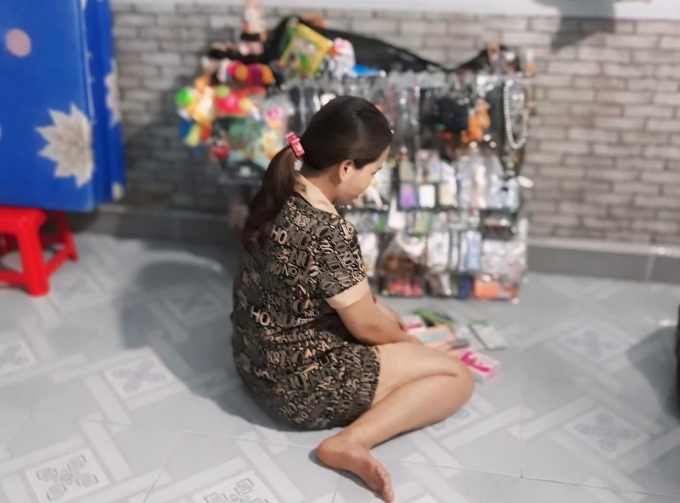
Ms. Thuy prepares her goods in her rented room in Bien Hoa, Dong Nai , on the afternoon of April 17th, getting ready to sell them the following morning. (Photo provided by the subject)
When the Covid-19 pandemic broke out, Le Thi Thuy, 42, and her husband from Thanh Hoa decided to return to their hometown, ending their life as street vendors in Bien Hoa, Dong Nai. They told each other that this time they were determined to stay in their hometown because they were so tired of living far from home.
Her husband ran a duck restaurant in front of their house, but there were rarely any customers because people in the countryside only eat home-cooked meals. Thuy worked at a garment factory, earning over 4 million dong a month, while they had to support three young children and her elderly mother. After two years, she was laid off because the company ran out of orders. They had to send their children to daycare and return to the city after struggling for several months without finding work.
The "second migration to the city" of people like Mr. Tung and the couple Ms. Thuy is a new phenomenon because many had previously intended to return to their hometowns and never came back. For example, a survey report on the post-lockdown labor market in Ho Chi Minh City in 2022 recorded that 42% affirmed they "would not return to the city".
In 2022, a survey by the International Organization for Migration (IOM) and the Ho Chi Minh City branch of the Vietnam Chamber of Commerce and Industry (VCCI) of Commerce and Industry (VCCI) showed that 15.5% chose to return to their hometowns, while 44.6% remained undecided.
However, the PAPI 2023 report published by UNDP in early March this year shows that nearly 22% of people want to migrate to Ho Chi Minh City, and 15% want to migrate to Hanoi. Two of the three biggest reasons given by people are a desire for a better working environment (22%) and a better natural environment (17%).
Research team member, Dr. Paul Schuler of the University of Arizona, USA, suggests that the desire to move to large cities to find work is directly proportional to the increase in the number of people reporting poor or very poor household economic conditions in 2023 compared to surveys conducted between 2017 and 2022.
"What is noteworthy is that the percentage of people who have a more negative assessment of their household economic situation has risen to 26% compared to five years ago, second only to 29% in 2021," said Paul Schuler.
Associate Professor Dr. Nguyen Duc Loc, from the Institute for Social Life Research, believes that these figures show that many people think about returning to their homeland to reconnect with it, but due to livelihood circumstances, they are forced to leave again.
According to experts, Vietnam's economic development follows a model of key economic sectors, with development resources concentrated in urban areas, leading to a significant disparity between rural and urban areas. Despite wanting to return to their hometowns, many people cannot find jobs that match their skills, expertise, interests, or living needs.
Young people can find jobs in factories, but it's very difficult for older people like Thuy to find suitable positions that provide an income.
According to sociologist Dr. Pham Quynh Huong, besides economic and educational factors, other elements such as urban services, urban culture and lifestyle, and urban civilization are what make many people want to live in the city. Some people want to move to the city because they are unsure of what they want or want to explore and challenge themselves in a different environment. "Some people realize their strengths in the city, but others realize they want to return to their hometown," Dr. Huong said.
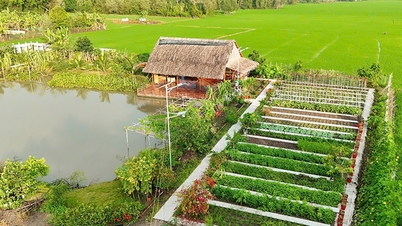
Nguyen Van Truong, 28, and his wife, from Hung Yen, decided to return to their hometown three years ago to help their parents cultivate over 3 hectares of organically grown vegetables. Their stable income means they don't face financial pressure, but they always feel sad and miss the vibrant life in Hanoi.
After living in his hometown for over a year, when his daughter turned three, Truong decided to return to the city. Besides fulfilling his emotional needs, he wanted his daughter to have a better educational environment, and he and his wife also wanted to pursue further education to improve themselves.
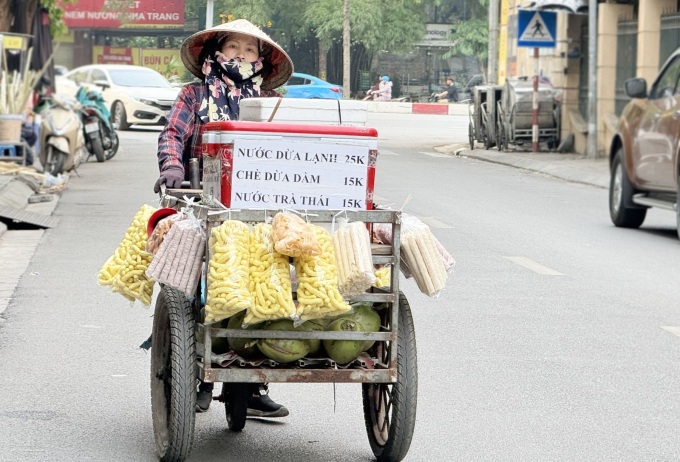
A woman from out of town sells goods on Tran Tu Binh street, Cau Giay district, Hanoi, on the afternoon of April 19. Photo: Pham Nga
Mr. Loc believes that going to work in the city is a natural process. Whether driving a taxi, selling goods on the street, or working in an office, everyone contributes to society. However, in the long run, the influx of workers into cities for informal jobs will create an excessively precarious labor force, putting pressure on the social security system.
For those who want to return to their hometowns but have to live in the city, like Mr. Tung or Ms. Thuy, Mr. Loc advises them to change their mindset about life. Nowadays, most people are influenced by the consumer wave, so they always feel deprived and are caught in a whirlwind of competition. When you have a mindset of having enough, and know how to organize your livelihood, you may not be rich, but you can still live comfortably.
Ms. Quynh Huong believes that those who want to stay in their hometown but end up moving to the city may not truly understand their own needs. "Leaving is also a way to truly understand what you want and need," she said.
In terms of policy, Mr. Loc suggested that after 30 years of implementing key economic policies, Vietnam needs to develop a more harmonious and balanced strategy between rural and urban areas to narrow the gap.
"Like China, in previous years they focused their efforts on urban areas, but in recent years they have shifted to compensating for the rural areas, so that workers can return," he said.
Tung still longs to return to his hometown. But after four years of struggling in his birthplace, he knows he needs capital for long-term stability instead of just returning whenever he feels like it.
"It's really hard to live in poverty and be happy," he said.
Pham Nga
Source



























































































Comment (0)