

Following in the footsteps of oyster divers.
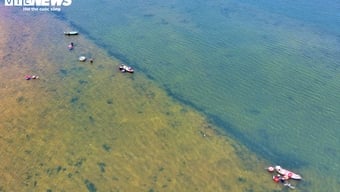
The Nhật Lệ River flows from its source to the Quán Hàu area in Quảng Ninh commune, where it "transforms" and splits in two, forming a small islet that locals call Cồn Hàu (Oyster Islet). Notably, this section of the river is home to a concentration of oysters, a highly nutritious mollusk and a popular delicacy.
Opposite Con Hau is Binh Minh village (formerly known as Phu Binh village). Perhaps because they live next to this "natural oyster deposit," the people of Binh Minh village have chosen oyster diving as their livelihood for generations.
Previously, when oysters were abundant, during the oyster season (spring), people only needed to use a long-handled iron rake to harvest them or go diving (diving without machinery) to collect them. For the past 10 years or so, the oyster resources have been depleted, and to catch oysters, the people of Binh Minh have switched to using diving equipment.
 |
| After nearly an hour of diving to the bottom of the river, Mr. Chau brought a bag of oysters onto the boat - Photo: PP |
One day in early April, I asked to accompany Mr. Le Dai Chau (55 years old) - who has been involved in oyster diving for over 30 years - to learn about this arduous and dangerous profession.
After a quick breakfast of sticky rice, Mr. Chau steered his small boat away from the dock. About 20 minutes later, he stopped the boat in the river area above the Nhat Le 3 bridge, about 6km from the sea.
Having spent over 30 years diving for oysters, Mr. Chau knows every shallow and deep section of the Nhat Le River, which has sustained his family. According to him, this stretch of river has many large rocks, where oysters typically attach themselves to live.
Anchoring his boat in the middle of the river, Mr. Chau prepared the necessary equipment: a diving suit, goggles, gloves, an iron bar for prying oysters, a mesh bag, and an oxygen supply machine. Thanks to this equipment, divers like Mr. Chau can work at depths of 5-10 meters for extended periods.
After carefully checking the air hose, he put on his clothes and goggles, then tied a lead weight and a chain weighing nearly 20kg around himself to keep stable at the bottom of the river. "Dive in the river is harder than dive in the sea because the current is strong, and without lead weights, it's very difficult to stay steady," Mr. Chau shared.
Having said that, he plunged into the water. Just seconds later, his body sank completely beneath the river's surface, leaving behind small, regularly rising bubbles.
Nearly an hour later, he surfaced with a net full of oysters. "Oysters are scarce now; before, it only took ten minutes to fill one," he said, then quickly emptied the oysters into his boat and continued diving. The work repeated itself for many hours.
After nearly six hours submerged in water, Mr. Chau collected a boatload of oysters mixed with rocks. He estimated that after shucking, the amount would be only about 10 kg. At a selling price of 120,000 VND/kg, after deducting costs and labor for shucking, he earned approximately 700,000 VND…
Oyster stocks are dwindling, and the number of divers is decreasing.
In Binh Minh village, oysters have become an inseparable part of people's lives. While the men dive into the river to catch them, the women stay at home diligently shucking the meat, packaging it, and taking it to the market to sell. Thanks to oysters, many families have a stable life, and their children can receive an education.
However, in recent years, due to overexploitation and the impact of climate change, the oyster population in the Nhat Le River has been declining.
According to Mr. Le Van Thang, a veteran diver, the number of people still practicing this profession can be counted on the fingers of one hand. Many have had to abandon the profession because they no longer have a sufficient source of income, while the work is too arduous and dangerous.
 |
| Mr. Le Dai Chau anchors his boat above Nhat Le 3 bridge, beginning a day of oyster diving at the bottom of the river - Photo: PP |
Every day, divers have to work long hours at the bottom of deep rivers, facing strong currents and many risks. When they are young, they can endure it, but in old age, their health declines, and illness inevitably follows.
Mr. Vo Xuan Duong, Head of Binh Minh village, said: The village currently has 230 households with more than 1,000 inhabitants. During its "golden age," most families in the village worked in jobs related to oysters, but now only about 40% of households remain engaged in fishing, aquaculture, and seafood processing, including about 10 households who work as oyster divers in the river.
Along the Nhật Lệ River, oysters have become a specialty dish, rich in nutrients. Not only locals but also tourists visiting Đồng Hới want to enjoy a bowl of oyster porridge or savor a plate of grilled oysters with scallions and butter. The reputation of Nhật Lệ oysters has spread far and wide, winning numerous awards at national food fairs.
According to tourists, oysters can be found in many places, but nowhere are they as delicious as those caught in the Nhat Le River. Perhaps, when the Nhat Le River reaches Quan Hau, the salty and fresh currents blend, creating a unique and distinctive flavor in the oysters, making them subtly sweet and unlike anything else.
“The job of diving for oysters at the bottom of the Nhat Le River may sound simple, but it's incredibly hard work. Sometimes, even in freezing weather, we have to go into the water to find something to eat. Besides physical strength, divers need skill, quick reflexes, and keen eyesight, because the riverbed is always full of hidden dangers. Even so, we have maintained this profession for many years, because it's not only a source of income but also a traditional occupation deeply connected to our hometown river…,” Mr. Le Dai Chau shared.
Without any attempt to hide it, many people in Binh Minh village regularly import farmed oysters from elsewhere and soak them in the Nhat Le River water in front of the village before shucking them and selling them to buyers. And although the oysters are imported, soaking them in the Nhat Le River water makes them fatter and sweeter... This is something the locals know and do, but they can't explain why.
To "preserve" oysters in the Nhat Le River, local authorities have experimented with various models such as enclosure and protection of natural oyster populations. Some households in Binh Minh village have also brought oyster spat from other areas for cultivation, but so far without success due to climate change, unusual rainfall and flooding, and incompatibility with the local environment and water salinity.
Therefore, for oyster divers in Binh Minh village, their family's livelihood largely depends on the natural oyster resources in the Nhat Le River. In years with favorable weather and abundant oyster growth, oyster divers earn an income; in years of poor harvests, they have to put aside diving and find other ways to make a living. Consequently, the number of oyster divers in Binh Minh village fluctuates from year to year.
Phan Phuong
Source: https://baoquangtri.vn/xa-hoi/202604/lang-lan-hau-ben-song-nhat-le-6291321/
![[Photo] My Son at night: A thousand-year-old heritage site amidst the Milky Way](https://vphoto.vietnam.vn/thumb/1200x675/vietnam/resource/IMAGE/2026/04/15/1776261039184_ndo_br_chon6-jpg.webp)
![[Photo] Mrs. Ngo Phuong Ly meets and exchanges views with Mrs. Peng Li Yuan](https://vphoto.vietnam.vn/thumb/1200x675/vietnam/resource/IMAGE/2026/04/16/1776277858080_phu-nhan-1-jpg.webp)
![[Photo] National Assembly Chairman Tran Thanh Man attends the opening session of IPU-152](https://vphoto.vietnam.vn/thumb/1200x675/vietnam/resource/IMAGE/2026/04/16/1776277863731_ctqh5-jpg.webp)
![[Photo] The General Secretary, President and his wife meet with Vietnamese-Chinese friendship leaders.](https://vphoto.vietnam.vn/thumb/1200x675/vietnam/resource/IMAGE/2026/04/15/1776264829725_vna-potal-tong-bi-thu-chu-tich-nuoc-to-lam-gap-mat-nhan-sy-huu-nghi-viet-nam-trung-quoc-8703641-3130-jpg.webp)







![[Infographic] How to register to buy social housing in the Thanh Sen ward project?](https://vphoto.vietnam.vn/thumb/402x226/vietnam/resource/IMAGE/2026/04/16/1776306626899_fb_tren-dia-ban-tinh-ha-tinh-png.webp)


































































Comment (0)