In the context of a market increasingly demanding quality, food safety, and sustainable development, expanding the area of organically grown tea is identified as a strategic direction for the tea industry in Lao Cai .
To date, the total area of organic tea in the province has reached over 2,341 hectares, including more than 1,141 hectares of organically grown tea in Ban Lien commune and 1,200 hectares of ancient tea trees meeting organic standards concentrated in Phinh Ho, Son Luong, and Van Chan communes. The province's tea products are diverse in types (black tea, green tea, oolong tea, white tea, red tea, etc.), meeting consumer tastes, and the quality and value of tea products have been enhanced.

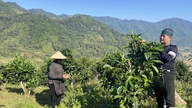
Agricultural extension officers guide farmers on caring for and controlling pests and diseases in organically grown tea. Photo: Luu Hoa.

Currently, Lao Cai tea products not only serve the domestic market but are also exported to many demanding markets such as the Middle East, Europe, the US, Canada, Taiwan, and China.
In recent years, Lao Cai tea has increasingly affirmed its quality and brand. Many tea-growing households have boldly invested in and switched to organic production. This is considered a sustainable development direction for tea cultivation, thereby contributing to protecting the health of growers and consumers, while increasing income and moving towards sustainable agricultural development.
For the period 2026-2030, Lao Cai province aims to maintain a stable tea cultivation area of 15,800 hectares, applying technical procedures in design, planting, care, and certification of VietGAP and organic tea. It will implement improvements and intensive cultivation to increase productivity to 10-15 tons/ha/year, raising the percentage of processed high-quality green tea from 15% to 30-40%. The province will gradually reduce the proportion of exports to less demanding markets (Middle Eastern countries and Pakistan), increasing exports to EU countries, Eastern Europe, and Taiwan to 20-30% of production, while domestic consumption will reach 30% of production.
In addition, it is necessary to expand the area and improve the quality of organically and sustainably produced highland and ancient tea, combining the preservation of native tea varieties with the application of science and technology in processing and building brands for ancient Shan Tuyet tea products from Suoi Giang, Bac Ha, and Muong Khuong.



Source: https://nongnghiepmoitruong.vn/lao-cai-co-hon-2340-ha-che-huu-co-d794656.html
![[Image] National conference summarizing one year of operation of the overall organizational model of the political system, the three-tiered government model.](https://vphoto.vietnam.vn/thumb/1200x675/vietnam/resource/IMAGE/2026/07/01/1782882811691_ndo_br_1-jpg.webp)














![[Video] Weather forecast for tonight and tomorrow, July 2nd, 2026: Tropical depression likely to strengthen into a storm; many areas will continue to experience thunderstorms.](https://vphoto.vietnam.vn/thumb/402x226/vietnam/resource/IMAGE/2026/07/01/1782911026600_thumb-dem-png.webp)


















![The Essence of the Viet Bac Villages: [Part 3] The Precious Fragrance of Nghinh Tuong](https://vphoto.vietnam.vn/thumb/402x226/vietnam/resource/IMAGE/2026/05/29/1780020600366_5237-tinh-tuy-ban-lang-viet-bac-bai-3-chuyen-o-nghinh-tuong-050626_700.jpeg)
![The Quintessence of Northern Vietnam's Villages: [Part 2] The Famous Cassava Noodles of Kunming](https://vphoto.vietnam.vn/thumb/402x226/vietnam/resource/IMAGE/2026/05/28/1779937455892_3929-3144-mien-dong-15-nongnghiep-023138.jpeg)