

The members of the Tran family, Tinh Khe branch ( Quang Ngai City), no matter where they go, always remind each other of the custom of offering sacrifices to the soldiers on the 5th day of the third lunar month. On this day, descendants of the family living in Binh Chau commune (Binh Son district), Tinh Ky, Tinh Hoa, Tinh Khe, and An Phu (Quang Ngai City) gather at the family's ancestral temple, located in Khe Tan hamlet, Co Luy village, Tinh Khe commune, to attend the ceremony.
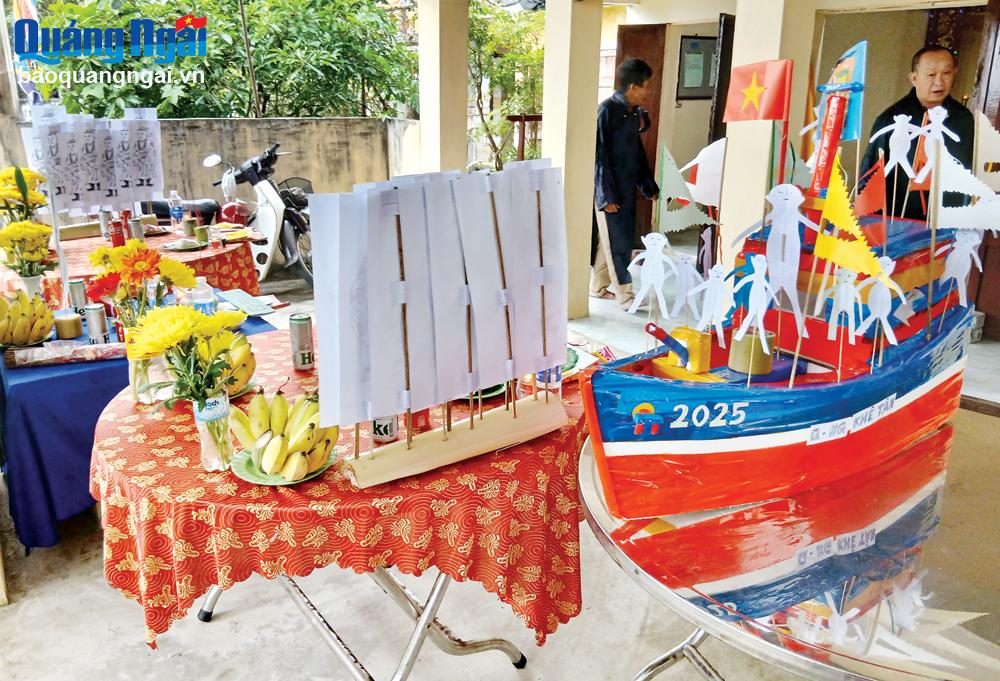 |
| Paper boat models and paper figures at the Trần family's soldier-worshiping ceremony, Tịnh Khê branch (Quảng Ngãi City). |
Similarly to the Hoang Sa Soldiers' Commemoration Ceremony held annually in February and March of the lunar calendar in Ly Son district, the elders of the Tran family, Tinh Khe branch, meticulously craft paper boat models in preparation for the ceremony. However, while the Hoang Sa Soldiers' Commemoration Ceremony in Ly Son district uses five paper boats, the ceremony organized by the Tran family, Tinh Khe branch, consists of only one paper boat. On the boat are paper figures and various items symbolizing drinking water, rice, and food. Beside the figures are paper ancestral tablets bearing the names of their ancestors from the past.
According to the descendants of the Tran family, Tinh Khe branch, in ancient times, members of the family obeyed the king's orders and became soldiers serving at sea, often facing many risks and uncertainties, leaving without a guarantee of return. Therefore, the family organized a ritual offering to the soldiers with paper boats and paper effigies at the ancestral temple, then took them to the sea to release them, hoping for safety and that the paper boats would bear all the risks in place of the living.
 |
| The Tran family church, Tinh Khe branch - where the ritual of offering sacrifices to the soldiers takes place in the third lunar month. |
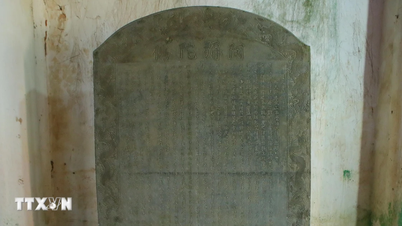
“In our ancestral temple, we still keep a wooden chest containing books and documents written in Han Nom script, passed down from our ancestors. Inside are the names of our forefathers who served as soldiers in the Hoang Sa and Truong Sa islands, protecting our maritime sovereignty . To honor our ancestors and their contributions and sacrifices, our family takes turns maintaining the ritual of offering sacrifices to the fallen soldiers. The ceremony takes place one day before the Thanh Minh festival. The day of the ceremony is also the only day of the year when we respectfully ask permission from the deities and ancestors to open the wooden chest before the ceremony. It's our way of expressing our sincerity, hoping that the soldiers who went to Hoang Sa in the past will bear witness for future generations,” shared Mr. Tran Quang (74 years old), the person trusted by the Tran family, Tinh Khe branch, to be the chief officiant at the ceremony.
Along with the residents of Ly Son Island, the Tran family, Tinh Khe branch, has also preserved and passed down the ritual of offering sacrifices to the soldiers through many generations. This is also one of the rare families on the mainland that still maintains this sacred ritual.
"According to Sino-Vietnamese documents I found in Ly Son, in 1604 (during the reign of Le Kinh Tong), Vietnamese people officially migrated from the mainland to Cu Lao Re - Ly Son to cultivate the land, and later established two wards, An Hai and An Vinh, both belonging to Binh Son district. Administratively, these two wards were still under the management of the two original communes on the mainland, An Vinh and An Hai, in the Sa Ky estuary area. The soldiers who participated in the Hoang Sa fleet in the past were recruited from An Vinh and An Hai communes on the mainland, as well as from the two wards of Cu Lao Re. In subsequent centuries, soldiers from many other localities in the province also joined the Hoang Sa fleet. It is for this reason that in the mainland of Quang Ngai, there are still families who preserve Sino-Vietnamese texts for commemorating the soldiers of Hoang Sa and Truong Sa, and continue to perform these rituals until the first half of the 20th century. In 2011, I found a Sino-Vietnamese text for commemorating the soldiers of Hoang Sa in the past." "The Diep family's ancestral temple is located in Tinh Long commune (now part of Quang Ngai City). In 2018, I found more Sino-Vietnamese documents about the rituals of offering sacrifices to soldiers who died in the Hoang Sa and Truong Sa islands in the Pham family's ancestral temple in Nghia Chanh ward (Quang Ngai City). Unfortunately, these families no longer preserve the ritual of offering sacrifices to soldiers – a type of cultural heritage associated with the great contributions of our ancestors who made significant contributions to the exploration and establishment of the sacred sovereignty of our nation's seas and islands," said Dr. Nguyen Dang Vu, Chairman of the Provincial Association of Culture and Arts and former Director of the Department of Culture, Sports and Tourism.
Text and photos: DONG YEN
Source: https://baoquangngai.vn/van-hoa/202504/le-cung-the-linh-o-lang-bien-khe-tan-3001da2/
![[Photo] National Assembly Chairman Tran Thanh Man attends the policy seminar to promote Vietnam-Türkiye cooperation.](https://vphoto.vietnam.vn/thumb/1200x675/vietnam/resource/IMAGE/2026/04/16/1776351415367_vna-potal-chu-tich-quoc-hoi-tran-thanh-man-du-toa-dam-chinh-sach-thuc-day-hop-tac-viet-nam-tho-nhi-ky-8705791-jpg.webp)




















































Comment (0)