

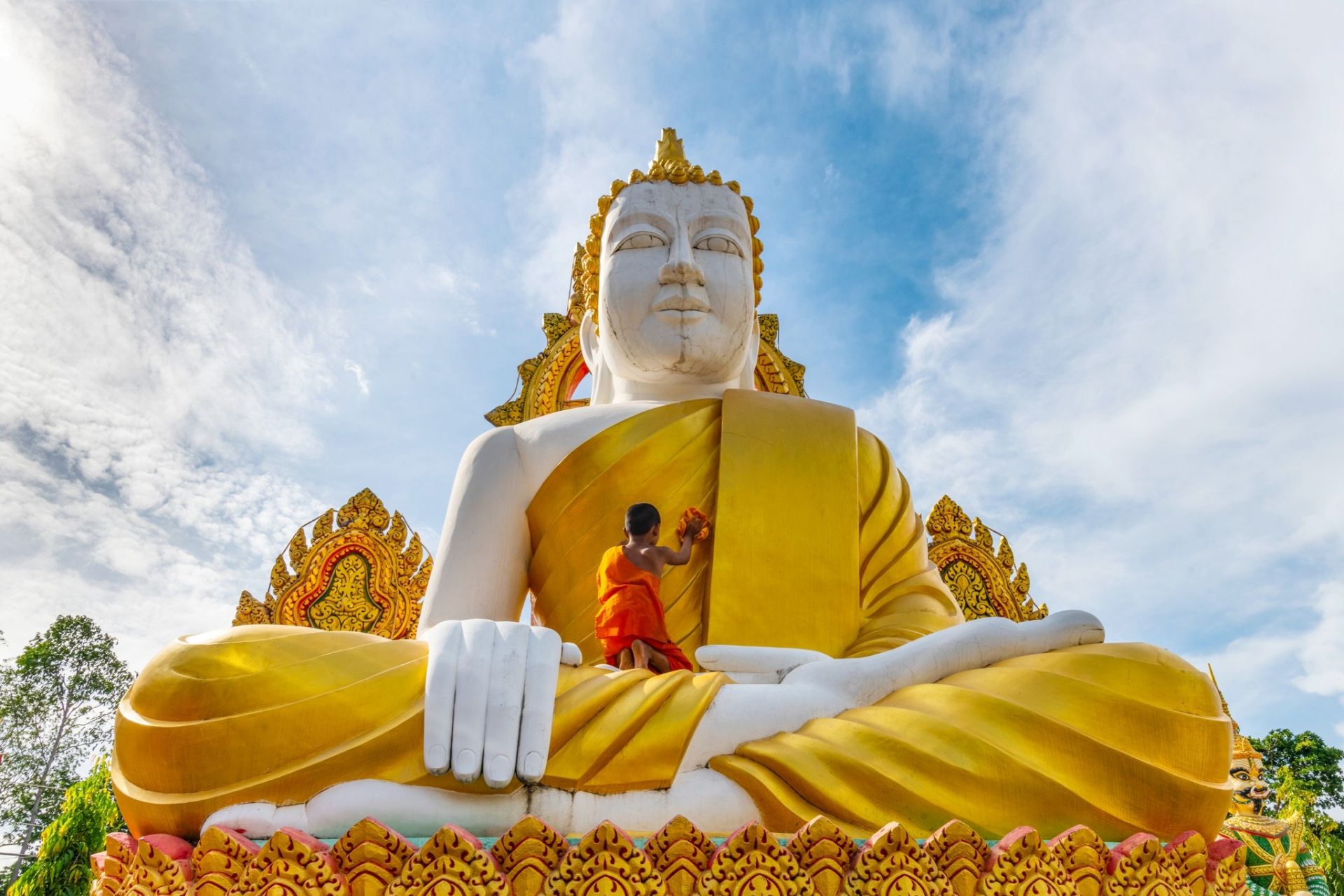
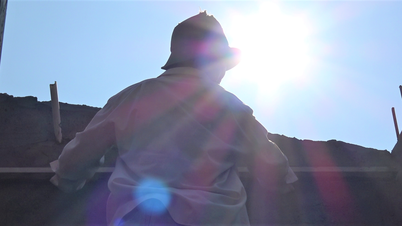
A young monk cleans a Buddha statue, preparing for the Lunar New Year. Photo: Le Van Hai
Chol Chnam Thmay is the Khmer New Year festival, celebrated according to the traditional calendar, usually taking place over three to four days in mid-April. During these days, there are three main rituals: the procession of the calendar, the building of sand mounds, and the bathing of Buddha and monks. Of these, the procession of the calendar is considered the most sacred and important.
Before discussing the rituals and legends of the procession of the great calendar, let me briefly explain the Khmer calendar. According to the Khmer lunisolar calendar, a year has 12 months. Meakase (January) has 29 days, Pos (February) has 30 days, and so on, alternating between even and odd days until Kadak (December) has 30 days.
Thus, according to the traditional Khmer calendar, a year has 354 days, with each month averaging 29 days plus half a day of the following month. The Khmer people do not celebrate the New Year in January like other ethnic groups, but rather in Chett (May), which corresponds to approximately April 13-16 in the Gregorian calendar.
The first reason is that the lunar cycle coincides with this month, and secondly, Chett has completed its harvest, so everyone is not busy with farm work. Besides, this is the dry season, the villages are clean, and it's suitable for people to enjoy themselves and relax.
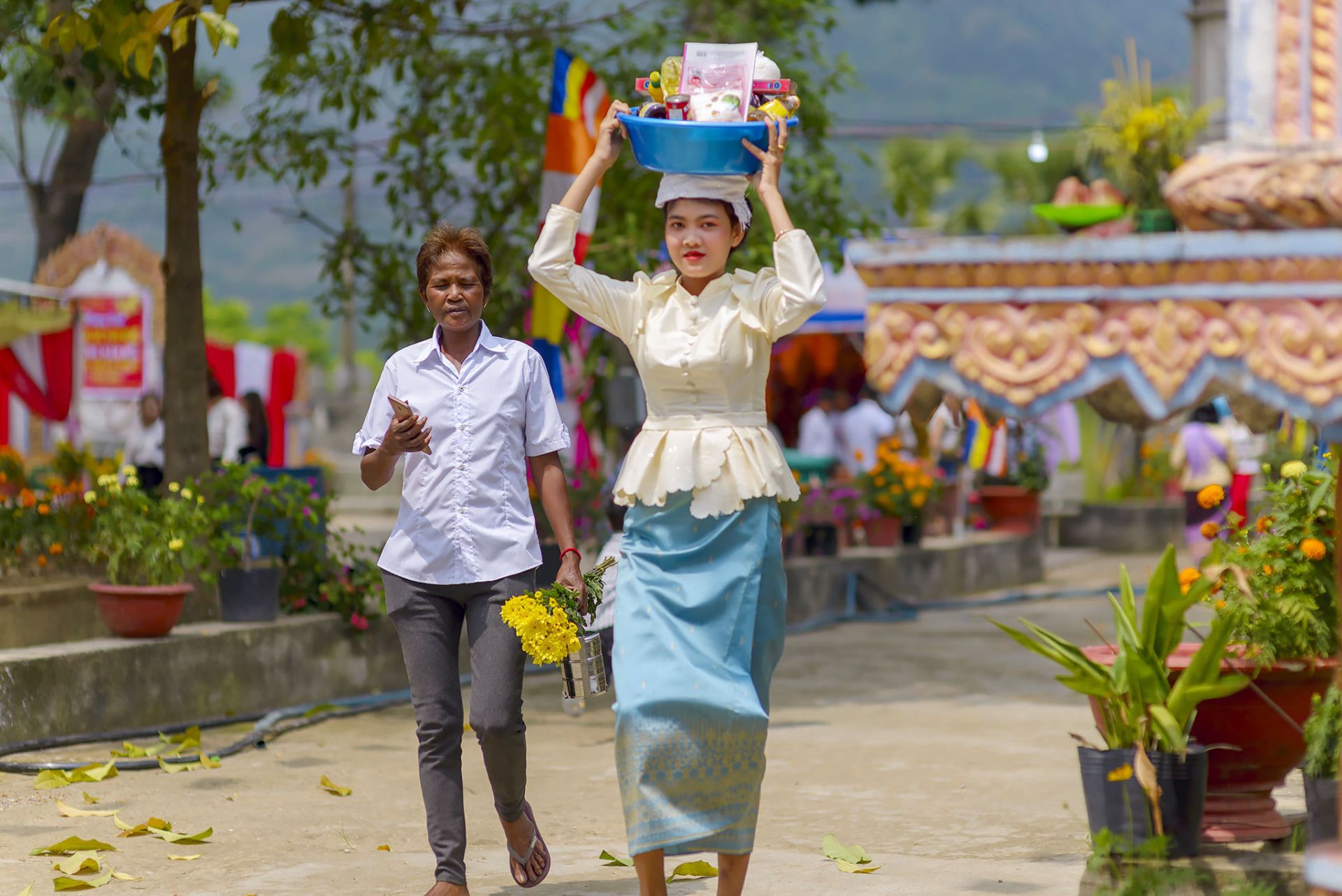
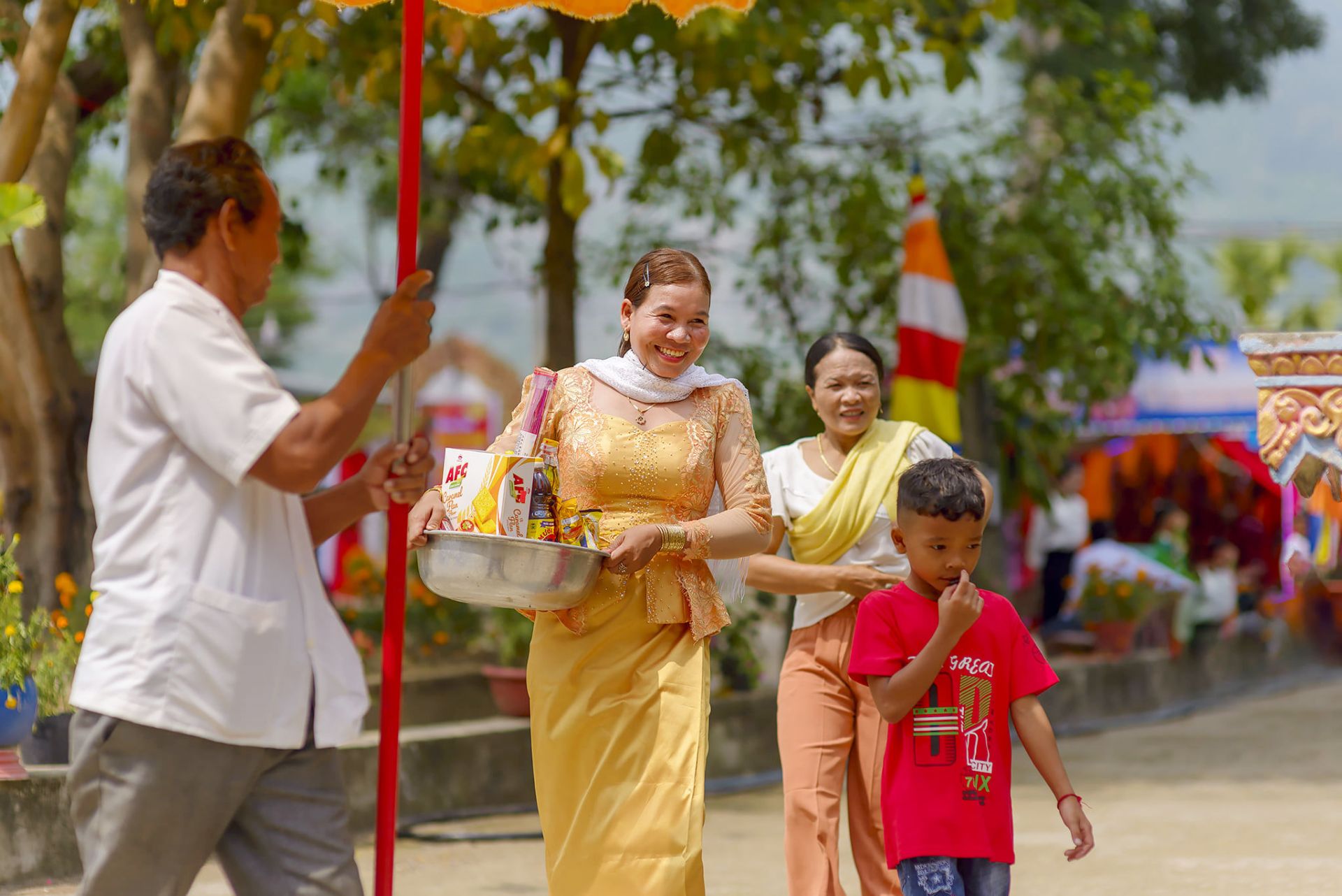
Khmer people come to Khedol Pagoda to make offerings. Photo: Nguyen Minh Thien
The Khmer calendar is called Moha Sankran (មហាសង្ក្រាន្ត). This is a traditional calendar compiled by the Hora (astrologers) for use throughout the year. The calendar clearly records the days, months, and times of all festivals, weather, and auspicious or inauspicious events throughout the year. The Khmer people rely on the calendar to organize New Year's Eve celebrations, determine the start of the new year, and predict good or bad fortune for the year.
While Chnam is based on the movement of the sun and marks the beginning of the new year, Chol is based on the movement of the moon and marks the change of the 12 zodiac animals in a cycle.
Based on the calculations of the Hora in the grand calendar, in 2023, the New Year's Eve moment will occur at 4 PM on April 14th, which is the year 2567 of the Buddhist calendar. April 14 is a Friday, so Avalokiteshvara [Tevoda Roksamonusslok - ទេវតារក្សាមនុស្សលោក] of the year Thos [ឆ្នាំថោះ - year of the rabbit] will be the sixth daughter of Great Brahma [Pres Moha Prum - ព្រះមហាព្រហ្ម], her name is Kemira Têvy [កិមិរាទេវ] sat on the back of a white cow to rule the world.
To explain this cultural ritual, the Khmer people have a story about Prince Dhammabal Palakumar and the Four-Faced God - Brahma, as follows: “Once upon a time there was a prince named Dhammabal Palakumar who was extremely intelligent and could answer all questions.
Brahma, upon learning of this, became furious. One day, he appeared before Dhammabal Palakumar and posed three extremely difficult questions: "Where can happiness be found in the morning, and where in the afternoon and evening?" Brahma declared that if the prince could not answer, he would be beheaded; if he could answer, Brahma himself would behead.
Upon hearing this, Dhammabal Palakumar was deeply saddened and went into the forest. Suddenly, he overheard two eagles speaking to each other, saying, "In the morning, happiness is present on the face; in the afternoon, on the body; and in the evening, it resides in the feet." This is the origin of the Khmer custom of using fragrant water to wash the face in the morning, bathe the body in the afternoon, and wash the feet in the evening during the New Year.
The prince returned and presented that answer to Brahma, who was defeated and forced to decapitate himself. Brahma had seven daughters. After beheading himself, he entrusted his eldest daughter with placing the head in a stupa. From then on, once a year, on this very day, his seven daughters descend to earth, carry their father's four-faced skull to the stupa, and circle the base of Mount Tudi three times, following the direction of the sun. Each year, one daughter carries the skull once, in order corresponding to each day of the week. The day of the skull procession is a day of peace and prosperity , and it is also the Khmer New Year.
The seven daughters of Brahma, in order from oldest to youngest, are named as follows: Tungsa Tevy (oldest); Khorakha Tevy (2); Riakhayasa Tevy (3); Monthia Tevy (4); Kerenay Tevy (5); Kemira Tevy (6) and Mahatharia (7).
The day of the week that New Year's Eve falls on corresponds to the order in which the daughters of the god Maha Prum descend to Earth to assume the role of the Guardian of the World. This year (2023), New Year's Eve falls on a Friday, so the Guardian of the World is the goddess Kemira Tevy. Accompanying the Guardian of the World to Earth are the celestial beings of the Jade Emperor Indra.
These celestial beings change annually according to the twelve zodiac animals of a cycle. When they descend to the mortal world, the celestial beings ride different animals, wear different clothing, eat different foods, and use different ritual objects each year. The Khmer shamans, based on the temperament, eating habits, clothing, and ritual objects used by the celestial beings, predict good and bad omens for the year, thus guiding their plans for the coming year.
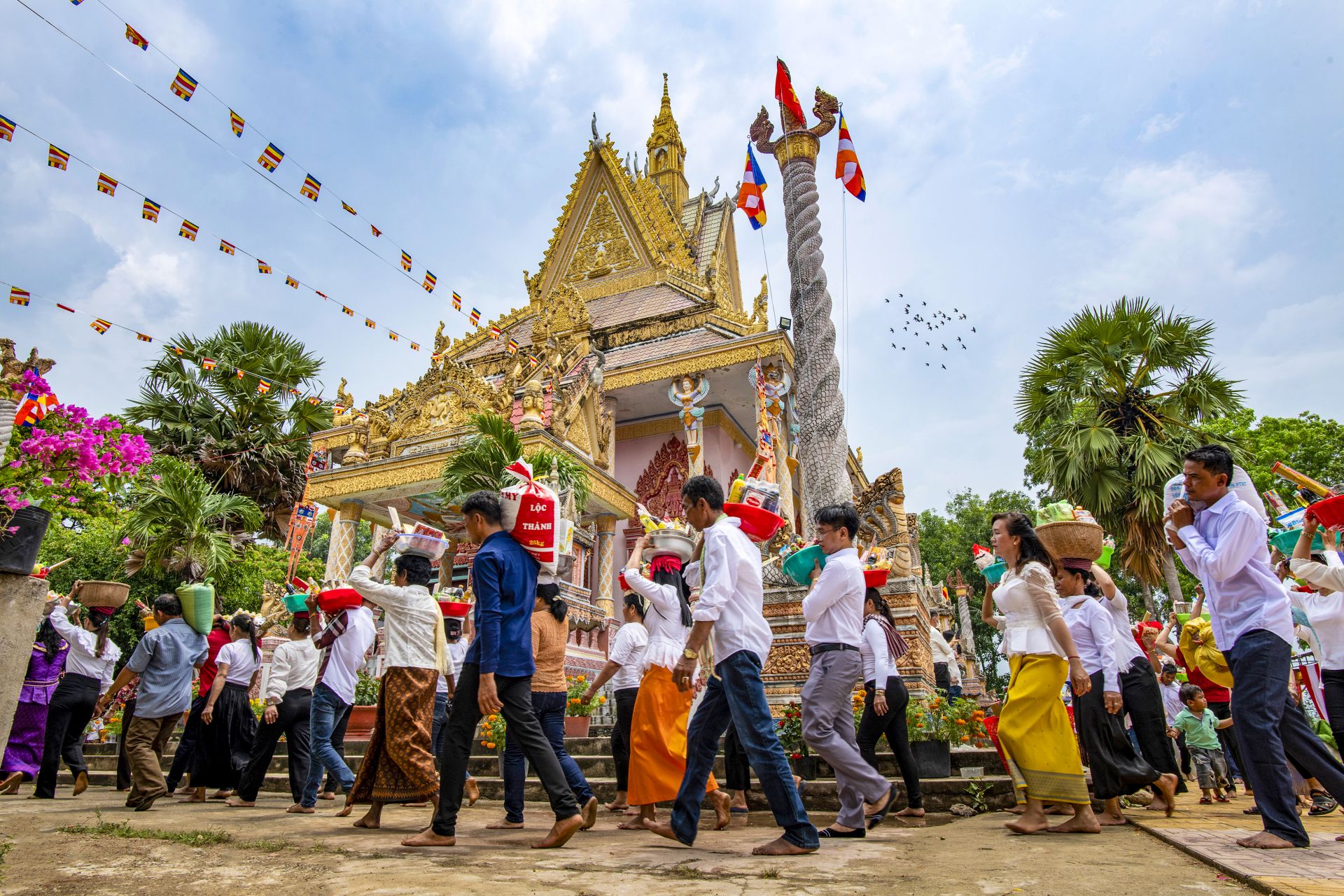
Khmer people visit Khedol Pagoda to worship Buddha during the Chol Chnam Thmay New Year. Photo: Le Van Hai.
To prepare for the procession of the great calendar, in the late afternoon, the Khmer people bathe and change into their traditional clothes, put on beautiful makeup, and then bring incense and candles to the temple to perform the ceremony of welcoming the new Moha Sankran calendar.
In the temple courtyard, under the guidance of the Kru Achar (the village's chief officiant), the villagers lined up in rows of four or five. When the drums sounded, the procession began to circle the main hall three times to show respect to the Buddha and welcome the deities of the new year.
Then, Kru Achar carried the tray of offerings on his head (including the Great Calendar, baisây, slathor, incense, candles, fruits, etc.) and together with everyone else, entered the main hall where the head monk received the Great Calendar, placed it on the altar, chanted prayers to welcome the Guardian Deity of the New Year, and chanted prayers for peace and well-being for all the villagers…
For families unable to participate in the procession of the calendar at the temple, the New Year's ceremony is performed at home. Khmer people usually hold the ceremony in front of their house with an offering tray containing the calendar, a pair of baisây (traditional Khmer ceremonial robes), a pair of slathor (traditional Khmer robes), fragrant water, incense, candles, puffed rice, fruits, cakes, etc. At the moment of midnight, when the temple's drum sounds, the whole family gathers at the ceremony site, lights incense and candles, makes a vow of purity, and performs the ritual of welcoming the deities into their home.
The procession of the calendar by the Khmer people of Tay Ninh is not much different from that of the Khmer people in Southern Vietnam. This ritual has a similar meaning to the New Year's Eve celebration of the Vietnamese, Chinese, and other ethnic groups, aiming to bid farewell to bad luck from the old year and express hopes for new, lucky, and auspicious things in the new year.
Bidding farewell to the deities of the old year and welcoming the deities of the new year, the people of the past year divined their fortunes, discerning auspicious and inauspicious signs to plan accordingly, find peace, overcome limitations, and have a better life.
The Vietnamese New Year's Eve celebration is usually held at a fixed time of midnight on the first day of the first lunar month; however, the Khmer people's procession of the Great Calendar to welcome the new year is not fixed in time and always changes from year to year. This is a unique feature and a part of the identity of Khmer culture.
Dao Thai Son
Source link
![[Photo] Prime Minister Pham Minh Chinh receives the Chinese Ambassador to Vietnam](https://vphoto.vietnam.vn/thumb/1200x675/vietnam/resource/IMAGE/2026/04/05/1775397481797_ndo_br_dsc-5512-jpg.webp)


















































Comment (0)