


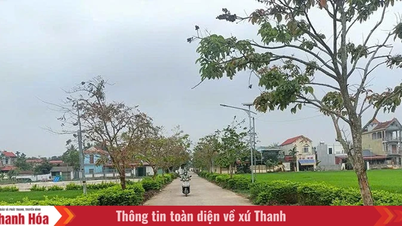
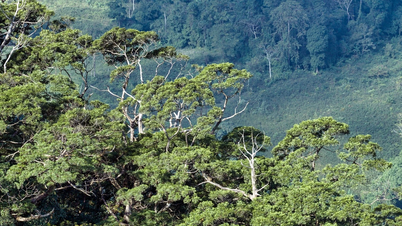
Beautiful natural scenery in Hang village, Phu Le commune.
Nestled amidst lush green forests, within the core of the Pu Luong Nature Reserve, Hang Village has attracted many foreign tourists since around 2000. Its beauty lies not only in its scenery and fresh air, but also in the poetic charm of its terraced rice fields winding around the hillsides. The village's beauty is further enhanced by its clear streams, traditional dances, the sound of the khene (a type of bamboo flute), folk games and performances, and the simple, rustic cuisine of the Thai ethnic minority.
Here, visitors can also explore the unique cultural and religious traditions of the local people, such as the custom of worshipping the village deity. According to the elders, the ceremony is held to express gratitude to the first two Thai ethnic people who came to this land to clear the land, build houses, and establish the village. Meanwhile, the village is close to famous tourist destinations in the Pu Luong Community Ecotourism Area such as Kho Muong, Don village, Hieu waterfall, etc., making it very convenient to connect with and welcome international tourists to visit and experience.
However, developing community tourism and retaining tourists in the village is not easy. Following the policy of the former Quan Hoa district, the Party branch and the Front Committee of Hang village have organized propaganda and mobilization efforts to develop community tourism through practical actions suitable to the local economic conditions, customs, and traditions. First and foremost, this includes organizing training on tourism knowledge and building model community tourism guesthouses. They have also launched campaigns to clean up the environment, sweep village roads, improve gardens and yards, creating a green, clean, and beautiful landscape. Furthermore, they have organized the cultivation and production of clean food, rejecting banned substances in livestock farming to ensure a reliable source of fresh, safe food for tourists.
According to the Party branch secretary and head of Hang Vi village, The Thiep, "Along with the promotional efforts of the government at all levels, the villagers, especially the homestay owners, have proactively introduced the beauty of the land and people of Hang village on many tourism forums and social media. Some households have also organized trips to Hanoi, Quang Ninh, etc., to connect with tourism and travel businesses to organize tours bringing foreign tourists to Hang village. Therefore, after being affected by the COVID-19 pandemic, community tourism in the village is returning to its growth trajectory."
Community-based tourism has many advantages, such as local people directly managing, operating, and participating in the supply chain, based on local cultural values, identity, and natural resources. Tourists can both visit and participate in experiencing the production activities and daily life of the local people. As the locals understand it simply: developing community-based tourism means using the existing identity, scenery, and way of life of the locality to serve tourists. Therefore, in addition to raising awareness about the rights and responsibilities of the people, the Party branch of Hang village has organized the establishment of a village performing arts group to perform for visiting tourists. At the same time, they encourage people to proactively invite tourists to participate in the production activities of the highland people, such as planting rice in the fields, cutting bamboo, digging cassava, etc.
"Many tourists enjoy the experience of planting rice alongside the locals. The locals are also very happy and proud that their profession is appreciated by tourists," Secretary Vi The Thiep shared.
In implementing the policy of developing community tourism in Hang village, Secretary Thiep was also one of the pioneers who borrowed money from relatives to invest in building two traditional stilt houses and renovating the garden area to create a homestay for guests starting in 2018. Besides actively promoting the beauty of the village and proactively connecting with travel agencies inside and outside the province to bring tourists to visit, he proactively taught himself foreign languages and how to prepare dishes to serve foreign tourists. Therefore, his family's homestay, with a capacity of 30 guests per day and night, has become a place of stay for many international groups.
Mr. Thiep shared: "What's important for foreign tourists to visit the village isn't luxurious or opulent accommodation, but first and foremost, the spirit and hospitality of the people. Therefore, the people of Hang village have prioritized environmental hygiene, friendliness, and are ready to help tourists when needed."
Starting from a poor village with many socio-economic difficulties, community tourism has contributed to increasing income and helping Hang village achieve the status of a model new rural village. For many people here, community tourism is not only about making a living, but also a channel to promote the image and beauty of the village to the world. Currently, more than 10 families in the village are participating in building community tourism guesthouses.
According to Mr. Nguyen Van Mung, Vice Chairman of the People's Committee of Phu Le commune, in order to concretize the Resolution of the First Party Congress of the commune, term 2025-2030, the commune is carrying out procedural steps and developing a general plan as a basis for implementing related plans on community tourism development. This is a prerequisite for investing in and upgrading infrastructure, and continuing to develop community tourism in Hang village to a new level.
Text and photos: Dong Thanh
Source: https://baothanhhoa.vn/len-ban-hang-xem-lam-du-lich-cong-dong-283076.htm


![[Photo] Xuan Son scores a brace, Vietnam wins 3-1 against Malaysia.](https://vphoto.vietnam.vn/thumb/1200x675/vietnam/resource/IMAGE/2026/03/31/1774971675344_ndo_br_52b4d11dd25c53020a4d-copy-jpg.webp)









![[Photo] Da Nang: Exploring the inside of Vietnam's largest "sail" symbol.](https://vphoto.vietnam.vn/thumb/1200x675/vietnam/resource/IMAGE/2026/03/31/1774964764698_ndo_br_anhcau1-jpg.webp)
















































Comment (0)