|
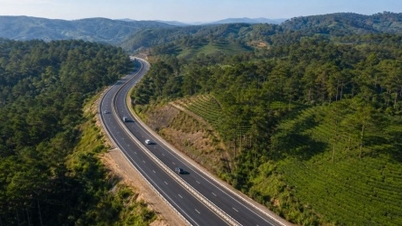
| North-South Expressway (Eastern section), Dien Chau - Bai Vot section. Photo: Tran Chau |
Expanding to 6 lanes soon.
Less than two years after the North-South Expressway (Eastern section) phase 2017-2020 was put into operation, the Ministry of Construction has begun developing a plan for a new phase of development of this vital national transportation artery: expanding the sections that were invested in in phases to the full scale according to the plan to meet the increasing transportation demand and the development requirements of the economy.
The latest development is that the Ministry of Construction has just sent the pre-feasibility study report for the project to expand the eastern sections of the North-South Expressway to the Ministry of Public Security and the People's Committees of the provinces and cities through which the route passes for comments before finalizing the plan to submit to the competent authorities for consideration and decision.
Specifically, the Ministry of Construction requested the Ministry of Public Security to provide input on the Pre-feasibility Study Report, focusing on the necessity and urgency of expanding the expressway sections from a limited 4-lane to a full 6-lane; issues related to ensuring traffic order and safety, rescue operations, incident handling during operation, as well as solutions to improve the investment efficiency of the Project.
The Ministry of Construction also requested the Ministry of Public Security to assess the shortcomings and limitations in traffic management, patrol and control, and handling of accidents and incidents on the currently operating sections of the 4-lane expressway with limited traffic.
In fact, during the operation of some sections of the limited 4-lane expressway, including component projects of the North-South East Expressway Construction Investment Project giai đoạn 2017 - 2020, the Ministry of Public Security has warned about shortcomings in ensuring traffic safety. According to this agency, for routes without continuously operating emergency lanes, when accidents or incidents occur, law enforcement agencies face many difficulties in accessing the scene, increasing the risk of chain accidents and prolonged traffic congestion.
"This is also considered one of the important bases for the Ministry of Construction to study options for expanding the expressway sections that are being invested in phases, in order to improve operational capacity and ensure traffic safety along the entire route," assessed Mr. Le Anh Tuan, Deputy Minister of Construction.
Meanwhile, the Ministry of Construction has requested localities through which the Eastern North-South Expressway passes to provide feedback on the necessity and urgency of investing in expanding these sections, based on the current operational status, transportation needs, and socio-economic development orientation of each locality.
The Ministry of Construction also requested localities to assess the socio-economic effectiveness of the Project, especially its contribution to economic growth targets, its ability to create momentum for the development of new economic spaces, and its support in realizing double-digit growth targets in the coming period.
In addition, localities are also required to provide opinions on appropriate investment methods, including public investment or PPP methods; and to propose specific mechanisms and policies within their authority to overcome difficulties and accelerate the project's implementation progress, especially in land clearance and the exploitation and supply of common construction materials for construction.



Before seeking opinions from relevant ministries, departments, and localities, the Ministry of Construction held a meeting chaired by Minister Tran Hong Minh to review the pre-feasibility study report for the project to expand sections of the North-South Expressway in the East, proposed by the Thang Long Project Management Board.
In Notice No. 260/TB-BXD issued a few days later, the head of the Ministry of Construction requested a comprehensive review and assessment of the current status of the entire North-South Expressway in the East, from Cao Bang to Ca Mau; and to divide it into three segments: Cao Bang - Hanoi, Hanoi - Ho Chi Minh City, and Ho Chi Minh City - Dat Mui, in order to conduct a detailed assessment of the current operational status, traffic volume, investment scale, and technical standards of each component project, as a basis for proposing appropriate investment scope.
Notably, Minister Tran Hong Minh agreed in principle to the plan to expand the existing 4-lane sections of the Eastern North-South Expressway to 6 lanes as planned. The Phan Thiet - Dau Giay section will be studied for expansion to avoid the problem of limited capacity along the entire route.
"First and foremost, we must agree on a plan to study the investment in expanding the Eastern North-South Expressway from a limited 4-lane scale to a 6-lane scale as planned, ensuring consistency and long-term sustainability, avoiding the need for further expansions that waste time and resources and affect the operation of the entire route," Minister Tran Hong Minh directed.
 |
Determine the order of priority.
Another important guiding principle in Notice No. 260/TB-BXD is the prioritization of investment in expanding sections of the North-South Expressway in the East, given limited resources and the simultaneous implementation of numerous large-scale infrastructure projects nationwide.
Accordingly, Minister Tran Hong Minh agreed on the principle of only considering allocating funds to the Project after securing resources for priority tasks under the Central Committee's Action Program and new expressway projects, aiming to achieve the target of 5,000 km of expressways by 2030.
Regarding the Eastern North-South Expressway Expansion Project, the Minister of Construction requested that priorities be arranged according to transportation needs and resource allocation. Specifically, sections with high traffic volume, part of the 2017-2020 Eastern North-South Expressway Construction Project, will be prioritized for expansion, with construction expected to begin in 2027. The remaining sections will be implemented from 2028, with the goal of completing the expansion of the entire route by 2030.
Notably, for the three component projects invested under the PPP method, namely Dien Chau - Bai Vot, Nha Trang - Cam Lam, and Cam Lam - Vinh Hao, the Minister instructed the Vietnam Road Administration to work with existing BOT investors to agree on expansion plans. For component projects invested with state budget funds, the relevant agencies are required to continue evaluating and comparing public investment and PPP options before reporting to the competent authorities for consideration and decision.
According to research by the Thang Long Project Management Board, the eastern section of the North-South Expressway from Hanoi to Ho Chi Minh City still has approximately 1,144 km currently operating in phases with a limited 4-lane capacity. The Can Tho - Ca Mau section, recently completed, has not yet met the transportation demand, faces complex construction conditions, and has limited local construction materials, therefore it has not been prioritized for expansion in this phase.



Based on a review of the current status of the entire route from Lang Son to Ca Mau, transportation needs, road network planning, and regional connectivity, the Thang Long Project Management Board proposes two investment options.
Option 1 focuses on expanding sections with high transport demand and requiring immediate investment, including the sections from Mai Son to Bai Vot and from Nha Trang to Dau Giay, with a total length of approximately 534 km. The preliminary total investment is approximately VND 63,411 billion, of which the expansion of 5 public investment projects accounts for approximately VND 38,158 billion and the expansion of 3 PPP projects accounts for approximately VND 25,253 billion.
Option 2 involves expanding the entire section from Mai Son to Cam Lo and from Quang Ngai to Dau Giay, with a total length of approximately 1,144 km, to ensure continuous connectivity from Hanoi to Ho Chi Minh City according to full expressway standards. The preliminary total investment for this option is approximately VND 154,246 billion, of which about VND 128,994 billion is public investment and about VND 25,253 billion is for expanding PPP projects.
“To ensure investment efficiency and suitability with the availability of resources in the context of the entire country implementing many important national projects, Option 1 is proposed to be prioritized for research and implementation first. If funding is secured, Option 2 will be considered for implementation to complete all remaining operational sections according to the phased scale,” suggested Mr. Dinh Cong Minh, Director of the Thang Long Project Management Board.
Source: https://baodautu.vn/len-kich-ban-nang-doi-cao-toc-bac---nam-phia-dong-d617771.html



![[Image] Overview of the construction site for the underground station of metro line 5 at the Hanoi Ring Road 1 intersection.](https://vphoto.vietnam.vn/thumb/1200x675/vietnam/resource/IMAGE/2026/07/03/1783065595682_ndo_br_z7974930852369-100ca093c306e72675f1d3700966a86b-jpg.webp)