


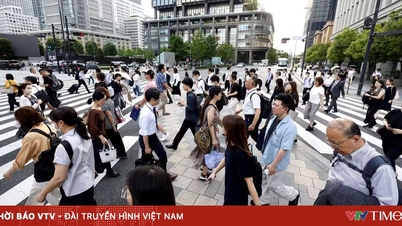
Customers shop at a supermarket in Tokyo, Japan. Photo: AFP/VNA
This plan is expected to be approved in the Upper House next week. It is the largest supplemental budget since fiscal year 2022, designed to fund an economic stimulus package aimed at easing the burden of rising living costs and supporting investment to boost growth amid the government's expansionary fiscal policies. The Japanese government plans to issue 11.7 trillion yen in new bonds to finance more than 60% of the budget.
To ease the burden of living costs for households, the Japanese government is preparing a series of measures such as electricity and gas subsidies for the first three months of next year and cash grants for families with young children. Prime Minister Sanae Takaichi's administration is also seeking to boost investment in industries such as semiconductors and shipbuilding.
In addition, the supplementary budget also allocates spending to defense to ensure Japan can achieve its target of spending 2% of its Gross Domestic Product (GDP) on defense this year, two years earlier than previously planned.
Currently, although Prime Minister Sanae Takaichi's ruling coalition does not hold a majority in the Upper House, the supplementary budget is still expected to be passed in the Upper House next week, having received support from several opposition parties, including the Democratic Party for the People.
According to analysts, the supplemental budget could help the Japanese economy overcome some of its current difficulties. A recent survey by Tokyo-based credit research firm Shoko Research found that the total number of corporate bankruptcies in Japan between January and November 2025 reached 9,372. At this rate, the number for 2025 is likely to exceed 10,000 for the second consecutive year.
According to Tokyo Shoko Research, in November 2025, the number of bankruptcies involving debts of 10 million yen (approximately $64,500) or more decreased by 7.5% compared to the same period last year, to 778 cases. Total debt in November decreased by 48.6% to 82.4 billion yen, due to a 50% reduction in the number of bankruptcies involving debts of 500 million yen or more.
By sector, the service industry recorded the highest number of bankruptcies this month with 250 cases, although this figure was down 17.8% compared to the same period last year. Data shows that small businesses were the hardest hit by rising prices and labor shortages.
Previously, Japanese household spending in October 2025 fell by 3.0% year-on-year, marking the first decline in six months. A report released by the Japanese government on December 5th indicated that this drop was primarily due to plummeting car prices and sluggish food consumption amid rising inflation. According to the Japanese Ministry of Internal Affairs and Communications, households with two or more members spent an average of 306,872 yen (approximately $2,000) in October 2025.
A survey conducted by private research firm Teikoku DataBank of 195 major food manufacturers across Japan revealed that the total number of food and beverage items that increased in price this year, including December, reached 20,609. This marks the first time in two years that the number of items with price increases has exceeded 20,000, a 64.6% increase from last year's 12,500 items.
By product category, price increases encompass a wide range of items such as spices, beverages in general, and processed foods. The most common reasons for price hikes by businesses are significantly increased raw material prices and logistics costs.
Representatives from Teikoku DataBank, the company conducting the survey, stated that service prices have risen beyond what businesses can absorb through their own efforts, resulting in a sharp increase in the number of items experiencing price increases this year.
In the third quarter of 2025, the Japanese economy contracted by 1.8% year-on-year, marking its first decline in six quarters. This was due to exports being affected by US tariffs.
The aforementioned decline was lower than the market's average estimate of 2.5% in a Reuters poll. Previously, Japan's economy grew by 2.3% (adjusted) in the quarter from April to June 2025. Compared to the previous quarter, Japan's economy contracted by 0.4% in the third quarter of 2025, lower than the average forecast of a 0.6% decline.
Exports are the main drag, as the impact of higher US tariffs intensifies. Automakers have seen a sharp decline in export volumes, even though they have absorbed most of the tariff costs by lowering export prices.
In addition, housing investment also weighed on growth as stricter energy efficiency regulations introduced in April came into effect.
Furthermore, private consumption, which accounts for more than half of GDP, increased by only 0.1%, lower than the 0.4% increase in the second quarter, suggesting that high food costs are making households hesitant to spend.
Many private sector analysts expect Japan's economic growth to rebound in the fourth quarter of 2025. A survey by the Japan Center for Economic Research of 37 economists forecasts the country's economy will grow by 0.6% in the final quarter of 2025.
Source: https://vtv.vn/lieu-doping-cho-kinh-te-nhat-ban-100251212061402916.htm































































































Comment (0)