

 |
| Whenever there's a festival or relatives and guests visit, the Pa Kô people often go into the kitchen to make Aquat cakes - Photo: KS |
Fragrant with the scent of the mountains and forests.
No one in the Pa Kô community remembers exactly when Aquat cakes originated. They only know that since birth, they have seen these uniquely shaped cakes, with their two pointed ends resembling buffalo horns, appearing at important village festivals. Unlike Achốih cakes, which only have one pointed end, Aquat cakes have a balanced shape, suggesting strength yet remaining close to the daily life and production activities of the people.
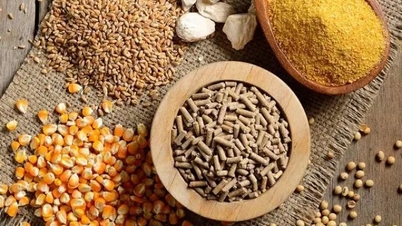
“To make a truly authentic Aquat cake, we have to prepare meticulously from the ingredient selection stage. That includes freshly harvested upland glutinous rice, still fragrant with the scent of sunshine, with plump, round, and translucent grains. The key to the difference in Aquat cakes is that the glutinous rice doesn't need soaking. The villagers wrap the cakes directly to preserve their natural stickiness and aroma, and also to help preserve them for longer without spoilage or loss of quality,” shared Ms. Ho Thi Danh (commonly known as Gia Du), an experienced Aquat cake maker in A Pul-Ka Hep village, Ta Rut commune.
The leaves used to wrap the rice cakes play a crucial role in creating their distinctive flavor. The Pa Kô people often go deep into the forest to select fresh, green leaves of the wild betel or cardamom plant, neither too old nor too young. The combination of the fragrant upland rice and the light, refreshing scent of the forest leaves creates a dish that truly embodies the spirit of the mountains and forests.
A symbol of happiness and togetherness.
According to the Pa Kô people's beliefs, the Aquat cake embodies a profound philosophy of life. The cake has three sides: the two upper sides are of equal length, like buffalo horns, while the lower side is wide and flat, like a buffalo's head. This balance symbolizes the harmony between heaven and earth, male and female, and humanity with the spiritual world .
 |
| Aquat cakes, with their unique shape, are always tied together in pairs - Photo: KS |
Making Aquat cakes requires meticulousness and skill from the women, from shaping the leaves to tying the strings. "The cakes must be tied very tightly before boiling. The baker must concentrate so that when cooked, the glutinous rice expands evenly without tearing the leaves. A beautiful, firm cake reflects the skill and diligence of the woman in the family," Gia Du explained.
Continuing in that spirit, the younger generation of the Pa Kô people are still striving to preserve the beauty of their ethnic cuisine . Ms. Hồ Thị Lan from A Liêng village, Tà Rụt commune, expressed: “I really enjoy making Aquat cakes. Every time I wrap the cakes with the women and mothers, I feel proud of my ethnic culture. I always try to make them beautiful and delicious so that this cake will forever be a source of pride for the village, so that every time guests come, they will always remember the distinctive flavor of the highlands.”
Aquat cakes are always tied together in pairs, symbolizing the unwavering love between husband and wife. In weddings, they are an indispensable offering, connecting two families. The cakes also represent community solidarity. When honored guests visit, the host prepares the cakes along with boiled chicken and rice wine to entertain them. The cake becomes a "messenger" of hospitality, conveying wishes for health and happiness. Despite its spiritual significance, the cake is rarely placed on altars but is commonly found in festivals and banquets, demonstrating its practical role in community bonding.
The simple yet profound values of Aquat cakes contribute to enriching the spiritual life and preserving the unique identity of the Pa Kô people in the modern era.
Let's work together to preserve our identity.
In the trend of globalization, the emergence of many new dishes sometimes overshadows traditional values. However, for the Pa Kô people, Aquat cake still holds an irreplaceable position.
 |
| Gia Du skillfully rolled the leaves to shape the Aquat cake - Photo: KS |
Outstanding artisan Kray Sức from A Liêng village, Tà Rụt commune, said: “Cuisine is an important part of cultural identity. Aquat cake embodies the customs, traditions, behavior, and feelings of people towards nature. Preserving the way of making the cake, as well as the meaning of giving the cake as a gift, is a way to preserve the soul of the nation. During festivals or Tet (Lunar New Year), the presence of Aquat cake reminds descendants of their roots, of hospitality, and of the spirit of unity.”
These small, simple crescent-shaped cakes serve as a bridge connecting family and community. Wherever they are, the Pa Kô people cherish the memories of the fragrant sticky rice, the distinctive shape of the cakes, and the genuine kindness of their fellow villagers, as an inseparable part of their spiritual essence.
Ko Kan Suong
Source: https://baoquangtri.vn/van-hoa/202604/linh-hon-am-thuc-cua-nguoi-pa-ko-c1e329e/


![[Photo] General Secretary and President visit the China-ASEAN AI Application Cooperation Center](https://vphoto.vietnam.vn/thumb/1200x675/vietnam/resource/IMAGE/2026/04/17/1776404277677_vna-potal-tong-bi-thu-chu-tich-nuoc-tham-trung-tam-hop-tac-ung-dung-ai-trung-quoc-asean-8706616-2286-jpg.webp)










![[Photo] National Assembly Chairman Tran Thanh Man attends the policy seminar to promote Vietnam-Türkiye cooperation.](https://vphoto.vietnam.vn/thumb/1200x675/vietnam/resource/IMAGE/2026/04/16/1776351415367_vna-potal-chu-tich-quoc-hoi-tran-thanh-man-du-toa-dam-chinh-sach-thuc-day-hop-tac-viet-nam-tho-nhi-ky-8705791-jpg.webp)




































Comment (0)