

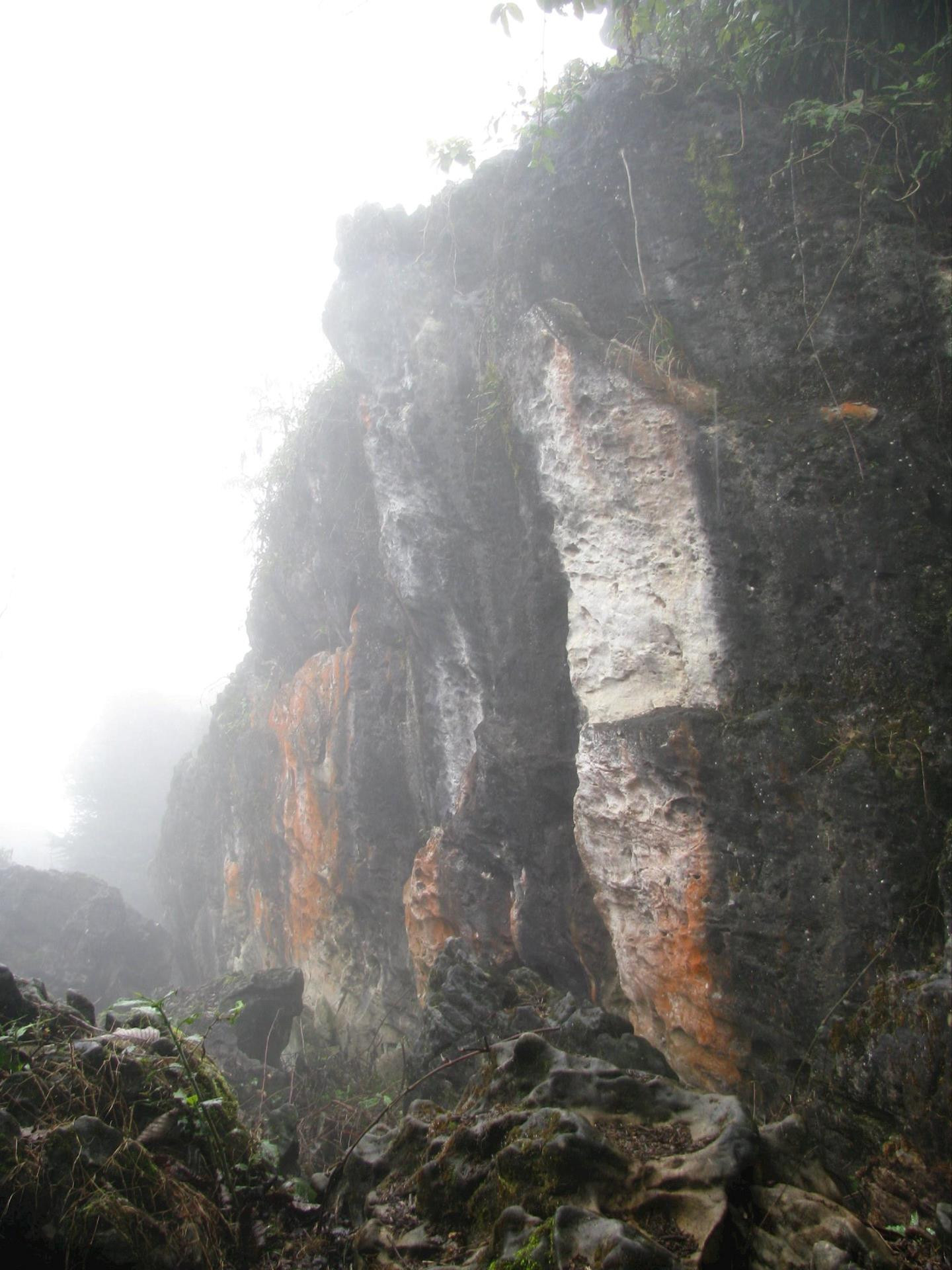
There are no roads; to reach the village, you have to travel by boat and then walk for hours. There's no phone signal, so the commune officials communicate with the village management committee by handwritten letters. Life is like something out of the late 20th century. Yet, upon entering the village, it's bright and clean. The residents greet visitors with gratitude. "Thank you for coming. It's been so long since we've had visitors." Something along those lines.
In Huồi Pủng, the village of the Khơ Mú people, there are customs that are both familiar and strange to me. The inhabitants live along a large stream. The village is named after the stream. Huồi means stream (in Thai), and pủng, or búng/văng, means a body of water, where the stream meets a bottleneck, causing the upstream area to widen into a bathing spot. The stream is dotted with large and small rocks. Under an ancient tree beside the stream stands a small shrine built of bamboo, wood, and thatched roof, which the villagers call a temple.
This type of shrine is quite common in Khơ Mú villages. People build shrines to hold offerings during the village's ritual for planting crops. After the ceremony, they abandon it. Before long, the shrine will rot, and the villagers will have to rebuild it for the following year's ceremony. This shrine is no different, but next to the tree trunk lies a small, unassuming stone nestled among decaying leaves. A stranger wouldn't notice it, but according to the village's shaman, the stone is sacred. When the village was founded, they brought the "spirit" from the stream and placed it beside the tree trunk, then built the shrine, and the stone has remained there for decades. Every June or July, the village holds a ritual to prepare for planting crops, which takes place at the small shrine next to the tree trunk.
The rock was thoroughly washed, all the moss and dust removed. They offered sacrifices to the forest spirits, the tree spirits, and even the spirit of the rock. The shaman said that trees, forests, mountains, and streams all have spirits and ghosts. But the rock is the dwelling place of the village spirit, the soul of the villagers. Therefore, besides the temple spirit and the ancient tree spirit, the spirit of the rock is also here, protecting the lives of the people.
Village temples built next to ancient trees are quite common among the Khơ Mú and Thái people in the mountainous areas of Nghệ An , but the custom of worshipping stones is no longer widespread.
***
Almost 20 years ago, I went to university. It was the first time I'd left my mountainous hometown for Hanoi . I knew I'd be unfamiliar with the place, the streams, the rivers – meaning the water for daily life. The food and drinks were also unfamiliar. These "unfamiliarities" easily led to minor illnesses. Before I slung my backpack and wooden trunk over my shoulder and set off for university, my mother slipped something into my bag that surprised me. It was a small white pebble, only slightly larger than a quail egg.
I was about to throw it away, but my mother told me to take it. She said it would help me avoid feeling disoriented by the water. When boiling water for bathing, she'd put a pebble in the kettle, and it would be like bathing in the spring water of our hometown, and I wouldn't have to worry about getting sick. Stone is the mother of the earth; the earth nourishes flowers, plants, birds, and even people. Wherever you are born, you'll be familiar with the climate of that region. If you can't bring the climate, the earth, and the plants with you, then bringing a pebble is like bringing the land and its climate. A pebble is also a part of this land. Stones have souls, just like trees and streams. My mother rarely spoke such profound things.
I carefully hid the pebble at the bottom of my box, not letting my roommates know. I thought it would be difficult for my new friends to understand my community's belief that stones are the mother of the earth and also have souls. Most of my dorm roommates were from nearby Hanoi, and they usually went back to their hometowns on weekends.
It's so convenient to just hop on the bus and go straight home. Unlike me, who had to be stuck in cramped cars for 10 hours, and then take another motorbike taxi ride to get back to my village. Every weekend, I'm practically alone in my room. I take out the pebble from the bottom of my chest and look at it, feeling a closer connection to the hills, mountains, and streams of my homeland. When no one's around, I often boil water for bathing and never forget to put the pebble in the kettle, as if it were a secret. The sound of the pebble bouncing in the boiling water in my quiet room is so melancholic. I don't know if it's my good immunity or the effect of the pebble, but throughout my university years I rarely got sick. I'm secretly grateful for my mother's folk remedies.
After graduating, my new job helped me connect more with my village and allowed me to travel to many places where ethnic minority communities like mine live. I learned more stories about stones, often with spiritual undertones. In my village, whenever someone dies, they still bury stones next to the grave—each a long, slender stone at each corner, called a burial mound.
The custom has existed for a long time, so often when people are clearing land and come across long stones neatly stuck into the ground vertically, they know that the grave is where the deceased lies and they avoid disturbing it. Hastily constructed graves, neglected for a long time, often quickly rot away like village temples. Only the burial stones remain, allowing people to identify whose grave it is.
Sometimes stories about rocks take on a mythical quality. In a rice field not far from my village, there's a large rock, the size of a mat, right near the largest stream flowing through the village. Legend says that the rock is the seat where a dragon from the deep stream would often transform into a human and sit to play its flute. People followed the sound of the flute but found no one. Perhaps the dragon, seeing the human figure, dived to the bottom of the water. Or perhaps the sound of the flute was a blend of the stream and mountain wind, designed to deceive human hearing.
There are also romantic, fairytale-like stories about rocks, such as the "waiting wife" rock, quite popular in folklore, or the story of Lady Tô Thị. The Thái people of Quế Phong are agricultural communities. Their villages are nestled against the mountains. Rice fields surround the villages, turning from green in autumn to golden yellow in the ripening harvest. Occasionally, one encounters a rock jutting out from the terraced rice paddies at the edge of the village. People call it the "waiting rock." Stories are woven with the familiar motif that the rock at the edge of the village is where young men and women often stand in the evening to wait for their lovers. The young men stand at the top of the rock, gazing towards the road winding through the rice paddies. As evening falls, the village girls returning from working in the fields inevitably catch their eye. The young men will choose a girl who is both beautiful and hardworking, and in the evening they will light torches and go to her house to court her. The girls stand waiting for a boy from afar, with whom they have a pre-arranged date, in a secret longing.
***
From the story of the pebble at the bottom of the wooden chest, I wrote a fictional tale. An indigenous culture researcher read it and called to talk about the custom of worshipping stones. He claimed that stone worship is a primitive custom of Southeast Asians. I don't know for sure about this, but I do know that since childhood, stream stones and mountain stones have been a part of my life and the lives of children in my community, both before and after me. We would go to the stream together, pick up thin, flat stones, and toss them, making them bounce on the water's surface, laughing with delight. It was a childhood game I played 30 years ago, and children still play it today. Mountain and stream stones are as familiar to me as the air and the deep forest, to the point where I no longer have any concept of a relationship between humans and stones. It's as normal as breathing air.
Beside the temple by the ancient tree in the remote village, I thought about the small pebble my mother gave me nearly 20 years ago and wondered if stream stones and mountain rocks truly have souls? Perhaps human souls have merged with them, transforming the stones into spirits.
Source: https://daidoanket.vn/linh-hon-cua-da-10287966.html

![[Photo] General Secretary and President To Lam presides over a meeting on assessing national development resources.](https://vphoto.vietnam.vn/thumb/1200x675/vietnam/resource/IMAGE/2026/05/20/1779253785852_a1-bnd-2943-8519-jpg.webp)
![[Photo] National Assembly Chairman Tran Thanh Man working with the Standing Committee of the Economic and Financial Committee](https://vphoto.vietnam.vn/thumb/1200x675/vietnam/resource/IMAGE/2026/05/20/1779249584387_ndo_br_1-jpg.webp)





































![[Workers' Month 2026] Spreading love on the Vinh - Dong Hoi frontline: Nearly 1 billion VND spent on caring for the lives of workers.](https://vphoto.vietnam.vn/thumb/402x226/vietnam/resource/IMAGE/2026/05/20/1779237885217_img_8650.jpeg)


































Comment (0)