

 |
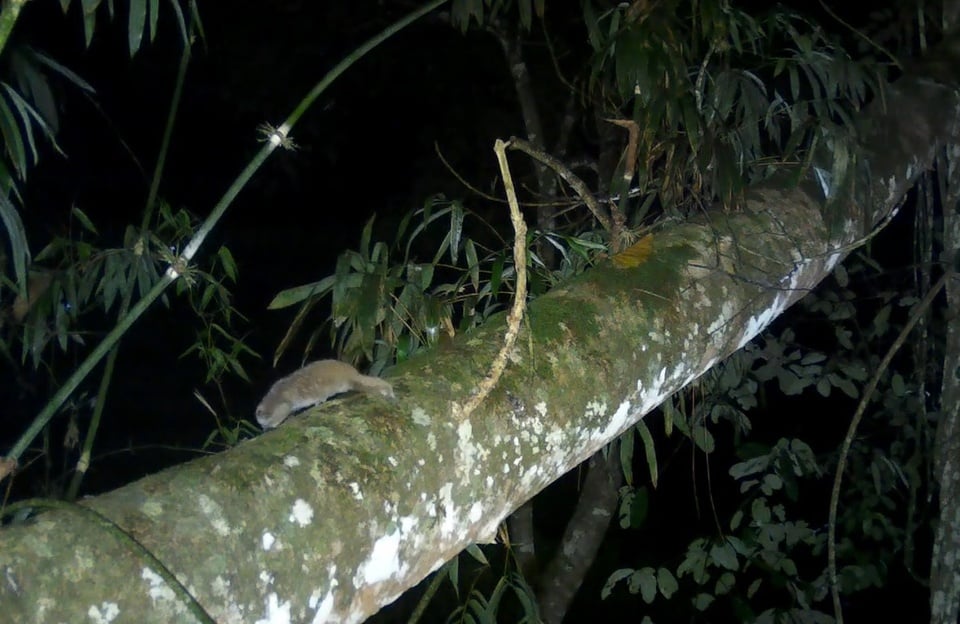
The pygmy slow loris in the wild. |
The pygmy slow loris is one of the rare and endangered animal species listed in the Vietnamese Red Book. This animal is distributed in some tropical forests in Vietnam, Laos, Cambodia, and other parts of Southeast Asia.
In Vietnam, the slow loris once had a fairly wide distribution range, but recent surveys and investigations show that the slow loris population is declining sharply across its distribution range and has disappeared in many areas where the species was previously recorded.
In Ben En National Park, only 8 individuals were recorded in 10 nighttime surveys conducted by four teams. In Phong Nha - Ke Bang National Park, only 1 individual was discovered during a survey in 2012.
Meanwhile, in Cat Tien National Park and Vinh Cuu Nature and Culture Reserve, Dong Nai , the number recorded was also only 13 individuals.
Recent surveys continue to reveal a very worrying situation. The Bac Huong Hoa Nature Reserve recorded only 1 individual, Vu Quang National Park recorded 5 individuals and an estimated population of around 10 individuals. The Pu Hu Nature Reserve recorded 1 individual, with an estimated population of only about 2–3 individuals remaining.
Therefore, recent videos documenting the activity of this species in Xuan Lien National Park, produced by the Center for Nature Conservation and Development (CCD) in collaboration with the National Park Management Board, are very rare footage of the species in its natural habitat.
The pygmy slow loris is quite modest in size, with a body length of only about 20–25 cm and weighing 300–500 g. Its small stature, combined with its large, bright eyes and nocturnal nature, has earned it the nickname "angel of the night." However, in reality, it is the only venomous animal found in Vietnam.
Small lorises possess a special gland located on the inside of their elbows, called the brachial gland. When they feel threatened or in danger, this gland secretes a fluid with a rather strong odor.
Then, the small loris licks this secretion with its tongue to mix it with saliva in its mouth, creating a toxic mixture. When attacked, it can bite its opponent and inject this mixture into the wound.
Despite possessing weapons for self-defense, the loris faces numerous threats, including habitat loss due to deforestation, illegal hunting, and wildlife trafficking.
According to the Vietnamese Red Book, the population of this species is estimated to have declined by more than 50% in the last 30 years due to hunting and trading for ornamental purposes and medicinal use, as well as habitat loss, fragmentation, and degradation due to infrastructure development, conversion of forest land, and logging.
Experts recommend implementing habitat protection measures in the species' natural distribution area, while strictly controlling illegal hunting and trafficking of this species domestically and internationally. In addition, public awareness campaigns should be conducted to minimize the impact on the species' habitat and population.
Source: https://znews.vn/lo-dien-loai-thu-co-doc-duy-nhat-o-viet-nam-post1653118.html





















































































![[INFOGRAPHICS] 25 targets and groups of targets that Can Tho City strives for by 2030](https://vphoto.vietnam.vn/thumb/402x226/vietnam/resource/IMAGE/2026/05/25/1779688983034_1779688951.webp)













Comment (0)