

It is necessary to consider the individual's preference for the chosen profession.
According to Professor Le Ngoc Thanh, Rector of the University of Medicine and Pharmacy (Vietnam National University , Hanoi ), when recruiting for medical programs, one very important factor that all universities hope to achieve is recruiting candidates who have a genuine love for medicine, because this profession requires meticulous and long-term training, and the learning process (as well as the work afterwards) is very arduous.
If students don't love their profession, they will soon become bored with studying, leading to poor academic results, or even dropping out. It's not unreasonable that in countries with developed medical education systems (except France and a few countries influenced by the French medical education system), medical school admissions require applicants to have completed a bachelor's degree. This is because only then do students have a certain level of maturity and truly know whether they have the ability and desire to pursue and commit to a career in medicine.

Input quality is the most important factor when recruiting students for health-related fields.
For 12th-grade students, not many are truly committed to a career in medicine. Therefore, when recruiting this group, students' strong performance in the science subjects (Block B) for the medical entrance exam is a temporary indicator that they may genuinely like and want to pursue a career in medicine. The results of the Block B exam show the extent to which they can realize their aspirations. Therefore, the use of "unusual" subject combinations for medical school admissions by some universities shows that these schools disregard the candidates' interest in the profession during the recruitment process. This is without considering how the quality of training will be affected when admissions are assessed based on "unrelated" or non-core criteria for medical school admissions.
"Somewhere people still say that to have quality, the training process is important, and the entrance requirement is just a high school diploma. But I assert that, especially for medical training, the entrance requirements are very important and greatly affect the quality of training, so we must be very careful in the admissions process," Professor Le Ngoc Thanh shared.
A comprehensive assessment is essential, but it must not omit the core elements.
Associate Professor Le Cu Linh, Deputy Director of the Institute of Health Sciences (VinUni University), stated that VinUni's admissions process combines application review with an aptitude test, not solely based on academic results. The university's admissions process follows these steps: application screening based on multiple factors, with academic results being just one; after screening, the admissions committee selects candidates deemed worthy to advance to the interview round; the next step is the interview, assessing individual aptitude. This process includes a 45-minute interview between the candidate and a faculty member, and may include additional activities.
Medical practice places great emphasis on human values.
The university uses the combination of Mathematics, Natural Sciences, and Literature for admission to the medical program. The Natural Sciences exam already includes Physics, Chemistry, and Biology. Therefore, this combination still ensures core knowledge and stability within the traditional subject combination for medical admissions. At the same time, this new combination is also consistent with the high school graduation exam and the current reformed high school curriculum. The university added (specifically Literature) but did not remove (specifically Biology), so the Mathematics - Natural Sciences - Literature combination is appropriate.
The inclusion of literature as a subject in the entrance examination stems from the practical needs of the medical field, which values humanism, compassion, empathy, sharing, and the ability to withstand pressure during patient treatment. Therefore, students need a solid foundation in literature to perform these tasks effectively.
Dr. VO THANH HAI (Vice Rector of Duy Tan University)
H. Ánh (recorded)
For candidates applying to health-related fields, the application screening process includes evaluating applicants through their academic records, in which the selection committee always looks at the three most important subjects: mathematics, chemistry, and biology.
"Of course, we don't just look at the grades in those three subjects, but we look broadly to assess the candidate's overall competence. However, those three core subjects are the basis for us to determine whether the candidate has the capacity to study the knowledge of the health science training program. As for other important factors for medical candidates, such as communication skills and empathy, we filter them through several tools, most importantly through direct interviews conducted by professors," Associate Professor Linh shared.
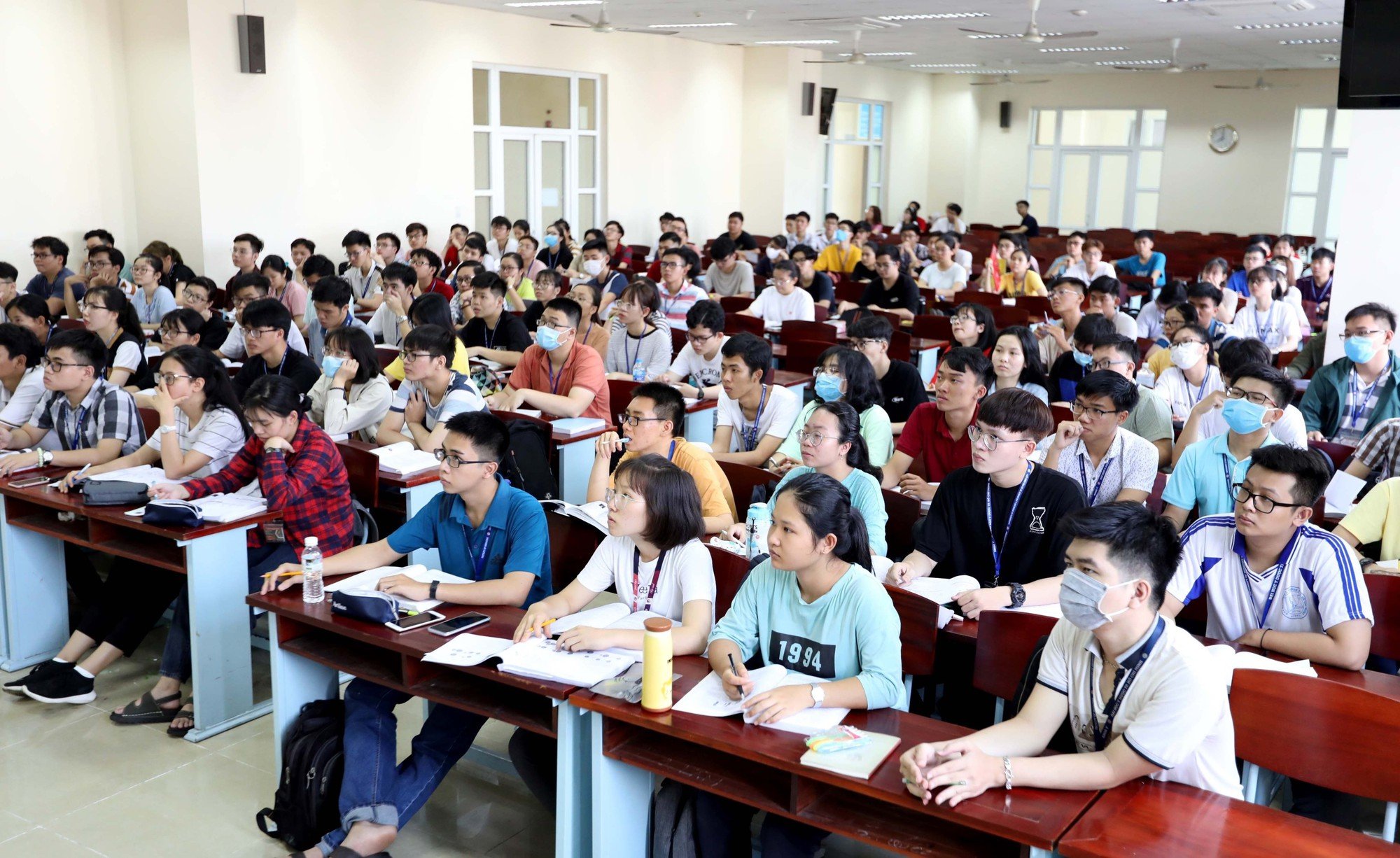
Most health-related training institutions currently accept students based on their B-block entrance exam results.
There are currently abundant sources of candidates for Group B.
According to Dr. Nguyen Quoc Dat, Head of Training Department (Vinh Medical University), with the method based on high school graduation exam results, the most reliable measure of entrance quality is still the results of the three subjects: mathematics, chemistry, and biology. This is because it reflects the knowledge students have accumulated during high school, and this knowledge is closely related to the content of the training program that medical students will study at university later.
"Some schools may require additional skills from applicants, such as foreign language proficiency or computer skills. However, in my opinion, to ensure the quality of medical school admissions, it's probably best to maintain the core requirements of mathematics, chemistry, and biology. Other requirements should only be supplementary and cannot replace those three subjects," said Dr. Dat.
People who excel in literature are essential for this job.
This year, the school is using a new combination of subjects: D12 (Literature, Culture, English). This admission combination complies with legal regulations and meets the necessary and sufficient requirements for this major.
The school's decision to expand the inclusion of literature and foreign languages in this admissions combination aims to meet the new societal demands for students in this field. Today's society requires doctors not only to be highly skilled professionally but also to possess a positive attitude, the ability to listen, empathy, and the capacity to share with patients and the community. The qualities of someone who excels in literature are essential for this profession.
A necessary condition is the regulation ensuring the quality of input. The Ministry of Education and Training requires candidates applying to this major to have excellent academic performance in grade 12 or a high school graduation exam score of at least...
A GPA of 8.0 or higher is required. In addition, candidates must achieve the admission score stipulated by the university to be admitted and undergo the 6-year training program.
Dr. Nguyen Hung Vi (Head of the Faculty of Medicine, Van Lang University)
H. Ánh (recorded)
According to Mr. Dat, the pool of applicants for Group B subjects is always abundant each year. For example, Vinh Medical University only had 910 places available for all majors last year, while there were over 3,000 applications. Therefore, even though the Ministry of Education and Training only required a minimum score of 22 for medical majors, Vinh Medical University set the cutoff score for medical majors at 24.75. This means that a very large number of candidates, even those who met or exceeded the minimum score, still failed to get into the medical majors at Vinh Medical University.
Based on the nationwide distribution of scores for Group B, it is evident that not only in the Central region but also in other areas, a large number of candidates who scored 1-2 points above the minimum threshold for Group B still failed to get into any medical program. Therefore, the pool of qualified candidates for Group B (as required by the Ministry of Education and Training) is very large, and Vinh Medical University shows that there is absolutely no need to expand the admission combinations to increase the pool of applicants.
"Students who dream of studying medicine usually prepare for the B-block exams early on, or those with a strong aptitude for medicine are those who excel in mathematics, chemistry, and biology. Expanding the number of subject combinations makes the admissions 'picture' more confusing and complicated, and creates difficulties for candidates. Students who already dream of studying medicine are determined to excel in the B-block subjects; some may also try their luck in the A-block subjects at some universities that accept A-block applicants. Now, if medical and pharmaceutical schools expand the subject combinations for admissions, it will create difficulties for these students, causing them confusion and making them feel that the competition is unfair," commented Dr. Dat.
Source link
![[Photo] Prime Minister Pham Minh Chinh receives the Chinese Ambassador to Vietnam](https://vphoto.vietnam.vn/thumb/1200x675/vietnam/resource/IMAGE/2026/04/05/1775397481797_ndo_br_dsc-5512-jpg.webp)






































































































Comment (0)