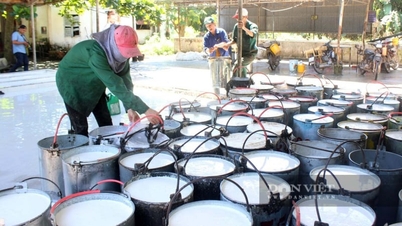
Loc Ha is located about 18km northeast of Ha Tinh city, along provincial road 9 and road 22/12. Blessed with abundant natural resources, it boasts a rich and diverse system of historical sites and scenic spots associated with the sea, such as Chan Tien Pagoda, Le Khoi Temple, Kim Dung Pagoda, Xuan Hai beach… and is also famous for its traditional craft villages: salt production in Ho Do, peanut oil production in Thach Chau commune; incense making, hat making, and broom making in Thach My commune…
It's no exaggeration to say that the system of historical sites and scenic spots in Loc Ha district is extremely diverse and unique due to its interconnectedness. Starting from the Mai King's Temple, passing through Truc Lam Thanh Luong Pagoda to Dinh Lu communal house, then to Chan Tien Pagoda with its poetic Tien Lake, down to Kim Dung on Bang Son mountain located on Xuan Hai coast, and stopping at Le Khoi Temple on Long Ngam peak on Nam Gioi mountain… Come to Loc Ha, and tourists will have the opportunity to explore and enjoy the unique beauty of this land!
Perspective view of Mai Thuc Loan Square
In Loc Ha, visit Mai Phu commune, home to the temple of Mai Thuc Loan – the emperor of the Hoan Chau uprising against the Tang dynasty's rule in 713-722. The Hoan Chau uprising, led by him, broke out in April of the Quy Suu year, driving out the enemy and liberating a vast area of Chau Dien and Chau Ai. In 722, the Tang army returned to suppress the uprising, and Mai Hac De's army was besieged. The emperor fled into the forest and died there. To commemorate his contributions, the people of Mai Phu commune erected a temple in his hometown. With the aim of preserving, restoring, and promoting the cultural heritage, Ha Tinh province recently invested in and built the Mai Hac De historical and cultural complex, including the temple, monument, and square in Loc Ha. This is a sacred cultural site, worthy of the stature and position of a king who made great contributions to his homeland and country.
Like the Mai King Temple, Dinh Lu communal house is a significant historical site in the Soviet-era Nghe Tinh region. Located in Tan Loc commune, it was built by the local people to commemorate the contributions of General Nguyen Xi, who fought against foreign invaders. Previously, Dinh Lu communal house was a gathering place for patriotic scholars in the region to discuss strategies against the French , a refuge for revolutionary fighters, and the site of the earliest establishment of a Communist Party of Vietnam branch in Ha Tinh province. Today, Dinh Lu communal house has been renovated to be spacious, clean, and beautiful, becoming a traditional house and a venue for major festivals in Loc Ha district and Ha Tinh province.
..."The pine forest rises, leaving behind traces of immortals."
Lake Thuy Thien Quang, Buddha Hall
Immortal monk, the path of the common people.
The stone chamber has existed since the Han dynasty.

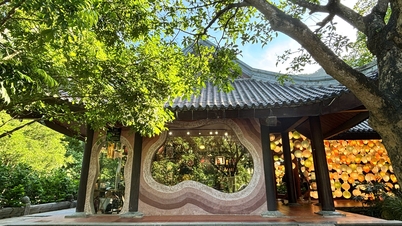
These are four couplets inscribed in front of Chan Tien Pagoda. Chan Tien Pagoda, located in Thinh Loc commune, was built during the Tran Dynasty and sits atop Tien Am Mountain at the end of the Ngan Hong mountain range. It is a historical site dedicated to the Holy Mother and the Buddha Shakyamuni. The Chan Tien Pagoda festival is held annually on the 3rd day of the 3rd lunar month, the anniversary of the Holy Mother's death, and is solemnly celebrated by the local people to honor their ancestors' contributions to nation-building and defense, and to pray for peace and prosperity for the people.
Looking down from the pagoda, one sees endless green pine forests. Visitors are captivated by the majestic natural beauty and the legends and myths about the footprints of fairies, the chessboard of fairies, the fairy pond, the foundation of Son Tinh, the foundation of Hoang Thach… Chan Tien Pagoda is not only a sacred place but also a place with magnificent natural beauty that attracts tourists to admire and enjoy.
..."Bang Son ancient temple, a place of love for the land and water."
"The ancient temple remains, its meaning as solid as gold..."
Bang Son – a mountain range rising amidst the coastal plain of Loc Ha, is a mysterious mountain range associated with many legends passed down through generations about the Huong stream, Bau stream, Ong rock, Mu rock, Muong rock, Trong rock… and the burial place of the ancestral Duke Nguyen Huu Chinh.
Standing prominently on the slopes of Bang Son mountain is the Kim Dung Pagoda. The pagoda was built during the Tran Dynasty. Legend says that during the Tran Dynasty, King Hung Dao, while touring the South, stopped his boat to admire the scenery, drink wine, and play chess. According to historical records, the Kim Dung Pagoda was formerly a secret revolutionary base, and the peak of Bang Son mountain was always brightly adorned with red flags bearing the hammer and sickle. Bang Son has become a symbol of heroic revolution, a source of pride for the people of Thach Bang commune.
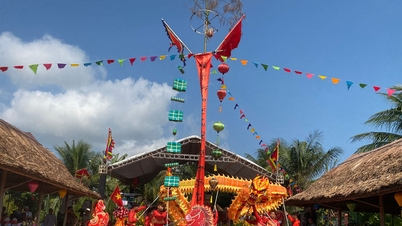
Kim Dung Pagoda, situated on the slopes of Bang Son Mountain, is a famous scenic spot with stunning natural beauty and a sacred atmosphere, making it suitable for cultural and spiritual tourism combined with ecotourism. The Kim Dung Pagoda Festival, held annually on the 14th and 15th of March in the lunar calendar, is a grand event with many ceremonial rituals, including a dragon palanquin procession from Xuan Dai Pagoda to Kim Dung Pagoda, bell ringing, and the welcoming of the Venerable Monk to pray for national peace and prosperity. It also features competitions such as tug-of-war, cockfighting, card games, and camping. Therefore, it is one of the largest festivals, attracting a large number of people from within and outside the district.
Heading north to Chieu Trung Temple, you can also enjoy a trip to Nam Gioi Mountain. Chieu Trung Temple is dedicated to Le Khoi – the second brother of Le Loi, who contributed to dam construction, land reclamation, village establishment, and agricultural development. In 1446, Le Khoi, under the command of King Tran Nhan Tong, went to fight Champa. On his return, he fell seriously ill and died at Cua Sot, at the foot of Nam Gioi Mountain. His remains were buried at the summit of Long Ngam Mountain. To commemorate his contributions, the court established a temple here. Every year, from the 1st to the 3rd of May (Lunar Calendar), a memorial ceremony is held here to remember the merits of this famous general in the history of resistance against the Ming invaders. At Chieu Trung Temple, visitors not only participate in the festival but also admire and enjoy the scenic Quynh Vien Eco-tourism Area – Nam Gioi Mountain – Cua Sot, associated with the legend of Chu Dong Tu and Princess Tien Dung.
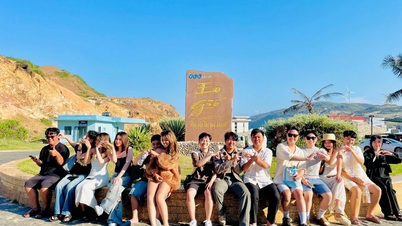
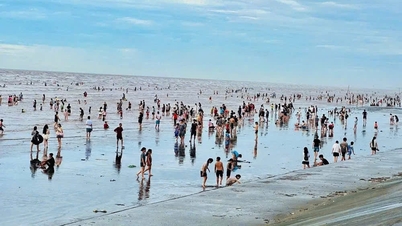
Besides cultural and spiritual tourist attractions, beach tourism is also considered one of Loc Ha's strengths, with many beautiful beaches. Thach Bang beach boasts fine, smooth white sand, gentle waves, clear blue water, and moderate salinity. Located quite far from residential areas, the beach is very clean and retains its pristine, unspoiled beauty.
With its central location in the district, Xuan Hai beach is situated right on Highway 70, which connects to Provincial Road 9 from Ha Tinh city all the way to the beach. Visitors can reach Xuan Hai from many directions: from Cam Xuyen along the coastal highway, crossing Thach Dinh bridge to Loc Ha (about 15km), from the Thach Long – Thach Ha bypass intersection (about 7km), from Ha Tinh city straight along Provincial Road 9 across Ho Do bridge (about 9km), or from Highway 22/12 towards Nghi Xuan straight to the district center. All routes meet on Highway 70 leading directly to the beach, making it very convenient. Here, visitors can leisurely stroll on the smooth sandy shore, breathe in the fresh air, and immerse themselves in the cool, clear water, feeling truly relaxed… This place is a perfect combination of nature, where the sea and mountains blend together harmoniously.
Besides its convenient transportation and beautiful beaches, this area also boasts abundant seafood resources such as various types of fish, crabs, shrimp, and squid caught from Thach Kim sea; Mai Phu clams, green mussels, Thach Chau oysters, hairy clams, and blood cockles from Thinh Loc... providing a plentiful supply of fresh seafood for restaurants and hotels serving tourists.



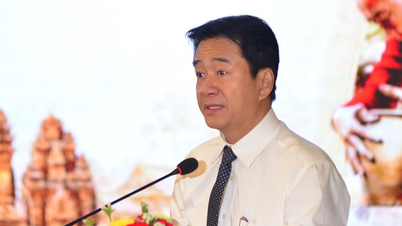
With a total coastline length of over 12km, after the People's Committee of Ha Tinh province approved the zoning plan for the construction of a coastal tourism area with a total scale of 400 hectares, including 150 hectares for services and 250 hectares for high-end tourism, Loc Ha district has maximized its advantages and concentrated resources to develop Xuan Hai beach into an ideal destination for tourists from near and far. In recent years, every year during the April 30th holiday, the People's Committee of Loc Ha district organizes the opening ceremony of the coastal tourism season. As usual, this year from April 20th to 24th, the People's Committee of Loc Ha district organized the opening ceremony of the Loc Ha 2016 Culture and Tourism Week. This event promotes and introduces the tourism potential, the image of the people and land of Loc Ha to tourists inside and outside the province, aiming to attract and encourage investment projects in Loc Ha district. Linking with tourist destinations within and outside the province to form tours and routes, aiming to unlock the local tourism potential.
In addition to renovating and repairing facilities and cleaning up the environment on the beach area, Thach Bang commune has established a management subcommittee with a permanent force to ensure security, order, and safety for tourists at the beach. With 2 accommodation establishments with approximately 100 rooms, nearly 20 restaurants, and 30 service businesses along the coastline, Xuan Hai beach has been leveraging its advantages, gradually asserting its position and becoming a favorite destination for tourists during the beach tourism season.
With its rich tourism potential, convenient location, and the concerted efforts of various departments, Loc Ha will soon become one of the attractive tourist destinations in the province.
Author of the article: Tú Quỳnh
Source: https://dulichhatinh.com.vn/tai-nguyen-du-lich/loc-ha-diem-den-an-tuong-568/
![[Image] A look back at the capital's preparations for the century-long master plan.](https://vphoto.vietnam.vn/thumb/1200x675/vietnam/resource/IMAGE/2026/06/29/1782750453122_quy-hoach-100-nam-minh-duy-1-2118-jpg.webp)


![[Photo] General Secretary and President To Lam works with the Party Committee of the Government on the work of preventing and combating storms, floods, extreme natural disasters and climate change.](https://vphoto.vietnam.vn/thumb/1200x675/vietnam/resource/IMAGE/2026/06/29/1782729441945_a1-bnd-0385-9454-jpg.webp)