

 |
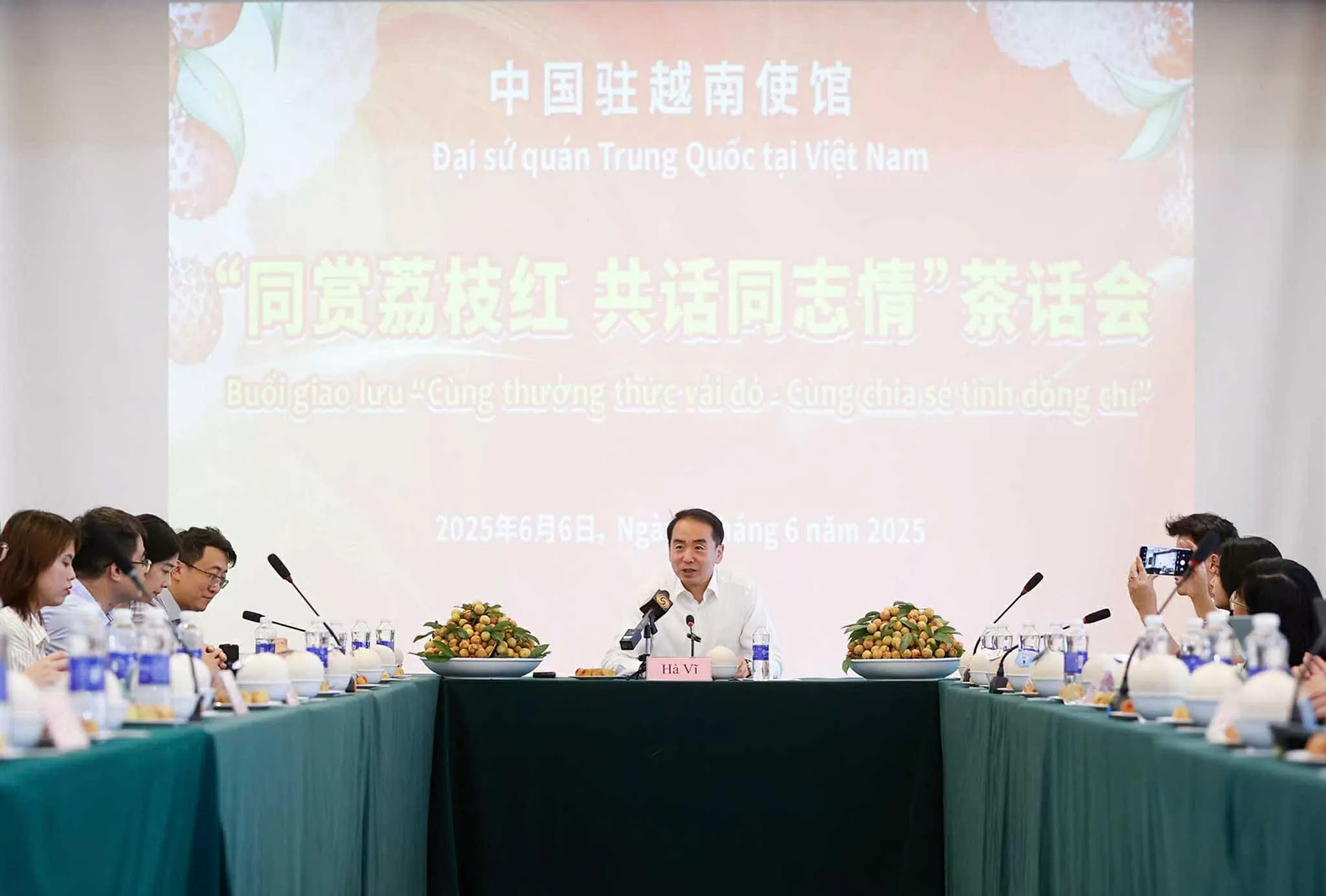
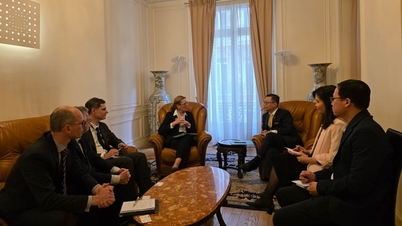
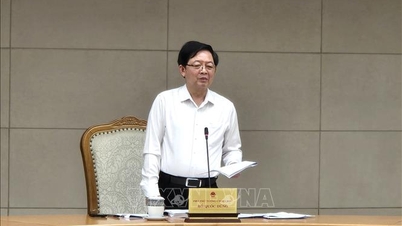
| Chinese Ambassador He Wei interacts with Vietnamese reporters on June 6. (Photo: Phuong Ha) |
Enjoy the red fabric, share the friendship.
Last October, at the beginning of his term in Vietnam, Chinese Ambassador He Wei met with Vietnamese reporters to discuss his many plans aimed at further promoting the Vietnam-China Comprehensive Strategic Partnership and the Vietnam-China Community of Shared Future, which is of strategic significance.
While strolling through the embassy grounds, Ambassador Ha Vi stopped by the ancient lychee trees in the corner of the garden and recounted how embassy staff and officials throughout their terms had meticulously cared for these trees. In the past, during the lychee season in May and June, the embassy would select the freshest and most delicious bunches of lychees to present to President Ho Chi Minh . Each time he tasted the lychees, he would praise their deliciousness.
Ambassador Ha Wei said that caring for the lychee trees was also a way of cherishing the affection that President Ho Chi Minh had for the embassy. "I very much hope that next lychee season, we will enjoy the red lychees together and talk about Sino-Vietnamese friendship," the Chinese diplomat expressed. The group of reporters enthusiastically applauded, creating a lively atmosphere in a corner of the embassy garden.
This year, as the summer sun began to intensify, lychees ripened, dyeing many rural areas in the central highlands red. Street vendors laden with ripe lychees adorned markets and city streets. While many of us reporters were so engrossed in our work that we forgot our appointment, we unexpectedly received an invitation from Ambassador Ha Vi to attend a gathering titled "Enjoying Red Lychees - Sharing Friendship." Everyone eagerly awaited the chance to taste the lychees that President Ho Chi Minh had praised so highly years ago.
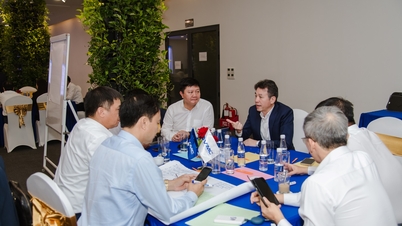
At the meeting, the Chinese Ambassador invited reporters to enjoy not only red lychees but also fresh coconuts – two prominent fruits that Vietnam exports to China, achieving impressive export figures. The lively exchange covered many topics, from stories of the timeless friendship between the two countries to the bonds of cooperation, especially in agricultural products. Agricultural cooperation between the two countries has developed rapidly in recent years, becoming a pillar in economic cooperation.
Ambassador Ha Vi shared that for many years, China has been Vietnam's largest export market for agricultural, forestry, and aquatic products, contributing to increased income for tens of millions of Vietnamese farmers. He cited that nearly 91% of Vietnam's total durian export value goes to China. "Upon returning to our homeland, we can already see Vietnamese durian," the Ambassador shared.
According to him, advantages in transportation help high-quality Vietnamese goods access the market of over a billion people. In August 2024, fresh coconuts from Vietnam were officially licensed for export to China. In just four months of 2024, according to statistics, the export value of fresh coconuts and coconut products from Vietnam to China exceeded $1 billion.
Late last year, Ambassador Ha Wei made a field trip to several provinces in South Central Vietnam. He observed that the price of fresh coconuts in the area had doubled compared to 2023, significantly increasing farmers' incomes. This further motivated the Chinese diplomat to make greater efforts to ensure smooth shipments of agricultural products through border crossings to all parts of the Northeast Asian country.
According to the Ambassador, China will continue to open its market to Vietnamese goods. In terms of PPP (purchasing power parity), China is a super-large market (population 1.4 billion), with vast potential and room for growth, capable of boosting the consumption of Vietnamese products.
Two "golden periods"
Ambassador Ha Wei spent considerable time discussing with Vietnamese reporters the great friendship between the two countries, which originated from the sentiments between President Ho Chi Minh and Chairman Mao Zedong, and has been nurtured by generations of leaders and people of both nations.
"The warm friendship between China and Vietnam has helped us achieve victory. We consider the period under President Ho Chi Minh and Chairman Mao Zedong as the first golden age in the history of our bilateral relations," Ambassador Ha Wei emphasized.
According to Chinese diplomats, the two countries are currently in a "second golden age," guided by General Secretary and President Xi Jinping, the late General Secretary Nguyen Phu Trong, and General Secretary To Lam, deepening the comprehensive strategic cooperative partnership and promoting the building of a strategically significant Vietnam-China community with a shared future.
Ambassador Ha Vi was particularly impressed by the images of General Secretary Nguyen Phu Trong planting a friendship tree at the Huu Nghi Border Gate in Lang Son province, in the border area between the two countries (August 2023). During the recent Vietnam-China Humanitarian Exchange Year 2025, General Secretary To Lam planted a "Vietnam-China Humanitarian Exchange" tree in the grounds of the Vietnam-China Friendship Palace.
Within a year and a half, General Secretary and President Xi Jinping made two state visits to Vietnam, "therefore, we consider this the second golden period in the history of friendly relations between China and Vietnam," the Ambassador said.
Entering a new era, with the strategic direction of the leaders of the two Parties and two countries, Ambassador Ha Vi believes that Vietnam-China relations will develop to a new level. "China-Vietnam relations are developing in an unprecedented phase, at the highest level and at the fastest pace," the Ambassador stated.
The exchange ended as the plates of fresh lychees on the table gradually emptied. A representative from a newspaper shared that the sweetness of the lychees was like the "sweetness" of the friendship between the two countries. The lychee tree, through the years, has blossomed and borne fruit, just as cooperation between the two countries in various fields continues to expand and develop. "The red lychee tree is like a sacred place, a place imprinted with memories of President Ho Chi Minh from the past, so that we can cherish and further promote the enduring friendship between Vietnam and China," remarked a reporter before the exchange concluded amidst continuous applause...
Source: https://baoquocte.vn/loi-hen-mua-vai-thang-sau-317509.html
![[Image] National Assembly discusses the implementation of the socio-economic development plan.](https://vphoto.vietnam.vn/thumb/1200x675/vietnam/resource/IMAGE/2026/04/20/1776696707422_ndo_br_img-20260420-185419-jpg.webp)

![[Photo] General Secretary and President To Lam meets with National Assembly delegates from ethnic minorities.](https://vphoto.vietnam.vn/thumb/1200x675/vietnam/resource/IMAGE/2026/04/20/1776696701056_a1-bnd-8331-3342-jpg.webp)








































Comment (0)