

Before dawn, many figures could be seen in the distance along the Tuy Hoa sea. Mr. Nam Chien (78 years old, residing in Tuy Hoa ward), who has spent more than half his life with his small boat and fishing net, quietly prepared for his first fishing trip of the day with his fellow fishermen. The salty sea breeze, the pungent smell of fish and engine oil mingled in the air, creating a familiar scent for the fishermen of this coastal region.
"I'm used to this job; I can't stand not going," Mr. Chien said, constantly checking his nets. As the clock struck 4 o'clock, he and his crew pushed the boat into the water. The sputtering engine roared through the night, and the small boat cut through the waves, heading out to sea.
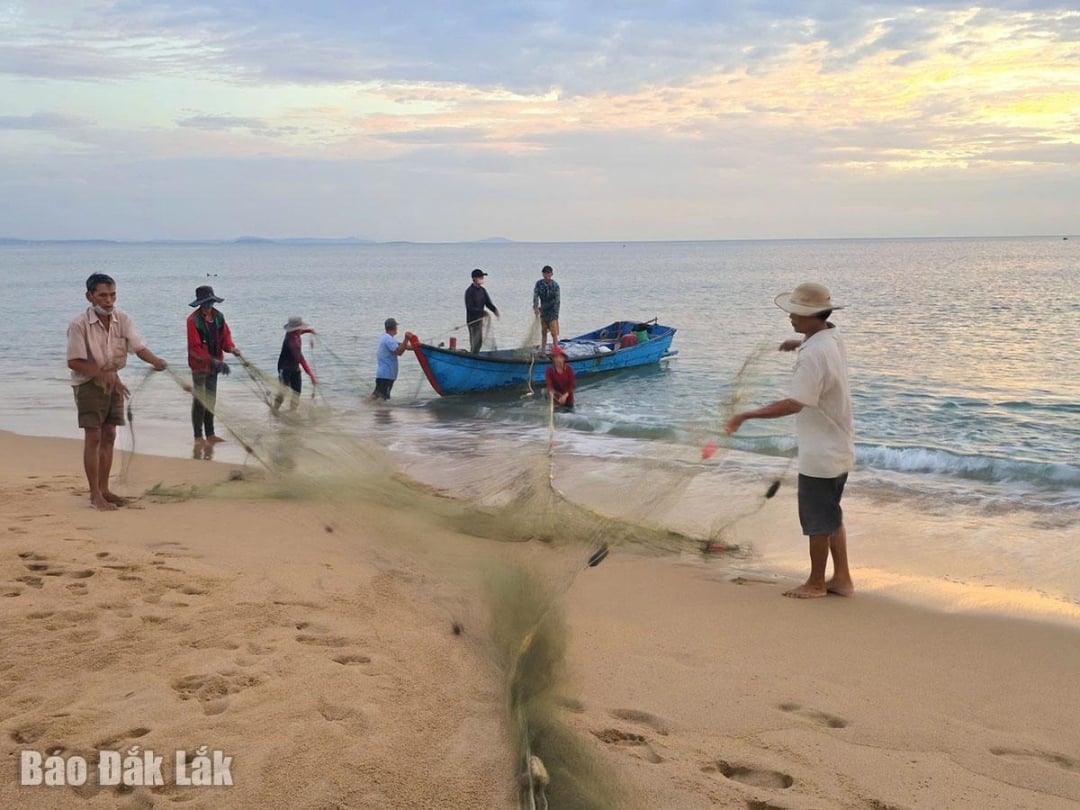 |
| Fishermen in Tuy Hoa ward prepare their nets to go fishing early in the morning. |
“Every day, my fellow fishermen and I wake up at 3 a.m., prepare our gear, and go fishing. From 4 a.m. to 8 a.m., we make two trips. Some days we catch fish, some days we don't, but we go almost every day,” Mr. Chien said, his eyes still gazing out at the distant sea. For over 40 years in the profession, the sea is not just a source of livelihood, but also his home, his friend, and the place where he has shared all the joys and sorrows of his life.
Mr. Chien's boat is small, only suitable for near-shore fishing. Every day, he and his crew cast their nets and catch scad, barracuda, anchovies, shrimp, squid, and sometimes even mackerel and tuna. As soon as the boat returns to shore, his wife quickly sorts and selects the best fish to sell to early-morning fishermen or to deliver to restaurants along the coast. On a good day, each crew member receives 80,000 - 100,000 dong; on a bad day, they return empty-handed, considered a loss (the cost of the fishing trip).
"This way, we earn a bit, not a lot of money, but enough to live on. We have little capital, so we only fish near the shore. Only those with more money can afford to buy bigger boats to fish for tuna further offshore," Mr. Chien said, his eyes still fixed on the sea, which was just turning pink from the sunrise.
Not only in Tuy Hoa, but many fishing villages along the eastern coast of Dak Lak also begin their day with the sound of waves and motorboats and small fishing boats echoing along the shore. In My Quang Bac village (Tuy An Nam commune), Mr. Nguyen Tam and his wife, Mrs. Ho Thi Thu Tuyet, have been connected to the sea for over 35 years. Their equipment consists of a small motorboat and a few worn fishing nets.
"You can't predict the future when you're fishing. Some days you strike it rich, other days you only get a few kilos of fish. The fish are seasonal, like anchovies this season," Mr. Tam said, rearranging his nets to prepare for the next trip.
Every day, Mr. Tam wakes up at 2 a.m., pushing his motorized boat out to sea while it's still dark. The vast night sea is filled only with the howling wind and the flickering lights of distant boats. Although he's used to it, he's still not complacent because the sea is unpredictable. Sometimes the sea is suddenly rough, with waves crashing down, almost capsizing the boat. Once, the engine broke down mid-way, and he had to call for help from the shore in a boat.
Around 5 a.m., as the sun rose above the sea, he returned to shore. In the soft golden sunlight, the net was pulled up, glistening with fresh fish and shrimp – a gift from the sea after years of hard work. On shore, Mrs. Tuyet was also busy preparing baskets, ready to receive the fish, sort them, and sell them to her regular traders.
"Every time my husband goes to sea, I can't sleep, I'm always worried and anxious because the sea is so vast. But over time, I've gotten used to it; I've been working at sea for decades, how can I give it up now?" Mrs. Tuyet said, her hands still nimbly removing anchovies from the net.
Making a living on the sea, fishermen not only face dangers at sea but also bear the burden of ever-increasing costs: from fuel and fishing gear to repairs and maintenance of boats and rafts. Meanwhile, fish prices fluctuate erratically, sometimes plummeting, meaning that an entire night's work at sea may only yield a few tens of thousands of dong. Many poor families lack the capital to build new boats and buy nets, and are forced to settle for small-scale fishing near the shore, with incomes precarious depending on the tides. Yet, despite everything, they remain loyal to the sea. They accept hardship and even losses to preserve their profession, the sea, and the way of life passed down from their ancestors.
| Every morning, as the sun rises, small boats line up, cutting through the waves to head out to sea. And life continues—peaceful and simple, just like the people who are deeply connected to the sea. This is the rhythm of life for those who make their living from the waves, where each mesh of the net not only holds fish but also preserves the memories and soul of the fishing village. |
My Quang Bac village, a fishing village nearly 200 years old, currently has over 780 households, most of whom make a living from near-shore fishing. The small boats and vessels, with just enough capacity to go out to sea, are valuable assets and the "means of livelihood" for countless generations of fishermen here. Mr. Nguyen Hoang Yen, head of My Quang Bac village, said: "The villagers have been involved in fishing since their grandparents' generation, and now their children and grandchildren still do. Almost everyone here knows how to pull nets, mend nets, and has known the smell of fish since childhood. Some families have never left the sea for three generations."
According to Mr. Nguyen Hoang Yen, although the seafaring profession is arduous, it is ingrained in their blood. Fishermen go to sea not only for a living, but also because they love the sea. The nets hanging in front of their houses are not just fishing tools, but symbols of their resilience, of generations of memories connected to the sea.
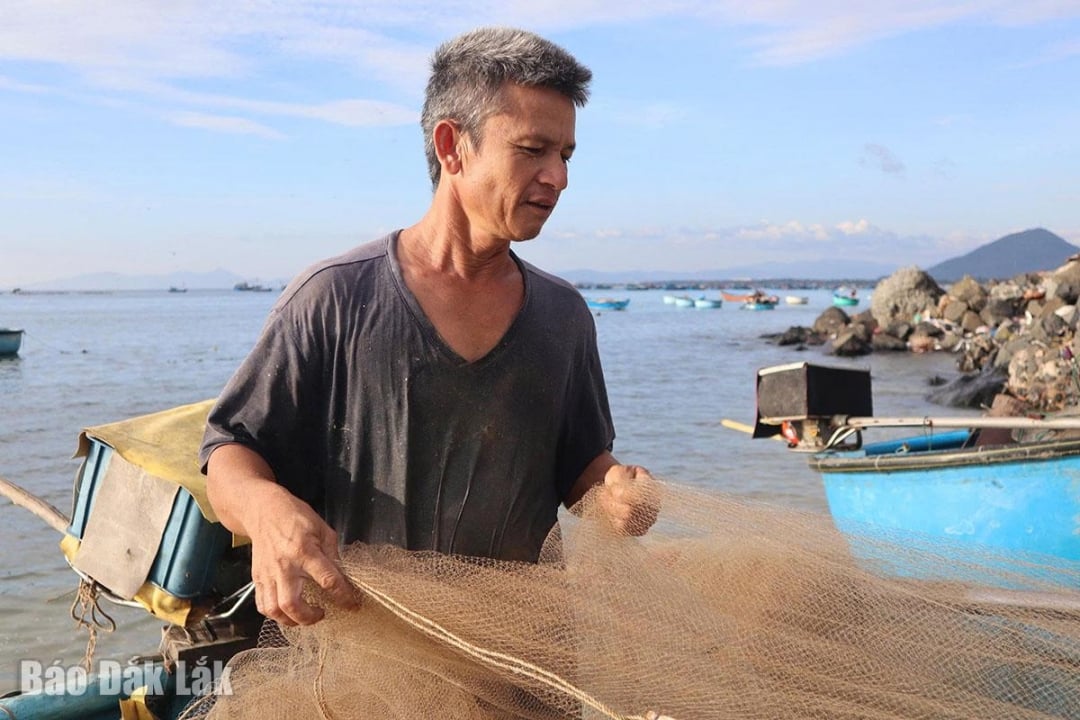 |
| Despite the precarious income, fishermen in the eastern fishing villages of Dak Lak province are still striving to stay at sea and preserve their profession. |
On days when the sea is rough, the fishing village is unusually quiet. There's no more engine noise, no more shouts of people pulling in their nets. But then, as soon as the sea calms down, the villagers head out to sea again. Even though they know fishing is hard work and the income is uncertain, they still don't leave their nets. Because this profession has sustained countless generations, taught them patience, loyalty, and the courage to overcome hardship.
“In this profession, as long as you have the strength, you can still go out to sea. As long as you can still hear the waves and smell the salty wind, you can still go to sea,” said Mr. Nam Chien, his words a firm affirmation from someone who has never surrendered to the sea his whole life. Mr. Nguyen Tam smiled gently: “The sea gives us life. We avoid the rough sea and rejoice in the gentle sea. The sea may not make us rich, but it can support us, our wives, and our children. The sea will not let down those who cherish it.”
Amidst the constant changes of life, fishermen in the eastern coastal region of Dak Lak quietly preserve their traditional occupation. Not just for a living, but to maintain a part of the soul of their fishing village – a place with waves, wind, and the warm hospitality of the people, just like the sea itself.
Source: https://baodaklak.vn/xa-hoi/202508/luoi-ca-nhip-doi-6cf0a4e/

![[Photo] People in Ho Chi Minh City experience the green space at Ly Thai To Park No. 1.](https://vphoto.vietnam.vn/thumb/1200x675/vietnam/resource/IMAGE/2026/03/06/1772783731988_01-9003-png.webp)
![[Image] Me So Bridge - an important connecting point on the Ring Road 4](https://vphoto.vietnam.vn/thumb/1200x675/vietnam/resource/IMAGE/2026/03/06/1772781627165_ndo_br_dji-0917-jpg.webp)
![[Photo] Prime Minister Pham Minh Chinh meets with representatives of female leaders and managers of central agencies and presents the Kovalevskaia Award 2025.](https://vphoto.vietnam.vn/thumb/1200x675/vietnam/resource/IMAGE/2026/03/06/1772789429283_ndo_br_dsc-1149-jpg.webp)



























































































Comment (0)