

Dressing appropriately and respectfully at tourist attractions and public places is not just a rule, but also an act that reflects one's cultural character.
Right place, right time
During a visit to historical sites in the ancient capital of Hue (Thua Thien Hue province) in early September, while visiting places like Minh Mang Mausoleum and Thien Mu Pagoda, the author encountered many tourists, both domestic and international, casually wearing shorts, tank tops, or even tops that fully exposed their backs.
At some tourist attractions, despite signs (in both English and Vietnamese) outlining dress code regulations, this situation still occurs. The regulations for visiting the Hue Imperial City stipulate: "Visitors must dress respectfully. Sleeveless shirts or shorts are not allowed when visiting places of worship."
Also related to the issue of clothing, images circulated on social media in late August showing three female tourists wearing two-piece swimsuits walking through Hanoi 's Old Quarter, casually chatting and laughing with their friends.
Stories about inappropriate attire, such as wearing bikinis or taking semi-nude photos in Hoi An Old Town; young women taking revealing photos in supermarkets; wearing short skirts, see-through tops, and posing suggestively in sacred places, appear quite frequently on social media and have often caused outrage.
Everyone has their reasons for their actions and even tries to justify them in every way possible, even when condemned by the online community.
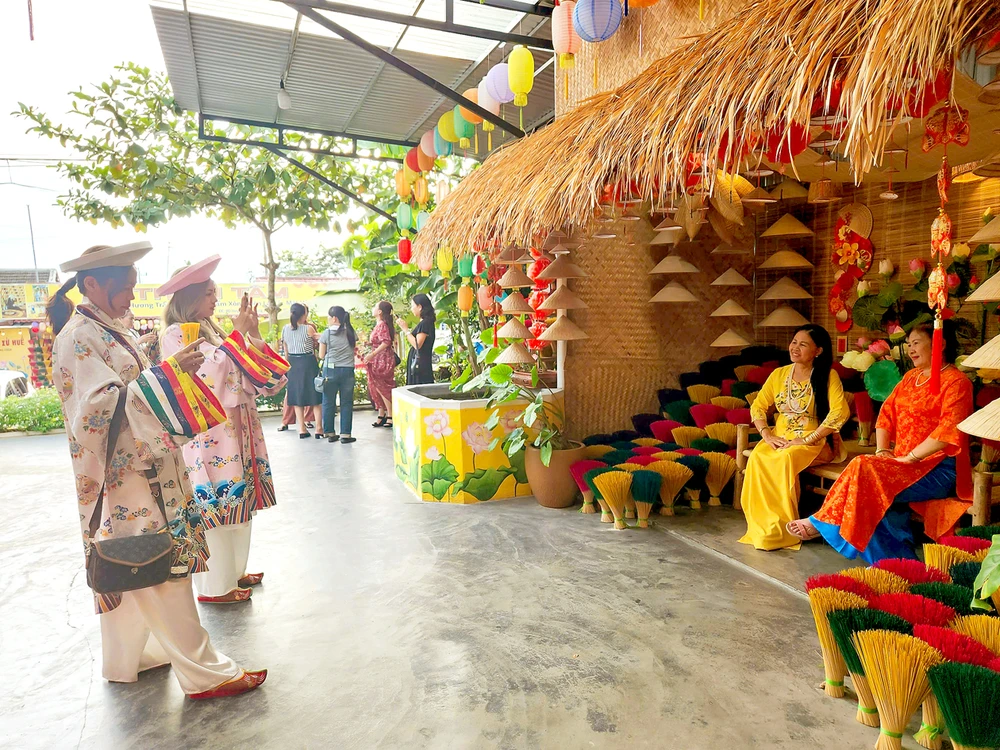
However, there are also stories of people dressing stylishly that suddenly go viral, surprising even those involved. Minh Đời, a young woman who specializes in tailoring traditional ao dai (Vietnamese long dress), experienced an unexpected situation during a visit to Hue.
Dressed in beautiful, meticulously made traditional Vietnamese ao dai dresses that they had sewn themselves, the group posed for commemorative photos. Foreign tourists mistook them for monument staff and rushed to take pictures.
The video , which has garnered over 1 million views and thousands of comments, is full of praise, with many saying that this small act has contributed to spreading the image of Vietnamese culture and traditional clothing.
Awareness of beautifying the community.
Besides choosing beautiful and comfortable clothes, many people forget that clothing needs to be appropriate for the context and location they are going to, even though that is one of the most important things.
Bikinis were originally designed for the beach, fashion shows, or beauty pageants. They can't possibly become street wear just because of the hot weather.
Similarly, for tourists visiting Hue, the outfits consisting of shorts, tank tops, and camisoles are clearly only suitable for strolling or going out in public places, not for visiting historical sites.
Therefore, when visiting the The To Temple located within the Imperial Citadel complex, there are always security guards at the entrance checking and reminding visitors about inappropriate attire. Visitors wearing short or revealing clothing who wish to continue their visit will be asked to use a shawl to ensure modesty in this sacred place.
This has made both domestic and international tourists feel completely comfortable and comply with the dress code happily. For tour groups, before each destination, tour guides should also inform visitors in advance about the dress code so they can make appropriate choices. Similarly, at historical sites, there should always be someone reminding visitors about the dress code right from the entrance, gradually forming a good habit.
Dress code regulations have also been formalized in writing, on signs at tourist attractions and historical sites, or even as unspoken conventions in daily life, from the workplace to meetings, funerals, and weddings…
There are regulations and penalties for wearing overly revealing or inappropriate clothing, although this isn't necessarily the best solution. However, the most important thing ultimately comes down to each individual's awareness. Aside from those who intentionally seek attention, surely no one wants to become the target of criticism and ridicule simply because of their clothing.
The saying "Eat for yourself, dress for others" reminds us that, in addition to providing comfort and confidence for oneself, each individual's clothing choices also influence and contribute to the community's culture.
VAN TUAN
Source: https://www.sggp.org.vn/mac-dep-thoi-chua-du-post759100.html













































![[Workers' Month 2026] Spreading love on the Vinh - Dong Hoi frontline: Nearly 1 billion VND spent on caring for the lives of workers.](https://vphoto.vietnam.vn/thumb/402x226/vietnam/resource/IMAGE/2026/05/20/1779237885217_img_8650.jpeg)












































Comment (0)