

That dreamlike realm felt as close and familiar as every village I passed through, every person I met in my daily life amidst the vast mountains.
1. I remember that time, following the banks of the Ba River at the end of the Kông Chro region, I sought out a land that still retained a strong Bahnar character. Bahnar villages along the Bờ Nơm river, such as Plei Yơng and Plei Pyang, have shown considerable resilience against the whirlwind of urbanization, preserving many traditional features.
Among them are cemeteries and burial grounds, along with mysterious customs for bidding farewell to the souls of the deceased. Visiting Kông Chro only intensified my desire to forever be a traveler through such diverse and colorful lands.
I long to be a guest in the stilt houses nestled peacefully, overlooking the communal house, with their curved frames resembling elephant tusks, low and long in the middle of the village.
I also wanted to open up and share stories with the friendly Bahnar men and women I met by chance on the road, at the loom, or while sharing meals of wild vegetables and stream fish…
I also remember a rainy day at the end of the year in the border region of Bo Y. The mountains and forests were a dark, soaking wet color, and the wind carried the unique hue of the borderland. The Indochina Tripoint marker, situated at an altitude of 1,086 meters above sea level, projects an azimuth angle of more than 2 kilometers across three countries, revealing only towering mountains. Nowhere else is quite like this place; a simple turn around the stone pillar is enough to cross the borders of three nations.
The vegetation of each country seems to bear the distinct colors of history and culture. From the border markers, travelers can more easily grasp the dimensions of the Central Highlands and the shape of the homeland.
From the Indochina Crossroads, I gazed broadly toward the Central Highlands. Within that stream of thought, a vast realm of reflection on the land unfolded; a region both mysterious and enchanting, yet also familiar and endearing…
2. In the beliefs of the people of the Central Highlands, the higher the mountains, the deeper the rivers, and the more rapids and waterfalls there are, the more miraculous the spirits of that place are. The inhabitants of the highlands behave according to the echoes of the mountains and rivers; the spirit of the mountains and streams flows into their veins and creates their systems of wisdom.
High mountains and deep rivers are spaces of belief, spaces for survival, and spaces that nurture romantic love stories. More than just geographical markers, mountains and rivers are an integral and sacred part of this land's soul.
The three majestic mountain ranges of Chu Yang Sin, Bidoup, and Ngok Linh stand tall like three roofs spreading their legs from three corners of the vast forest, creating a firm and proud stance.
Major rivers such as Krông Anô, Krông Ana, Sêrêpôk, Sê San, Đồng Nai … originate from high mountain ranges like colorful patterns, carrying within them cultural and historical sediments.
From the desolate mountains and wilderness, from the villages nestled against the mountains and facing the rivers, epic poems like Dam San, Xing Nha, Khinh Du, and Dam Noi were born. From the rocks and bamboo forests, musical instruments such as the lurgòong, tingning, klongput, and t'rưng produced enchanting sounds.
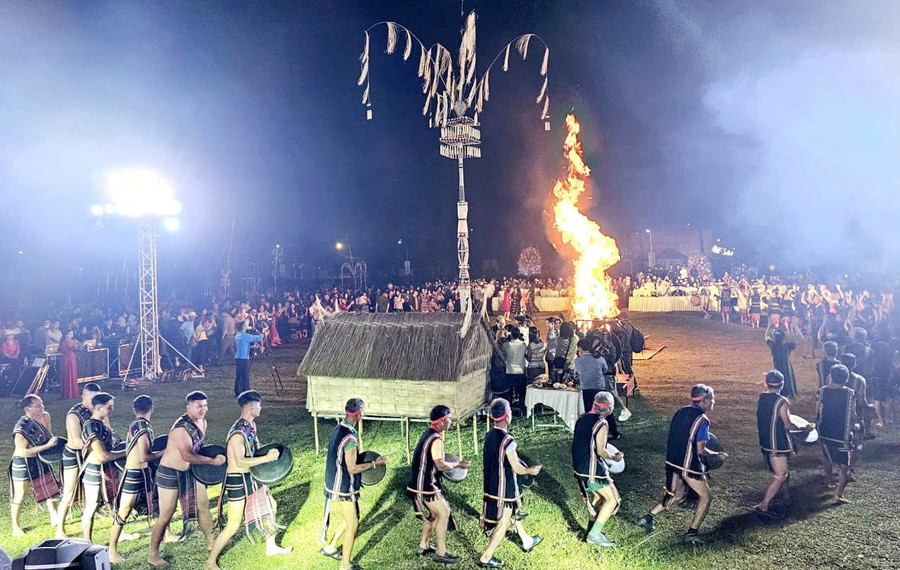
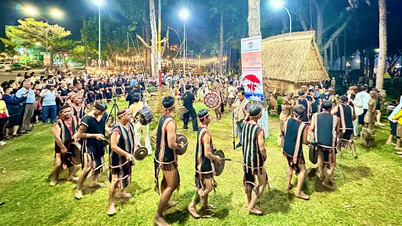
The folk songs of Nrí, Nrìng…; the folk melodies of Ayray, Kưứt, Lảhông, Yalyău…; and the distinctive folk dances all blend together around the forest fire, creating an atmosphere that is both real and dreamlike.
Throughout my years in this vast mountainous region, I've always wondered, by what measure is the true dimension of the Central Highlands? Is it measured by towering mountains, deep rivers, mysterious forests, boundless grasslands, or the millions of years of geological formations?
It's difficult to quantify things visually. Whether the mountains are high or low, the rivers large or small, they all share a common source, originating somewhere upstream.
The villages I've visited seem to share a common root of brotherhood. I encountered them in Stơr village, home to the hero Núp; Saluk village, where G. Condominas discovered the stone xylophone and wrote his famous research "We Eat the Forest"; the Bờxaluxiêng region, home to the steadfast Stiêng people; Kotam village, where the Ê Đê people worship the source of their water; and the land of the Brâu people near the Bờ Y border gate… all sharing a familiar atmosphere.
These villages are sheltered by forests, nourished by rivers, and the people harmonize with the mountains and rivers, creating a system of cultural values.
The ethnic groups in the highlands, whether small in population like the Brau and Ro Mam or large like the Ede and Bahnar, all share the same living space, the same rhythm of their footsteps, and the same hearths of the plateau…
3. From prehistoric times to the modern era, the Central Highlands region has undergone periods of internal upheaval and significant shifts in its interaction with the outside world .
At the foot of the Truong Son mountain range, the brotherly ethnic groups have forged the history of this proud land. It is a brilliant stream of memories spanning thousands of years of creation and development.
It is the unwavering determination, as steadfast as mountains, as vast as rivers, as deep as the great forests, in the long campaigns to defend the nation. From the wilderness, from the bloodshed, the people of the Central Highlands have for generations struggled against countless hardships and countless enemies, but they have overcome, triumphed, and established their enduring position as masters of this vast forest land.
Whenever I question whether I truly understand the Central Highlands, I think of the words of the French ethnologist Jacques Dournes: "If you must understand in order to love, then you must love in order to understand."
I wouldn't dare compare myself to Dournes; I'm just an ordinary person who had the chance to "travel through a land of dreams" and fall in love with this place. I thought "love means understanding," but that's not the case.
One night in the longhouse in the Loc Bac forest, when the village elder K'Diep of the Ma ethnic group pulled me to the fireplace, smeared drops of fresh chicken blood on my forehead, and prayed to Yang to accept the Kinh boy as a son of the village, I was speechless with emotion.
From that moment, I realized that I needed to start searching from the simple things, from the "a, b, c..." in the vast expanse of unknowns about the Central Highlands.
Source: https://baogialai.com.vn/mai-mai-la-mot-mien-mo-tuong-post580251.html
![[Photo] National Assembly Chairman Tran Thanh Man attends the policy seminar to promote Vietnam-Türkiye cooperation.](https://vphoto.vietnam.vn/thumb/1200x675/vietnam/resource/IMAGE/2026/04/16/1776351415367_vna-potal-chu-tich-quoc-hoi-tran-thanh-man-du-toa-dam-chinh-sach-thuc-day-hop-tac-viet-nam-tho-nhi-ky-8705791-jpg.webp)
































































Comment (0)