

 |
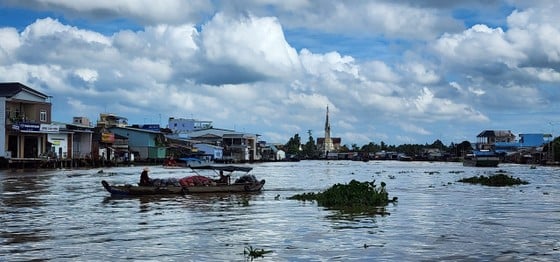
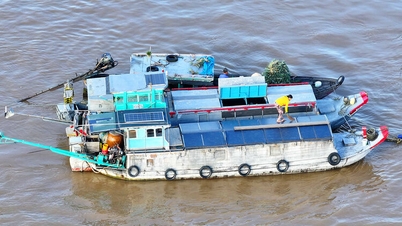
The current space of Cai Be floating market. |
Tourists were disappointed.
Cai Be Floating Market (Cai Be town, Cai Be district, Tien Giang province) is located at the confluence of three rivers, where the Tien River and Cai Be River meet. The market was formed around the late 17th century, on the Cai Be estuary, when many trading boats from the surrounding area gathered here to exchange agricultural products and other goods, gradually becoming a floating market.
Alongside this, people living along the river also equip themselves with boats to trade goods such as fabrics, seafood, household items, food and drinks… especially fruit, to serve locals and tourists, making the floating market bustling and vibrant. Cai Be floating market is the most vivid evidence of a unique cultural feature of the Southern region, serving as a transit point for fruits and other products to all parts of the country.
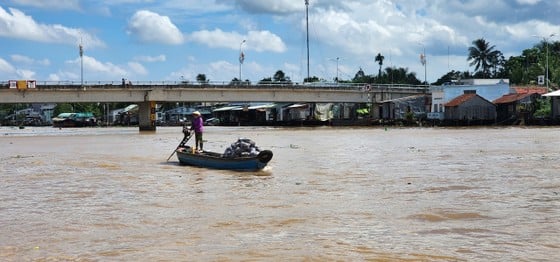 |
The boats carrying the villagers' agricultural products travel back and forth on the river. |
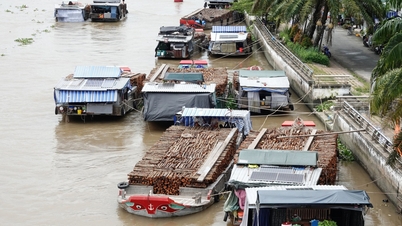
However, nowadays, with improved road transport, people have switched to transporting goods by vehicle, and the trading space on the floating market has become deserted and desolate, with only a few agricultural boats belonging to people from the Mekong Delta provinces anchored there for trading.
Mr. Nguyen Trung Thanh, a tourist from Hanoi, shared that through the media, he imagined a bustling floating market with many goods, where he could visit, take photos, and witness firsthand the unique trading practices of the people of Southern Vietnam, and experience the swaying motion of a boat while enjoying local specialties... However, he was truly disappointed when he found that this floating market was not like the images he had seen in the media, but rather just a stretch of river with a few boats selling vegetables.
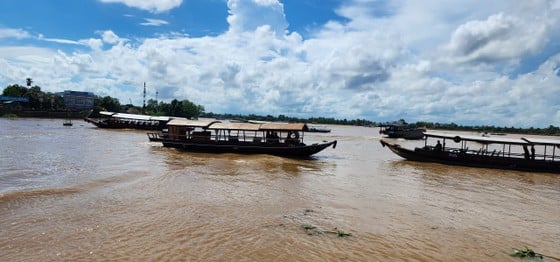 |
The tourist pier is sparsely populated. |
Tran Thanh Phong, a boat driver who transports tourists on this route, said that in the past, the Cai Be floating market was bustling with boats and canoes selling a wide variety of goods and fruits, attracting many tourists to visit and shop. However, in recent years, every time he takes tourists past the floating market area, he feels uneasy hearing the tourists sigh because of the market's quietness.
Like many other families, Mr. Nguyen Huu Bon's family (70 years old, Binh Hoa Phuoc commune, Long Ho district, Vinh Long province) has lived off the Cai Be floating market for over 50 years. Around 4 a.m., they would take their boat to the floating market to sell fruits from their gardens or locally sourced produce, and also buy vegetables from the Eastern region to resell in Vinh Long. Their lives revolve around the ebb and flow of the water, with boats from all directions converging here to exchange goods, and they have become neighbors without even realizing it.
Mr. Bon confided: "Before, our people used to buy and sell fruits and many other goods to each other, including tourists, and the income of the villagers was quite good. Now, people have switched to land transport, so our old neighbors have all left, only a few families like mine remain clinging to this floating market. Since the floating market has become less crowded and business has slowed down, we only sell agricultural products to make a living."
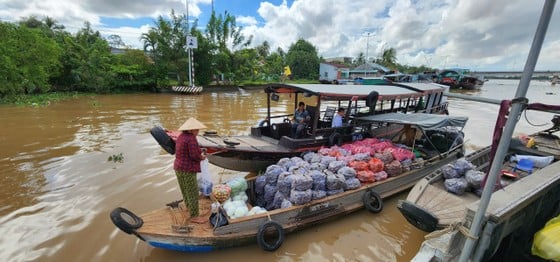 |
Some families in the western provinces still trade on this floating market. |
Preservation on paper
Facing the risk of losing a unique tourism product and a distinctive cultural feature of the famous riverine region, in 2017, the functional agencies of Cai Be district developed the "Conservation and Promotion of Cai Be Floating Market" project for the period 2017-2020, with a vision to 2025. At the same time, the functional agencies of Cai Be district also organized many seminars on the topic: "Conservation and Promotion of Cai Be Floating Market," with the participation of scientists, tourism businesses, and representatives of traders at Cai Be Floating Market.
Accordingly, the Cai Be floating market will maintain its current state, but with rearrangement, management, and layout to meet the requirements of waterway traffic safety; the planned water area will be 400 to 500 meters long, from the Cai Be estuary to Canal 28; ensuring the number of permanently moored boats and ships ranges from 100 to 150, and accommodating 200 to 300 boats and ships with a tonnage of 20 to 60 tons for trading. The Cai Be District People's Committee will invest in supporting infrastructure such as public toilets, lighting, and wharves, combined with implementing support policies in education, health, electricity, and water to create favorable conditions to attract traders to come and conduct business.
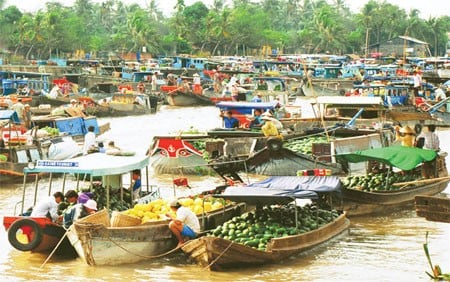 |
Cai Be floating market many years ago |
However, the project remains on paper, and the floating market is gradually disappearing. Mr. Le Van Y, Vice Chairman of the People's Committee of Cai Be District, said that the locality is focusing on implementing several key projects such as: Planning and constructing a festival and tourism area in Dong Hoa Hiep ancient village; a specialty ecological garden tourism site in Dong Hoa Hiep ancient village, Hoa Khanh; a resort tourism area on Co Lich islet in Hoa Hung; and developing more cultural, artistic, and entertainment activities to encourage tourists to stay longer… The project to preserve and promote the Cai Be floating market has yet to be implemented.
It is thought that nowadays, with the remarkable development of land transportation, agricultural products from the Mekong Delta are now transported directly to the farms by traders. The lives of river traders are becoming increasingly difficult. If we do not promptly reorganize and rebuild the Cai Be floating market, we will lose a prime location for Mekong Delta tourism, a unique and distinctive cultural feature of the riverine region, as well as an opportunity to create livelihoods for people living along the river.
Source

![[Photo] General Secretary and President visit the China-ASEAN AI Application Cooperation Center](https://vphoto.vietnam.vn/thumb/1200x675/vietnam/resource/IMAGE/2026/04/17/1776404277677_vna-potal-tong-bi-thu-chu-tich-nuoc-tham-trung-tam-hop-tac-ung-dung-ai-trung-quoc-asean-8706616-2286-jpg.webp)




















![[Photo] National Assembly Chairman Tran Thanh Man attends the policy seminar to promote Vietnam-Türkiye cooperation.](https://vphoto.vietnam.vn/thumb/1200x675/vietnam/resource/IMAGE/2026/04/16/1776351415367_vna-potal-chu-tich-quoc-hoi-tran-thanh-man-du-toa-dam-chinh-sach-thuc-day-hop-tac-viet-nam-tho-nhi-ky-8705791-jpg.webp)
















































Comment (0)